Author: Diane Neas

  • On What the Wind Carries

    I watch the wind pass over grasses,
    their long backs bending,
    bare branches clawing at the clouds.

    Along the shore, it lifts the foam
    and carries it beyond the breaking wave.

    Dried leaves whisper at my feet.

    A scent arrives
    with nothing here to name it.

    Some winds seem to linger,
    turning through familiar trees.
    Others travel high,
    past countries I have never seen.

    I wonder what remains in them
    of all they have touched.

    When strong winds are coming,
    I climb the dune
    or go down to the lake
    where nothing stands between us.

    It tangles my hair,
    pushes me forward,
    makes me lean into the next step.

    Something of a distant place
    seems to reach me there,
    enough to make me want
    to follow it back.

    Before a storm,
    the air feels electric.
    I stand inside the moment
    before anything has happened,
    feeling how much could.

    And in winter,
    snow gives the wind a body:

    a turning,
    a gathering,
    a white ballet
    across the dark.

    There are winds that come too close,
    hot and heavy,
    their breath against my neck
    until even breathing feels like work.

    Then, after the long summer,
    I catch that almost metallic smell.

    Cold is gathering somewhere above us.

    I breathe it in with relief.
    Soon I can turn inward,
    settle among the animals,
    feel their sleeping weight against me.
    Soon I can let a quiet day
    be all the day asks.

    But I remember the last monarchs,
    how the sky had been full of them,
    then almost empty.

    I watched the few remaining
    and wondered if they could still go.

    For those who could not,
    I wished an easy death.

    The wind moves over
    what is leaving
    and what has found shelter.

    I close my coat.
    Far out on the lake,
    another wave rises.

    Still, I go to meet it.

  • On the Apple Orchard after Dark

    I have come to recognize a pattern in the way I write. I begin with something that captures my attention. Sometimes it is a sound, a scent, or a small movement in the natural world. Other times, a memory, a feeling, or a thought that refuses to leave me alone. I rarely know where it will lead, and I rather like that.

    I follow it. I gather impressions, sensations, memories, and the thoughts they awaken, allowing one thing to lead to another without worrying too much about where I might arrive. I don’t begin with a conclusion I wish to reach. Often, I discover what I am trying to say only after I’ve allowed myself the freedom to explore it.

    Then comes the work of finding the words. Rearranging, listening, searching for rhythm and cadence until the language begins to resemble music. I want the reader not only to understand what I have noticed, but to experience something of it.

    The Orchard After Dark began this way. With the creaking of old branches, the scent of fermenting apples, and the quiet movements of a world that continues whether anyone is there to witness it. I followed those observations, and somewhere along the way, a poem emerged.


    The branches creak beneath the weight
    of what remains,
    their old wood bending
    in the cooling air.
    The bees have abandoned their summer hum,
    and leaves, curled and brittle at the edges,
    brush against one another
    with the dry whisper of paper.

    Somewhere in the darkness,
    an apple loosens from its stem.
    A brief descent,
    the soft, low sound
    of fruit meeting earth.

    The orchard smells of dark soil,
    of rain held in the grass,
    of wet wood and sweetness
    beginning to turn.
    Beneath the trees, fallen apples split,
    their flesh growing soft,
    their sugars surrendering
    to the invisible work of decay.

    Clouds drift across the moon,
    scattering its pale light
    among the naked branches,
    touching wood that has spent the summer
    hidden beneath a thousand leaves.
    For a moment, the orchard is silver.
    Then shadow gathers again.

    Deer move between the trunks,
    their hooves pressing gently
    into the rain-softened ground.
    The faint musk of their passing
    mingles with the dampness,
    and somewhere among the grasses
    a small creature stirs
    beneath the fallen leaves.

    Close to the earth,
    where bruised fruit gathers
    and the season’s remnants settle,
    the slow work of decomposition
    holds its hidden warmth.

    Above, the branches sway
    against a sky that cannot quite
    decide to clear.

    Below, in the dark,
    roots draw what they can
    from the cooling soil,
    and the orchard continues
    its quiet, intricate life—

    the softening,
    the falling,
    the slow, unseen becoming
    that requires no witness.

  • On Expanding Ground

    I began listening to a book about nonhuman intelligence and found myself contemplating what it means to be human.

    I had expected to encounter unfamiliar ideas, perhaps to challenge a few things I believed I understood about existence. What I had not anticipated was the extraordinary pleasure of discovering how much I did not know, or the frustration of realizing that my desire to understand could move considerably faster than my ability to do so.

    There were theories about consciousness, evolution, artificial intelligence, and the possibility that humanity might someday become something we would scarcely recognize. Science and spirituality appeared alongside one another, not as opposing explanations of existence, but as different ways of approaching questions that have occupied human minds for centuries. I encountered thinkers who had devoted entire lifetimes to ideas I was only beginning to discover, and I wanted, quite unreasonably, to understand them all at once.

    I was trying to build an understanding, and the ground kept expanding beneath my feet.

    Each new idea seemed to open a passage into another, until I found myself following questions in so many directions that I could scarcely remember where I had begun. There were moments when something suddenly became clear and I felt an almost physical rush of excitement, followed immediately by the recognition of how much remained beyond my comprehension.

    And there was a peculiar irony in my frustration. Among the ideas I was encountering was the possibility that the human mind, shaped by the limits of its own experience, might be incapable of imagining certain forms of intelligence or existence, including those that may already surround us. I was struggling to understand the very limitations of understanding.

    I have always loved learning. There is a particular kind of awe that comes when an unfamiliar idea begins to make sense, when something that had existed entirely outside the boundaries of your knowledge suddenly becomes visible. Yet I was discovering that understanding one possibility did not necessarily bring me closer to certainty. More often, it revealed how many others I had never considered.

    Some of those possibilities gave me hope.

    I encountered the evolutionary vision of Teilhard de Chardin, in which consciousness moves toward a greater unity without the necessary loss of individuality. I found myself drawn to the idea that we might become more deeply connected without surrendering the qualities that make each of us distinct, that there might be a way of belonging to something immeasurably larger while remaining ourselves.

    Other possibilities filled me with an unexpected sadness.

    I began contemplating a future in which consciousness might exist independently of the physical body, and with it came questions I had never seriously considered. What would existence mean without the senses through which I have come to know the world? Without touch, taste, warmth, or the exquisite vulnerability of inhabiting a body that can experience pleasure and pain?

    The weight of a sleeping dog against my legs. The smell of bread warming in an oven. Rain against bare skin. The extraordinary tenderness of holding a child who has cried herself to sleep.

    And not only these moments of comfort. There is the ache of longing, the physical weight of grief, the peculiar way sorrow can settle into the body and remain there long after words have failed us. These experiences do not necessarily bring joy, but they are no less a part of what it means to be human.

    I cannot separate the life of the mind from the life of the body. Thought gives meaning to sensation, and sensation informs thought. The experience of being human, as I understand it, relies as much upon the tactile world as the cerebral.

    Yet even as I considered what might be lost, I recognized the limitations of my own imagination. How could I possibly know whether an existence without physical sensation might contain something equally meaningful, something for which I have neither experience nor language? I could not measure an unfamiliar form of being against the only one I have ever known and declare it richer or poorer.

    I found myself thinking, too, about the strange position we occupy in history. Ideas once confined to science fiction have begun to enter serious scientific and philosophical conversations, and some technologies that previous generations could only imagine are becoming part of our ordinary lives. I suspect that far more is unfolding than I, or perhaps any one of us, can fully comprehend.

    There is awe in that realization, though not an uncomplicated sense of optimism. Possibility is not a promise of improvement. What lies ahead may enlarge our experience of existence, diminish it, or transform it in ways that make such distinctions meaningless. I do not know.

    What surprised me most was how naturally these questions brought science and spirituality into conversation with one another. I had never believed they needed to be adversaries, but I had not understood how closely their inquiries might approach the same mysteries. Questions about consciousness, connection, and the nature of existence seemed to move between them, sometimes changing their language without entirely changing their substance.

    I have never thought of the sacred as something separate from existence, something we must reach beyond ourselves to discover. To me, it is already here, inherent in the very nature of being. What I had not considered was how many different ways there might be to understand our place within it.

    There is a tendency, perhaps, to imagine that the world becomes smaller as we grow older, that the boundaries of what we know and what we might yet discover gradually settle into place. I have found the opposite to be true. The more I learn, the more aware I become of the vastness of what remains unknown, and rather than diminishing my appetite for discovery, that awareness seems only to deepen it.

    I finished the book without the answers I had hoped to find, although I am no longer certain answers were what I needed.

    I do not know what humanity will become, whether consciousness can exist beyond the body, or whether there are forms of intelligence and being so unlike our own that we would fail to recognize them even if they stood before us.

    But I know what it feels like to encounter an idea that changes the dimensions of the world I thought I understood.

    And I know that whatever mysteries lie beyond the boundaries of human experience, it is through this profoundly imperfect, vulnerable, feeling existence that I have come to wonder about them at all. The very limitations that prevent me from comprehending everything are part of the life that allows me to ask.

    And perhaps I do not need the ground beneath me to stop expanding.

    Perhaps I only need to remain willing to explore it.
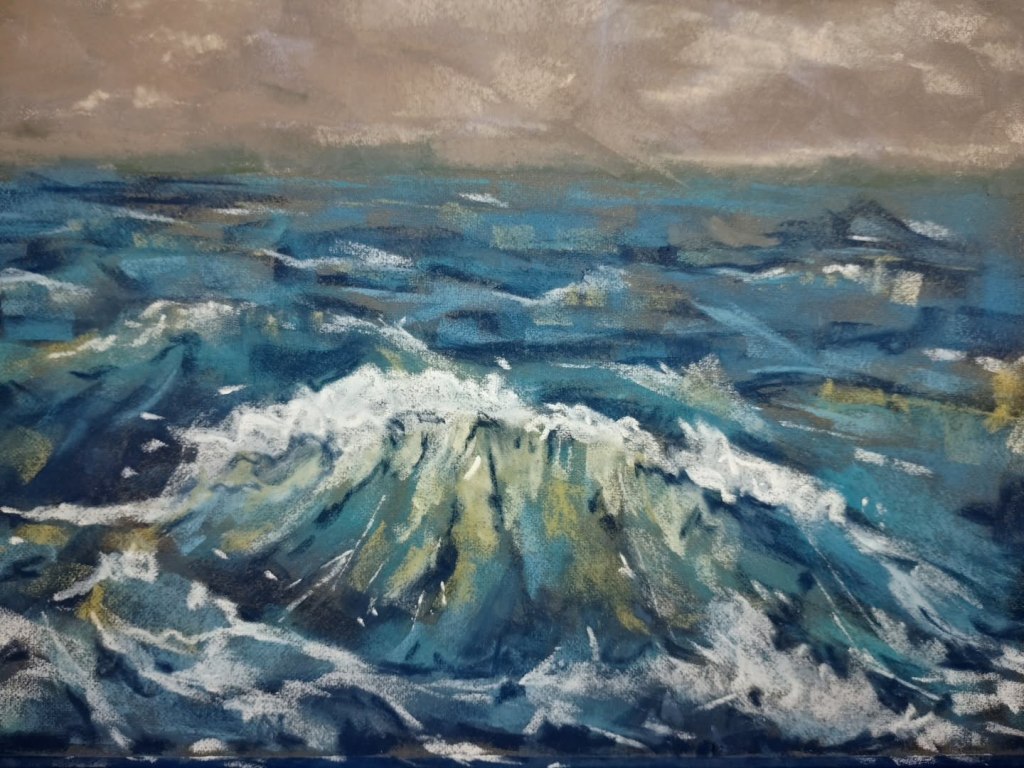
  • On the Beautiful Pain of Being Human

    There are moments
    when being human
    is almost too much to bear.

    Not because the world is cruel,
    though it can be.

    Not because sorrow is heavy,
    though I have known its weight.

    But because beauty
    sometimes enters so completely
    there is nowhere left
    inside me
    to put it.

    Today, a stray cat
    who has kept her distance
    for three months
    allowed my hand
    to travel the length of her back.

    Such a small surrender.
    Such an extraordinary gift.

    And I stood there,
    nearly undone,
    by the unbearable beauty
    of being trusted.

    How is it possible
    for something so small
    to fill a human heart
    so completely?

    There are days
    when I am so in love
    with being alive
    that I can scarcely bear
    the knowledge
    that I must someday leave it.

    Not because I am afraid,
    but because I have only just begun
    to understand
    how beautiful it is.

    And love.

    God, the terrible beauty of love.

    To know that everything we cherish
    is passing through us.
    That every embrace
    contains the possibility
    of a last embrace.
    That the very things
    which make life worth living
    are the things
    we cannot bear to lose.

    And still,
    we reach.

    We open our arms.
    We offer our unguarded hearts.
    We plant things
    whose shade we may never sit beneath.
    We love creatures
    whose lives are shorter than our own.
    We bring children into a world
    that cannot promise
    to keep them safe.

    What astonishing courage
    there is in tenderness.

    Sometimes I look at the world
    and feel such affection for it
    that I ache.

    For the quiet intimacy
    of two people
    who no longer need words
    to know they are loved.

    For the sudden return
    of desire
    in a body that had nearly forgotten
    its own longing.

    For the sound of laughter
    escaping someone
    who has known
    more sorrow than anyone should.

    For all of us,
    brief and bewildered,
    trying to make something beautiful
    of the time we have been given.

    And I wonder
    how a heart can hold
    so much sorrow
    and still find room
    for wonder.

    How it can break
    and remain open.

    How the very wound
    through which grief entered
    can become a place
    where beauty gathers.

    Perhaps this is what it means
    to be human.

    To live with the knowledge
    that nothing stays,
    and to love it anyway.

    To be pierced by the world
    and refuse to turn away.

    To stand inside
    the unbearable tenderness
    of existence
    without asking
    to feel less.

    Because I do not want
    a smaller heart.

    I do not want
    to be spared
    the ache of loving
    what is mortal.

    I want to feel
    the whole impossible thing.

    The sorrow.
    The wonder.
    The longing.
    The joy.

    Even when it brings me
    to my knees.

    Especially then.

    For what a strange
    and magnificent privilege
    it is

    to be here,
    for this brief moment,

    and to feel
    so terribly,
    so beautifully,
    alive.

  • On the Work of Healing

    I did not know joy as a child.

    I knew wonder. I knew the particular stillness of sitting beneath an apple tree, hidden among its branches, watching the last light of afternoon settle over the woods. I knew the warmth of baby goats pressed against me in the barn, the small sounds they made, the astonishing tenderness of their existence.

    I knew something sacred lived in those moments, although I had no language for it then.

    But joy was something else.

    My children brought me joy. Immense joy. Yet even that was weighted by fear. I loved them with a fierceness that was accompanied by an almost constant awareness of how much there was to lose.

    And then I lost my daughter.

    I want to be very clear about something. Becca’s death did not liberate me. It did not happen so that I might become stronger, wiser, or more capable of appreciating life. There was no hidden gift waiting inside that terrible loss.

    What happened afterward was something entirely different.

    I began the work of healing.

    At first, that work was about learning how to survive the absence of my daughter. How to wake each morning in a world that continued turning without her. How to remain a mother to my sons when so much of me wanted to disappear into the place where she had gone.

    I thought I was doing the work of grieving my daughter. I didn’t understand that somewhere within that work, other wounds were being tended. Wounds I had carried since childhood. I wasn’t deliberately reaching back into those years, searching for what needed healing. I was simply trying to find a way to live in the world without Becca.

    Only much later did I recognize what had happened.

    There is an old saying that when you pull one pearl, the entire necklace moves.

    I had been watching the pearl in my hand. I hadn’t noticed the movement of the others.

    The frightened little girl who had sought refuge beneath an apple tree had been changing, too. The woman who had carried her fears into motherhood, who had loved so fiercely while remaining so afraid, was changing alongside her.

    Not all at once. Not in ways I could have measured or even named at the time.

    But slowly, something within me was becoming less burdened.

    It has taken me a long time to recognize what that work has made possible.

    I experience joy now in ways I never did before. Not because my life is free of sorrow. It never will be. Not because I have found answers to all the questions that once frightened me.

    But because fear no longer occupies quite so much of the space within me.

    I can stand before a turbulent lake and feel exhilaration. I can be moved to tears by a bee, by music, by the extraordinary tenderness of an ordinary moment. I can paint for the pleasure of making something, without demanding perfection from my hands.

    The sacredness I recognized as a child was always there.

    What has changed is my capacity to receive it.

    I would give anything to have my daughter alive. Anything.

    But I cannot change what happened to her.

    What I could change, slowly and imperfectly, was how I lived in the years that followed.

    And perhaps that is what I most want to say about healing.

    It does not make the terrible thing worthwhile.

    It makes a fuller life possible in spite of it.

    Healing is not a destination. It is a way of living.

    I will be healing until the day I die.

    And I no longer need to be finished healing to live joyfully.

  • A Life Shaped by Reverence

    I’ve been listening to The Others, a book that has stirred some of my deepest questions about consciousness, existence, and our place in the universe. What has stayed with me most is not the possibility of what lies beyond our understanding, but how little attention we sometimes give to the extraordinary world already before us. I find myself increasingly drawn toward a life shaped by reverence – not necessarily reverence for anything divine, but for the profound mystery and inherent worth of existence itself. And I worry that, in our pursuit of progress, we may be losing not only the natural wonders around us, but our capacity to recognize them as wonders at all. This poem grew from those thoughts.


    The season was ending
    when I found the bumblebee,
    its small body surrendering
    to the cold.

    I lifted it gently,
    laid it upon a fallen leaf,
    red as the last warmth of autumn,
    and tucked it beneath a bush
    where the wind might not find it.

    There was nothing to be saved.
    Only a life to be regarded
    with tenderness
    as it passed from the world.

    I have come to believe
    there is something sacred
    in the act of noticing.

    The pale interior of a broken eggshell.
    Sand clinging to the underside
    of a gull’s discarded feather.
    The ancient face of a sleeping man
    who, for a moment,
    looks like someone’s little boy.

    A spider mending its web
    after the violence of a storm.
    The blue rivers beneath
    the translucent skin of an aging hand.

    A seed splitting open
    in the absolute darkness of the earth,
    beginning its astonishing work
    with no one there to witness.

    And beyond these small astonishments,
    the immense and unknowable—

    stars burning in the darkness,
    light traveling unimaginable distances
    to fall upon our upturned faces.

    How extraordinary
    to be alive at all.
    To inhabit a body
    capable of tenderness,
    of desire,
    of grief so deep
    it seems the earth itself
    must surely feel its weight.

    And still,
    to love the earth.

    To love it knowing
    nothing here is ours to keep.

    But something is happening to us.

    We are learning the price of everything
    and forgetting how to recognize its worth.

    Forests become timber.
    Rivers become resources.
    The living earth is measured
    by what can be taken from it.

    Even wonder is hurried along,
    reduced to an image,
    a moment captured
    before it has been fully lived.

    I fear the poverty of a world
    that no longer knows
    how to be astonished.

    I fear what becomes possible
    when nothing is held sacred.

    For there is a difference
    between accepting the passing of a life
    and consenting to its destruction.

    Reverence is not always quiet.

    Sometimes it rises fierce,
    a refusal,
    a voice lifted against the ruin
    of what cannot be replaced.

    Sometimes it is grief.
    Sometimes anger.
    Sometimes the wild, unreasonable joy
    of belonging to this world
    for however brief a time.

    And sometimes
    it is no larger than two hands
    cupped around a dying bee.

    I cannot hold back winter.
    I cannot ask the stars
    to reveal their mysteries.
    I cannot keep the things I love
    from passing.

    But I can live
    as though their existence matters.

    I can bend toward the smallest life.
    I can stand beneath the heavens
    and allow myself to be undone
    by their immensity.

    I can refuse
    to let familiarity
    make the miraculous ordinary.

    And when the world asks
    what all this tenderness is worth,

    I can offer no answer
    except the red leaf,
    the shelter of the bush,
    and the small, fading life
    I could not save

    but would not leave
    unloved.

  • On the Arrival of Night

    I watch night slip around corners,
    not as a thief of light,
    but a bringer of solitude.

    At first, only a suggestion of color,
    a faint blue gathering
    where the walls meet the floor,
    beneath the furniture,
    in the hollows daylight has abandoned.

    Indigo surfaces in the lowest places,
    deepening without movement,
    as water rises from somewhere unseen.

    Violet wells up from within it,
    a slow unfolding of color,
    until the corners lose their edges
    and the room begins to soften.

    The darkness rises without a sound,
    slipping beneath the table,
    curling around the legs of chairs,
    filling the spaces between things
    until it reaches me.

    It rests against my skin
    with the softness of fog,
    cool and permeable,
    a presence I can breathe through.

    I do not turn on the light.

    There are things too delicate
    for the brightness of day,
    thoughts that scatter
    beneath its insistence,
    strange and lovely things
    that have not yet learned
    the shape of themselves.

    Here, fragments begin to gather,
    remnants of what has been,
    intimations of what might yet be.

    They take shape in the indigo,
    vibrate for a moment
    at the edge of recognition,
    then dissolve
    back into themselves.

    Somewhere beyond the windows,
    the world is becoming mysterious again.
    And within me,
    something equally unknowable
    begins to rise.

    I sit quietly
    in the indigo dark,
    neither waiting nor searching,
    allowing the night
    to bring whatever it will.

  • On the Nature of Fog

    The fog has settled over the meadow,
    but not upon it.

    It hangs suspended,
    a pale blanket stretched
    just above the earth,
    leaving a narrow space
    where the world remains astonishingly alive.

    Beneath its softness,
    the grasses seem to vibrate.

    Their greens deepen,
    each slender blade more vivid,
    each seed head more defined,
    as though the fog has gathered
    all the colors of the meadow
    into that small space
    between earth and sky.

    A world inside a world.

    There, beneath the low white ceiling,
    small lives carry on.

    Insects cling to bending stems.
    Tiny creatures move
    through corridors of green.
    Roots reach into the dark earth,
    drawing what they need
    from places we cannot see.

    There is hunger here.
    And shelter.
    The quiet urgency of survival.
    The endless, intricate exchange
    of one life sustaining another.

    Nothing has stopped
    because the larger world
    has disappeared from view.

    And perhaps that is what
    the fog allows us to see.

    Not a meadow made beautiful
    for our admiration,
    nor a sanctuary created
    for our peace.

    But a world complete
    unto itself.

    We so often speak of nature
    in the language of what it gives us.

    The beauty of a sunrise.
    The comfort of a forest.
    The stillness of a meadow
    where we go to find ourselves.

    Even our admiration
    can become a way
    of making the natural world
    about us.

    Yet beneath this quiet veil,
    life continues
    without knowing we are watching.

    The grasses do not grow
    to please our eyes.
    The creatures moving among them
    do not require our wonder.
    The earth asks nothing
    of our appreciation.

    And still,
    how extraordinary it is
    to stand at the edge
    of such abundance.

    To witness, for a moment,
    the smallest glimpse
    of a world whose mysteries
    will never entirely belong to us.

    The fog will lift.
    The familiar landscape
    will return.

    But the world beneath it
    will continue,
    as it always has.

    Needing nothing
    from us
    but respect.

  • On the Nature of Her Anger

    On the Nature of Her Anger

    They call her angry
    when she rises against the shore,
    when her waves climb over one another
    and her voice carries inland,
    beyond the dunes,
    beyond the places where anyone
    has thought to listen.

    But is it anger?

    Or has she simply grown weary
    of being misunderstood?

    All summer they come to her,
    running laughing into her surf,
    letting her cool waters
    close around their bodies.

    They delight in her gentleness.
    They call her beautiful.
    They leave footprints in the sand
    and carry pieces of her home
    clinging to their skin.

    But who among them
    has ever asked
    what she remembers?

    In her depths
    lie the things the world has forgotten.

    Memories move along her floor,
    rolling over rippled sand,
    disturbed by currents
    older than the names
    we have given her.

    Occasionally,
    something that once lived
    finds its way to her edge.

    A shell.
    A bone.
    The fragile remains
    of a life she held
    long after the world above
    had ceased to remember it.

    And when the winds arrive,
    when her great body rises
    and throws itself against the rocks,
    they call it fury.

    They hear the thunder
    of her breaking waves,
    but not the voices
    carried within them.

    The cries of things lost.
    The long, unanswerable
    sorrow of the depths.

    Perhaps her spray
    is not merely water
    torn apart by wind.

    Perhaps it is memory
    rising at last
    into the light.

    There is something primal
    that moves across her surface,
    something that existed
    long before the first human foot
    pressed itself into her sand.

    It is there on quiet mornings,
    when she lies beneath the sun,
    and on nights when the wind
    draws her into mountains
    of dark, restless water.

    It does not disappear
    when she becomes gentle.

    And still they come,
    running into her surf,
    laughing as the waves
    break around their knees.

    They see the water.
    They feel its coolness.
    They marvel at its beauty.

    But how many recognize
    the ancient life
    moving beneath their hands?

    How many understand
    that what they call anger
    may be the sound
    of something enormous
    trying to be heard?