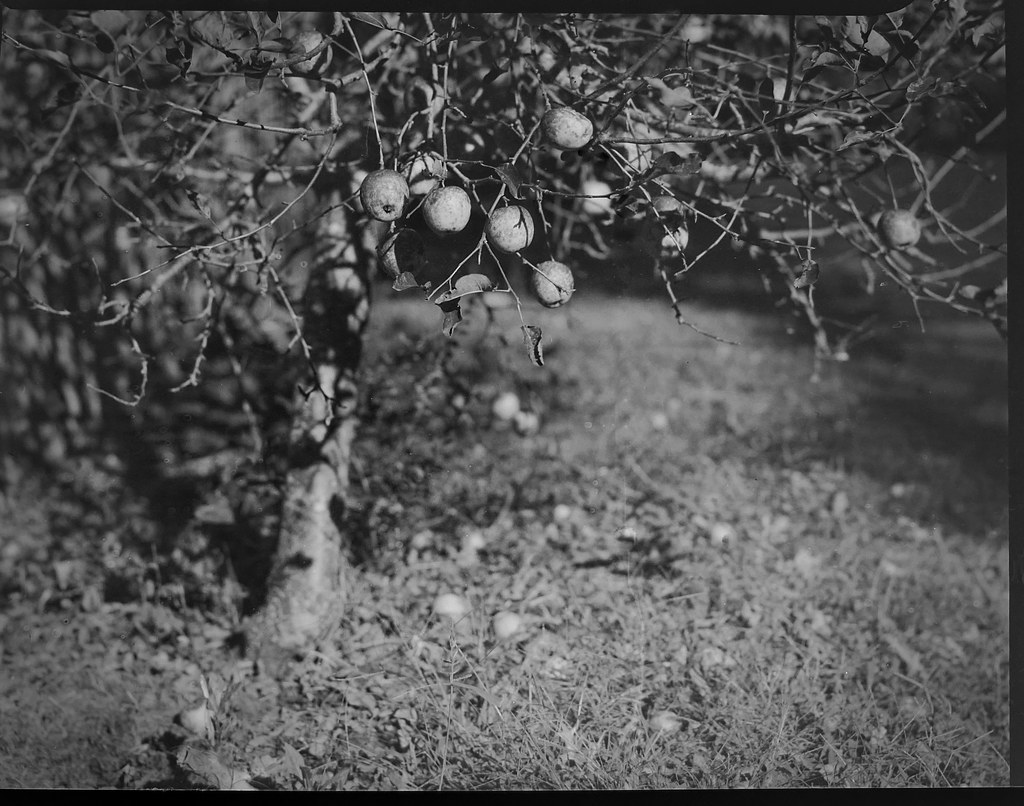
This is a stock photo as the tree written about in this essay is no longer standing.
Little House on the Prairie books were my favorite to read when I was growing up. I had a dress that was blue calico print and it had a matching bonnet. I’d secure the bonnet strings tightly under my chin, grab my book, and head out to the apple tree. I had to wait until my chores were done before I could go, and I always worried someone would see me and discover where I went. That’s why I created a slip of an opening on the side of the tree that faced the forest, opposite the house.
The sun also set behind the forest.
That was my favorite light.
By mid-July the grass was tall, and I could see grasshoppers perched on blades that bent under their weight. As I drew closer, they took off in an explosion of wings. The branches, weighted with small green crabapples, reached for the ground.
I imagined the earth and tree were holding onto each other.
Each year I had to bend a little more to fit beneath the branches, but I could still crouch slightly and enter the cool space beneath. I lowered myself to the flattened grass and leaned my back against the gnarled trunk. The bees sounded busy as they buzzed overhead between the branches.
Later in the summer, the air beneath the tree smelled of sweet decay. Fallen apples fermented in the grass. Beneath that was the clean smell of crushed grass and damp earth. Sometimes there was a musky scent. Years later, I wondered if it had been left by the deer I sometimes saw near the tree when I peeked through the branches.
I let my weight settle against the tree, and my body would begin to loosen. The earth was damp and reassuring when I dug my toes into the soil. I removed my bonnet so I could hear if anyone approached or was yelling for me.
The good days were the ones when all I heard were busy insects and an occasional bird.
There were times when I didn’t even open the book on my lap. Instead, I would watch the changing light as the day drew toward dusk. The insects would quiet, and a hush would fall over the meadow.
Other times, I would get so lost in the stories that I felt as if the Little House world would be waiting for me when I stepped out from beneath the tree branches. The meadow would have become a prairie. The dirt road near our house would be the one that led into the heart of Walnut Grove. And Ma Ingalls would be waiting for me in the little house.
I could spend hours imagining worlds beyond the leaves.
There were times when I would bring a sketchpad and pencil with me instead of a book. I would draw those imaginary worlds, humming softly as trees and deer and rabbits grew from my pencil.
Many times, I wouldn’t realize how late it had become until I could no longer see the paper in front of me. By then, the light on the barn would be on, and I knew it was time to go in.
My head would hang low, my dirty-blonde hair obscuring my face. I didn’t have to watch where I was going because I knew the journey back by heart. My stomach would tumble and my shoulders would clench. I would walk slowly until I reached the place where the meadow and the cut grass of the yard met.
My feet could feel the difference.
That was when I would start listening. To the quiet of the night closing down. For my family inside the house. For whatever I needed to hear so I could prepare myself.
 Words Can Express