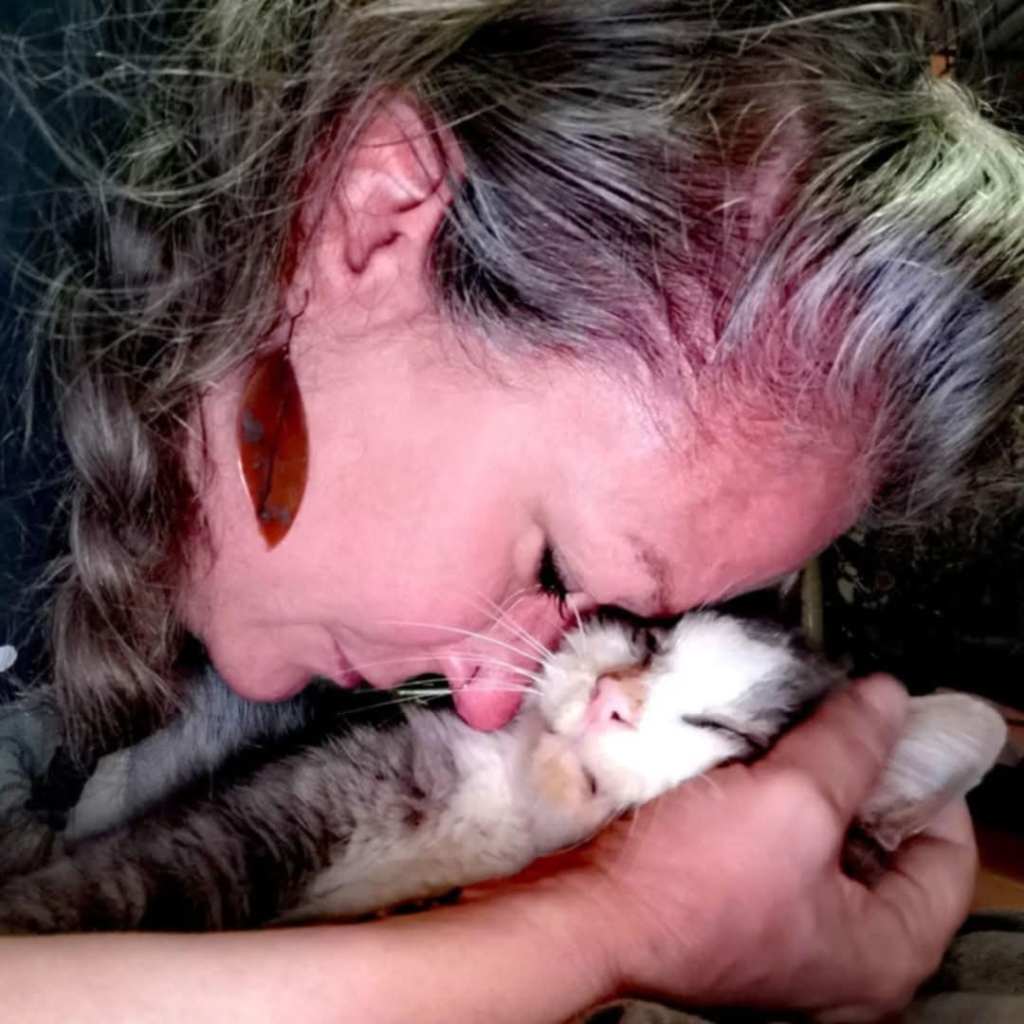
(Photo of the author with one of the cats she cared for.)
She’s brought to me, in recovery, wrapped in a blue potty pad. Handed to me, I take her gently and place her on a heating blanket atop the table. I’m given her chart and where it says “vet notes” is an order for warm fluids. Usually 100ml. It’s to replace what her body lost when she was spayed.
I know by the request for fluids that she went into surgery with babies tucked safely beneath her ribcage. Near her heart. Did she know, when she fell asleep, she was a mother? And, now she isn’t? Could she feel, even under anesthesia, the moment her babies left her womb?
Still limp from the effects of sedation, she’s soft as I lean in close and give her a kiss on her head and whisper, “I’m so sorry momma . . . I’m so sorry you lost your babies”.
Even as I say those words I know they aren’t the truth. We took them from her.
I press the fluids in, feel the warmth of her fur through the towel. She is so small. Fragile, really. Like something still becoming itself. The kittens were small, too. Perfect. But not meant to be born.
There is a line of blood on the pad where it pressed up against her body and touched the incision. Not much—but enough to say, something happened here. Enough to mark the place where her motherhood ended.
I whisper “I’m sorry” over and over, hoping somehow she feels what I am saying. Not for the procedure. For the loss. For what she’ll never understand, and what I can never explain.
I do what I need to do for each patient that comes to recovery. I give vaccines, microchips, trim nails, and clean ears. But it’s different with the ones who have had their babies taken from them. I still do all those things, but I do them differently. I talk to them all because I know coming out of sedation is disconcerting and confusing for an animal. The ones who have had their babies taken need something deeper than just reassurance. They need understanding. They need to be handled in a sacred way.
Her paw twitches in my hand—slight, but I feel it. My heart starts to race. She’s coming back to a world where her babies are gone. I whisper to her that we named her babies. Their existence didn’t go without acknowledgment. I want her to know they weren’t discarded. They were seen.
Her eyes move. Unfocused at first—still caught in that space between sleep and something else. But slowly, they begin to settle. Not on me. Not exactly.But somewhere past me. As if she’s trying to locate what’s no longer there.
And I wonder if some part of her knows. Can she feel a hollowness in her belly? Does she breathe easier without her babies pressing up into her lungs? Is her heart broken?
I clean the blood from her belly with a warm cloth, slow and careful. Not because she’ll notice—but because I will. Because dignity still matters. Because what she’s lost was monumental and someone needs to acknowledge this truth.
I hold her paw like it’s something breakable. Not because it is—but because she is.
And I tell her again: We named them. They mattered. Your loss matters.
I don’t know if she understands. I just know I have to say it. And when the tears come, I let them.
Maybe the ones who know loss are the only ones who can truly witness it in others.
I think losing my daughter broke something open in me—something that lets me feel what most people turn away from. It’s not that I’m stronger. It’s that I can see it now. The grief that lives in quiet places.
Like this one.
But I’m not alone in this. The team I work with—they see the babies. They make sure there’s always a box ready. They write the names. They protect me from that part of the process, not because I can’t do it, but because they know what it costs me.
They care for me as I care for the momma. And in that quiet, unspoken understanding, something holy happens.
A Note on the Work We Do:
I know this piece may be difficult for some to read. The termination of any pregnancy is painful—especially when it involves creatures so innocent and vulnerable. Our clinic is a low-cost, nonprofit veterinary facility. We work closely with shelters and rescue organizations, and the reality is this: resources are finite. We perform high-volume spay and neuter surgeries to prevent the suffering of countless animals who would otherwise be born into homelessness, neglect, or euthanasia. It may sound barbaric. But until pet overpopulation is no longer a crisis, and until more pet owners take responsibility, these heartbreaking decisions will continue to be made. None of us like it. All of us understand why it must be done.

 Words Can Express