Still Mothering

Behind me, there is a red set of shelves. In it’s former life it was a dresser. When I no longer needed it as such . . . I took the drawers out and made them shelves. I couldn’t get rid of it because it is a piece of furniture my daughter knew me to own. On it’s top, I have photographs, candles, and the marble urn which holds my daughter’s ashes. I always keep fresh flowers next to her urn. I call them ‘Becca Flowers’. Every night, I kiss her picture and tell her I love and miss her. I am going to do this until the day I die.

Another bereaved mom I know goes to the cemetery, to visit her daughter’s grave, every day. She decorates for the approaching holiday and talks to her child. I was privileged enough to help her choose new flowers, in the colors of Mardi Gras, to put in the wreath she keeps there permanently. We spent about twenty minutes picking the right flowers and color combination. The mom took much care in making sure the bouquet was exactly what she wanted, what her daughter would like. I understand her desire to spend the time and care she did in this small task. I do the exactly the same thing when I choose flowers to put next to Becca’s ashes.

Last week, I was talking to someone at work about how much I admire this mother for going to the cemetery every day to see her child. In response, he asked “Do you think that’s healthy?”. My immediate answer was “Yes.”. He asked me to explain and it’s taken until tonight for me to be able to put my reasoning into words.

When our child is born, and placed into our arms, we accept the responsibility that comes with being a parent. We help them learn everything they need to learn along the way. We love them completely . . . most times more than we love ourselves. Every single aspect of their life . . . we are a part of. As they grow, our role in their life changes. What they need from us moves from one thing to another, but it lessens as they grow more self sufficient. Then comes the days when they seem to barely need us at all. Yet we still have the deep calling to care for our child. It never goes away. Even after our child dies.
Especially after our child dies.

Try to imagine, if you can, having your child’s full life narrow to the size of a burial plot. Or a marble urn. All your mothering, the love you still need to give them, has such a small place to physically fit. The younger the deceased child the longer the list of things they never had a chance to do. Graduate from school. Attend college. Fall in love. Marry. Become a mother. Our child is robbed of so much.

Bereaved mothers are robbed, as well. Instead of helping my daughter choose a wedding dress, I chose what she would wear for the visitation. Becca will never call for me, while she’s in labor, because she needs her mom. All of those things, the mothering I never got to give her, still need a place to go. Where do I put it? I keep fresh flowers next to her urn. A candle burns every night.

Where does my friend do it? She keeps her daughter’s plot neat and tidy. Adorned with all the gifts she will never be able to place into her hands. I watch her rub her palms lovingly over the winter grass. Hear the words of loss and longing she speaks, as she places a kiss over her daughter, and tells her she’ll be back to see her tomorrow.

Is it healthy you ask? I think it would be unhealthier to have all of this love, and loss, bottled up inside of us with no place to go. We are mothers. Our child died, but we did not cease being their mother. Caring for the final spot our child inhabits is what we can do to care for our child in their absence. This helps us heal.

I hope those who have not lost a child can understand the importance of our actions when it comes to this. I also hope, very sincerely, that they never truly understand the truth of my words.

Sanctuary

This morning, at the last minute, I decided to go to church. I’ve not gone to church for a very long time. There are some pretty long standing beefs between myself and organized religion. Both the institutions themselves, and the deity said to be in charge of it all. Thus far, I’ve not written about religion in my blog. I guess today is the day to explain my beliefs. Only because I feel full disclosure helps my readers understand from where I write.

As humans, we like labels. Labeling a thing as either this or that helps us understand. It defines . . . but also confines. The closest definition of a word that explains religious beliefs, that I can find to describe myself is “agnostic”. However, even within the definitions, there are varying explanations, so it can get muddy. So, here’s my choice in what the meaning behind agnostic means to  me: I believe in the existence of a greater power, such as a god, but it can not be either proven or disproved. I know we can not know everything in the form we inhabit, here and now.

I don’t believe god is either male or female, rather both energies. I believe in the existence of another plane where our souls travel to upon our death, though it’s definitely not the Heaven of fluffy clouds and golden streets and the sound of harp music. I am not making fun of those who do believe in this place, who do believe god is an elderly white haired man sitting on a throne. I strongly adhere to the sentiment . . . to each their own. Please, know that I am not belittling your beliefs.

With my beliefs being shared, in a brief manner, I’ll now talk about my experience at church this morning.

I’d gone to catholic church as a child, with my nana, many times. The name on the wooden sign out front of the massive brick building was “Most Precious Blood” and it terrified me. Inside was no better. Cavernous and dark, it’s interior was old looking and felt eerily haunted to me. Though I can not remember any of the words that were said by the priest, I do remember the general feeling of being told I was not good enough to even be alive.  That there was little hope of escaping purgatory, even as a small child, no matter how hard I tried.

Today’s experience was much different. Though I did hear something to the effect we (the congregation) didn’t deserve “his” love . . . the message was much more positive than I had expected.The priest said that upon being baptized, in the catholic church, followers are given a mission. To spread the word of the church. There was a line in a song that said ” Lord, let me be a sanctuary”. As an agnostic, this is a sentiment I can get behind.

I want to be a sanctuary for other grieving mothers. Having traveled this journey myself . . . I know the terrain, the dark spots, where we can find light. No, I don’t have all the answers but I DO have experience from which to draw. When I say to another bereaved mother that I can understand . . . I really do.

My mission is to help other mothers who have lost a child. I won’t, however, say god had a plan for me to do this after my child died. I don’t believe that statement. It’s a choice I am making to turn my darkest time into something that shines light in our world.

I had a friend tell me, a few weeks ago, that my mess is my message. This saying is easier for me to say with full belief in it’s words. As I grow stronger, I am more able to use the horrible truth of losing my child as a message to reach others who are in a similar situation as my own.

Driving home after mass, another bereaved mom and I discussed what we heard and how we interpreted the words. She said that she has a firm belief in what her mission is after the loss of her daughter. To bring the truth of grieving, and all it’s parts, to our society. So others can understand what a parent goes through upon the death of their child. She said exactly what I believe: society needs to be taught the truth of grief. Before I lost my daughter, I didn’t understand. Neither did my friend. Now, we do and we have to do something with this painful knowledge.

The issues I have with organized religion did not disappear today. I’m not sure they ever will. In future blogs I will talk about them because I think it’s important to share my story fully.

Tonight, though, I’ll go to bed with the renewed belief that I have to do something with my knowledge and experience. I am not going out to try to bring people back to the church. But I do hope that, with my writing, I may be able to help people move back toward themselves.


For A Moment

I don’t think there is a bereaved mother that hasn’t bargained her way into the thought “I’ll be alright with never seeing my child again . . . if s/he can just be alive”. I did. In truth, I still do. Sounds silly, I know, but that is just the tip of the grief iceberg mental gymnastics we play with ourselves. Another piece of grieving that is exhausting. It’s really no surprise we always look like we need a good night’s sleep.

Shortly after Becca was killed I decided to attempt to go shopping by myself. You see, I didn’t venture out of the house alone very often. And when I did, it was to go to the lake shore to sit on the frozen beach. That day I’d decided to cook my family dinner and went to buy the ingredients. I rarely cooked in those first months, either. So this trip out was big.

After I’d finished gathering my groceries, I got into line to wait my turn. That’s when I saw the young woman a few people ahead of me. From behind, she looked exactly like my Becca. Or she looked enough like my daughter that my mind, desperate for it to be her, filled in the details. Either way, my breath caught in my chest and my heart raced. My mind screamed at me that it was her! Everyone else was wrong!! I had been right all along. My daughter was still alive . . . it had all been a huge mistake!

Then a small voice edged it’s way in between the rejoicing the rest of me was doing. “She’s dead,” it said, “you had her cremated, remember?”. All of a sudden I was listening to a debate between warring voices.

“That COULD be her!”

“But it isn’t.”

“Someone could have made a mistake . . . it was someone who looked like her.”

“You saw her body at the morgue.”

“I know, but maybe something has been fixed . . . and she’s back.”

“You know that’s crazy, right?”

I listened to the argument as I watched the girl shift her weight from one foot to the other. The way her ponytail swung. The big hoop earrings. Fidgeting impatiently while standing in line. Pure Becca. All of a sudden, it seemed the girl was going to turn around. I panicked. I closed my eyes. I didn’t want to see her face. In my mind, she was my daughter. I could not have that illusion shattered just yet. Deep inside, I knew it couldn’t be her . . . but a part of me needed it to be.

I turned away and left my groceries in the store. I never saw her face.

In the quiet stillness in the dark of the night every bereaved mother whispers the prayer: I don’t need to see my child again, I promise I won’t, but please . . . please . . . please just let her/him be alive somewhere else. I will give up my life with my child in order for her/him to have one.

Thesre are moments when we see someone who resembles our child so closely our hearts leap with joy. We can’t help it, we don’t control it, it just happens. Like a flower instantly blooming into fullness . . . we are whole again. As quickly as our heart fills . . . it bottoms out and the hope and joy empties from it.

We would give anything for our child to be alive again. Our own happiness. Even our own life.

The Weight Of Emptiness

The first time I held my daughter in my arms wasn’t supposed to happen. But it was meant to happen, I think.

Overhead lights in the hospital corridor had been dimmed for the night. A quietness fell over the floor as visiting hours had finished. My parents had left a half hour before the time for visits had ended. They’d only known I was pregnant for a week. They were still in shock. We didn’t have much to say to each other. We all agreed, however, that releasing my baby girl for adoption was the best future I could give her.

Doubts crept in with the shadows. I turned my back to the door because seeing other new moms carrying their babies was too much for me to bear. Each cry I heard from the nursery down the hall could be my daughter calling for me. I had to push those thoughts out of my head. I wasn’t meant to have her. I’d made a decision and I didn’t know how to go back.

Due to a mix up in the nursery, and a new nurse, my baby was brought to me for a night time feeding. I told the nurse I wasn’t supposed to see her . . . I wasn’t keeping her. She didn’t listen, or hadn’t heard me, either way . . . I held my daughter for the first time.

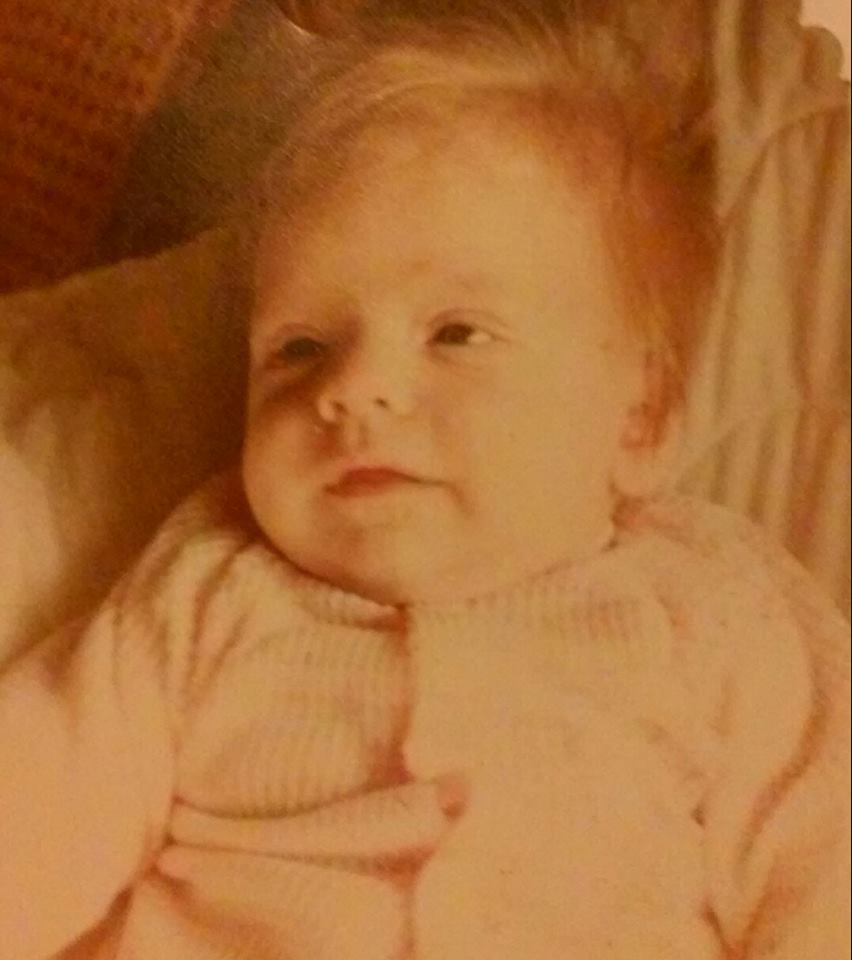
She was warm and solid in my arms. No longer a thought, she was a reality I could feel. I remember her smell, her soft skin, the way her tiny mouth opened with a yawn. Her hair was soft as I ran my fingers through it’s inch long length. It was the same color as mine. She belonged in my arms. We’d found home, together, sitting in the still hospital room. She was mine. I held her for hours.

The next day I told my counselor I had changed my mind. I wanted to keep her. The counselor told me that I could take my time to make my decision. They had a program in which my daughter could be placed in foster care so I had time to decide. I agreed. I knew I wasn’t going to release her but I didn’t feel strong enough to say no at that moment. In tears, I left the hospital without her. My mom pushed the wheelchair down to the car. Leaving the hospital without my daughter was the hardest thing I’d ever had to do.

That moment was the first time I felt the ache in my arms that could only be filled by holding my child. The month she was in foster care, I would fall asleep each night crying, my arms folded across my chest, rocking back and forth. I desperately needed to hold my baby. Nothing else could fill this void. The day I was brave enough to tell my parents I was keeping my daughter was the day my life truly began.

I never thought I would feel that ache again. The heaviness of empty arms. A weight you can not imagine . . . unless you’ve lost a child. The deep longing to feel their skin against yours, warm and soft. Your arms enveloping their body and pulling it in tightly. Holding our child is the most content most mothers ever feel. It’s completeness.

At Becca’s viewing, I kept rubbing her feet. She always complained her feet were cold, so I would pull them into my lap and rub them. I don’t think mothers ever grow tired of touching their children. The longing that is felt when this is no longer possible is wider than the universe.

It’s the heaviest emptiness I’ve ever felt. My arms ache with it ever single day.

Broken Mother

There is a very sweet little old lady who used to shop where I work. One day, I noticed a gold band on a chain around her neck. It had slipped out between the buttons of her sweater. She saw me see the ring, quickly tucking it back in, she explained she was a widow. Instantly, I knew the depth of her loss.

No word in our language conveys the type of loss a bereaved mother has experienced. One word is all I needed to hear from the elderly woman to understand this sad event in her life. When I hear someone is a widower, I know a man has lost his wife. When the word orphan is used . . . we know a child no longer has living parents. With seven letters, or less, a loss of such huge proportions is understood in definition.

I’ve often wondered why there is isn’t a word for us. To be honest, the wondering didn’t begin until after my daughter was killed because it’s not something I was forced to think about. Now I am. And I want to know why. The words I used as examples above carry within them the meaning of the loss. With the understanding of the loss we automatically extend condolences for the hole left in the person’s life. We may not intimately know what they are going through . . . but we know enough to be able to sympathize.

Broken mother. Mater Fractus in Latin. I don’t know Latin so this is just a guess helped by the internet. But I feel like a broken mother. I am a fractured soul. There should be a word that conveys this state of being. I know it’s very hard for those who have not lost a child to even comprehend what we go through. And a word or two would not be able to even begin to describe our situation . . . but there should be one.

Is there no word because nothing can hold the size of this loss? The heartbreak of outliving one’s child is unspeakable. No phrase is strong enough to carry it’s weight? No combination of letters which encapsulate the breadth of this path? Or is it because to put a name to it, a word that defines it, we might whisper it into existence in our own lives when it’s not visited us yet? I don’t know the reason why.

Maybe if there was a word we wouldn’t feel so isolated. Misunderstood. If a phrase could explain to others what our loss is, then the distance between us may not seem so far. If someone said to you, she is “mater fractus” then you would understand. I know it may seem a silly thing, to wonder why we don’t have a name, but it isn’t.

We feel invisible. Removed from those who have completely intact families. Unsure of where we fit into the world now. The only way others would know is when we voice our loss. Sometimes, it’s impossible to utter our truth, yet again, to a new person. To use the word’s “my child is dead” knocks the wind out of us. Often times, we just remain silent because it’s easier. We know we are hard to understand.

If a word could bridge that still space between the bereaved and others, imagine the understanding that would take place. Not only for us . . . but also for those who don’t know how to interact with a grieving mother.

The world needs more understanding and this is a good place to begin.

Our Winter

A few days ago I read a meme on Facebook that said “The path isn’t a straight line, it’s a spiral. You continually come back to things you thought you understood, and see deeper truths. This couldn’t be more accurate in describing the path of child loss.

I’ve often described as traversing through a landscape which vaguely resembles what your world was before. Our lives get divided up into two parts: before and after. A boundary that is solid and immovable. In the after, as we look around, things are familiar yet different.

I remember wanting to stay stuck in the moment right after I found out my daughter had been killed. I knew I couldn’t go back to before, but I didn’t want to start moving away from the space of time she had been alive. I wanted the world to stop. Everything to freeze. I understood I couldn’t have her back but I couldn’t imagine a life without her. I just wanted to stay as close to my living child as I could. But we can only stay there so long. Eventually, reality forces us to look up and around us as we begin to bring our child’s existence to an end in the tangible world.

In the eighties, there was a made for TV movie called “The Day After”. There is a nuclear explosion and the survivors are forced to find a way to survive the nuclear winter that follows the blast. This is what life was like, for me, in the months following Becca’s death. Even now I wince as I write those two words together.

In my “winter of the soul” life was muffled. As if cotton surrounded me. Voices bounced around and I was never quite sure where they came from. Grey. There was so much grey. I couldn’t see colors. I knew I should be able to fashion words into complete sentences . . . but the ability was lost to me. As far as I looked, all I could see was broken pieces of what my life had been before. Pieces that were scattered across my entire world.

I remember I was in a panic to scurry around, on my hands and knees, trying to find even the tiniest pieces so I could put it all back together. It’s not possible. The biggest piece that was missing couldn’t be found in physical form again. My child. So I started to walk the path with my head down, eyes blurred with tears, and muscles sore from attempting to carry all the pieces with me.  Except, I’d stumble upon a piece, I thought I’d picked up already, over and over. I couldn’t figure out why. Had I dropped them? Or had they been stolen? Why were they reappearing?

Finally, it dawned on me, they are in my path again because I have acquired new tools. Tools that allow me to work on them and fit them in more accurately than the last time I held them in my hands. We learn as we walk this path. Even when we don’t realize it. We learn from others who have been there before us. They come back for us when we seem hopelessly lost, and walk us toward the opening. Answers are found within us. Answers we didn’t know we had. Or more accurately, we couldn’t see the first time we walked past them. They were covered with the thin grey layer that settled on everything when our nuclear winter began.

When I was young, I was sexually abused. This truth reared it’s ugly head into my life over and over. When I became a woman. When I started my period. The first time I had sex. When I birthed a daughter. But each time it appeared, it seemed smaller somehow. Weaker. Pale. It didn’t have the hold on me it did when I was a young teen. When events in my life triggered the thoughts, I was more able to examine them, then put them away until the next time. I knew there would always be a next time.

And that is what this path is all about. We are never going to get to the end of it and say “there, it’s done. I’m finished”. Our life will be spent holding the truth of the death of our child in our hands and finding a place to carry it. We look at it to see where we can fit it into our lives. We guard it. We mourn it. We live with it. We survive.

This life isn’t about getting over it, or getting through it, or even finding closure. It’s about finding a way to accept the truth and allowing it to live within us in a way that doesn’t slice our insides every single day. Child loss is our truth.

It’s a hard life. But it’s still life.


You Can’t Stop A Boulder

Once a week I have the opportunity to talk to other grieving parents. I don’t always avail myself to said opportunity, but when I do, I am stunned at what we have in common. No matter how we lost our child . . . many feelings are universal.

The one that is most often mentioned: guilt. We find a way of taking whatever happened and making it our fault. One mom shared a story with me. The story is of a little boy who was sleeping soundly in his bed. One night a boulder, that had been firm in the side of the cliff for hundreds of years,  came loose. The massive rock rolled down the hill, gaining speed, eventually crashing through a wall. Instantly killing a little boy as he slept soundly in his bed.

How had the boulder become free? A storm, years prior, had caused the river to flood and weaken the earth in that area. Somehow, the surveying team missed the danger when they inspected the area for homes. Four years later, the boys parents had chosen the home because of it’s good school system and close neighborhood. It had taken them a long time to find the perfect place to raise their child. As a condolence, people said that there was no reason for this to happen, it was after all, an act of God.

Those of us who have lost a child know what the parents did to themselves, don’t we?

They blamed themselves for their son’s death. If they hadn’t chosen that house, on that hill, with those rocks that had seemed so beautiful in the sunset, he would still be alive. If they’d never left their previous home then this would not have happened. For the rest of their lives, they will carry the guilt of what happened.

When I listen to other parents talk about the death of their child, I am amazed at how easily events can be described in a way that illustrates their responsibility. As their words spill from their mouths . . .  I want to cry out: It’s not your fault!! Yet, I do it to myself, too. I can manage to weave the recounting of Becca’s death into a tale that makes me the guilty party. Why do we have such an intense need to be culpable. Society isn’t blaming us, we are blaming ourselves.

I’ve heard parents say if they hadn’t sent their child to school that day, they wouldn’t have died in a bus accident. Or if they had kept them home when it began to snow, their child’s car wouldn’t have skidded off the road. If they’d said no to going to the movies, their child wouldn’t have been drinking in the parking lot and  succumbed to alcohol poisoning. The truth is, as parents, we can do everything right, and it still doesn’t matter.

If you are reading this, and haven’t lost a child, please don’t become terrified of allowing your child to live. You can not wrap them in a cocoon and keep them safe. If we are alive, we have to live life. Don’t change that. But, please, if you know someone who has lost a child and is struggling with this massive, and very common, guilt . . . share this with them.

A lot of times we won’t listen to ourselves, but it helps to hear it from someone else. We can let the guilt go.

Our children would want that for us.


Being A Mess Is Expected

Valentine’s Day. For me, it’s never been about flowers and a dinner date. When I think about true love . . . my children are the image that forms in my mind. I love them completely and unconditionally. As all parents do.

Happy Valentine’s Day Becca, Gabriel, and Matthew. You are my greatest  loves. You always will be.

I wish that holidays didn’t now have a depth of sadness to them. I miss the ones that were nothing but joy. Sigh.

Over the weekend I moved, leaving the house where were a family for the last time, and starting a new chapter. Being so busy, I’d forgotten today’s holiday was just around the corner. Her absence didn’t hit me, again, until this evening. Then it floored me.

It made moving seem like a horrible mistake. I’m not in a room she’d recognize. How could I leave the walls that echoed our laughter? What was I thinking?

I’m a mess. A complete mess. So many emotions tumbling over me. I almost feel like I am going to lose the vise like grip I generally have on things.

I might. I have before. I’m sure I will again. It’s inevitable. Especially when they railroad car each other and pile up.

A new home. Valentine’s day. And numerous other triggers throughout the week. It’s exhausting.

I’ll have a lot to write about in the coming months, that’s for sure.

Until then, love each other well. Deeply and completely.

You’ll hear from me soon.


Understanding Others

I often wonder what people see when they look at me. Does my pain show on my face? Is my exhaustion apparent in how I carry myself? One woman told me that I had haunted eyes and it was difficult to hold my gaze. I can understand her point. Who wants to face the death of a child unless you absolutely have to? I wouldn’t.

I didn’t notice it immediately, but eventually the fact that people would become uncomfortable when I talked about my daughter revealed itself. They’d avert their eyes, start to fidget, and attempt to change the subject. Awkwardly cutting conversations short when they didn’t want to hear what I was saying. Many of my friends stopped calling altogether. At first, I was angry. I felt abandoned. What happened to all those who promised to “be there” whenever I needed them? I would reach out . . . but my hand would comeback empty.

For a long time, I let the anger build. I told myself that I would never treat someone else like that. But how could I be sure? Then one day, when I was outside in the sun planting flowers, I had an epiphany. My sad eyes and broken heart were just too much for some people. And that was nothing to be angry about. If I didn’t have to live in a world in which the death of children existed . . . would I choose to voluntarily? Probably not. It can be a dark and lonely existence. If all of my children were alive, would I want to be reminded, often, that child loss occurs? I doubt it. So, if I can’t be certain that I would handle the situation differently, how can I judge others?

This realization was very freeing for me. I didn’t have to carry the weight of anger toward anyone. I could just let it go. Doing so helped me to be more able to deal with the things I had control over. The things I could do something about. I couldn’t change people. I had to meet them where they were, even if they couldn’t seem to meet me where I was. In a place that is so terrifying it’s hard for them to imagine.

The sun shone a little brighter that day.

The day we realize that we are not responsible for other’s emotions, or actions, is the day we start to put all our effort toward healing ourselves. We deserve this. Women, especially, have difficulty putting themselves before others. From an early age, we are taught to be givers. We need to add ourselves to this list. Find what you need to heal and do it. Every day.

Each of us has a switch inside that we must search out and flip. The “thing” that is going to cause a shift in our thoughts and move us toward wholeness. We can have a hundred people around us, never be physically alone, but that won’t help. The work we have to do . . . we have to do in the quiet moments inside of ourselves.

This doesn’t mean that we can’t lean on others, we can. And we should. We just have to understand our hardest work will be done within our own minds and hearts.

However, search me out if you need to. I am always here.