Forever Searching

As I’ve shared in my writings before . . . I have a very complicated relationship with divinity. The easiest way to explain it is like this: I feel that “god” is a person I am angry with but can’t seem to remove completely from my life. Yet, I have no intention of ever getting close to him again. I have relatives like this, too. They’ve hurt me deeply. I know they exist but I don’t have them in my life. There is a silent truce between us and I am fine with this.

Over the past few months, I’ve gone to church more than I have in the past ten years. The first time, I told myself, was to support my friend. Like many mothers who have lost a child . . . our faith is damaged and we seek answers. That is what I said to the Bishop when he asked me what questions of faith I was struggling over. But, I think I’m getting ahead of myself.

As I said above, I initially believed I was going to be of support to someone else. Sitting in a pew in a catholic church, then a folding chair in an old mall, and today, in the lobby of Martin Luther King Elementary School, I’ve realized I’m searching, too. I consider myself Agnostic because this term comes closest to what I seem to be. I know there is “something” but I don’t know what, exactly. There are times when I wish I had unflinching faith, but it’s not to be I guess. Not for me, anyway.

I felt that today, as I sat in a group of six people, listening to the Bishop speak. My friend and I were invited to this service personally by the Bishop. He knows our stories of child loss. And I truly think he thought he could answer our questions, assuage our fears. I am thankful he cared enough to want to do so.

Listening to his words, I believe he was trying to tell us that god takes, but god gives, too. That god took something from our lives to make room for something else. A seed has to die for a plant to be born. God has to squeeze us hard to get the best juice. I understand what he was attempting to explain to us. But, I have trouble with it.

God could have squeezed me in a different way. God could have taken something else from my life. If a seed has to die, let me be the seed. The flower that should be growing is my daughter. I am sure my friend feels the same way. I think nearly all grieving mothers would gladly change places with their deceased child. Happily, and without a second thought.

If we could, we would give them life, twice.

Near the end of the service, the Bishop asked me to share what my questions were. I’ve not had this chance before. A one on one discussion, with a man of the cloth, where I could honestly voice my thoughts. So, I did.

I told him I don’t understand a god that would take my child yet let my pedophile uncle live. I have trouble believing “god is good” when Syria is happening. That there even is a god who would let the horror in the world continue without doing something about it. None of it makes sense to me. And his answer was the same one I’ve been told over and over again: you just have to have faith.

That answer isn’t good enough for me. It wasn’t good enough before my beautiful daughter was killed, and it sure the hell isn’t good enough now. I am not angry with the Bishop, I am thankful he cared enough about me, my friend, about my struggle to take the time to build a sermon around it all.

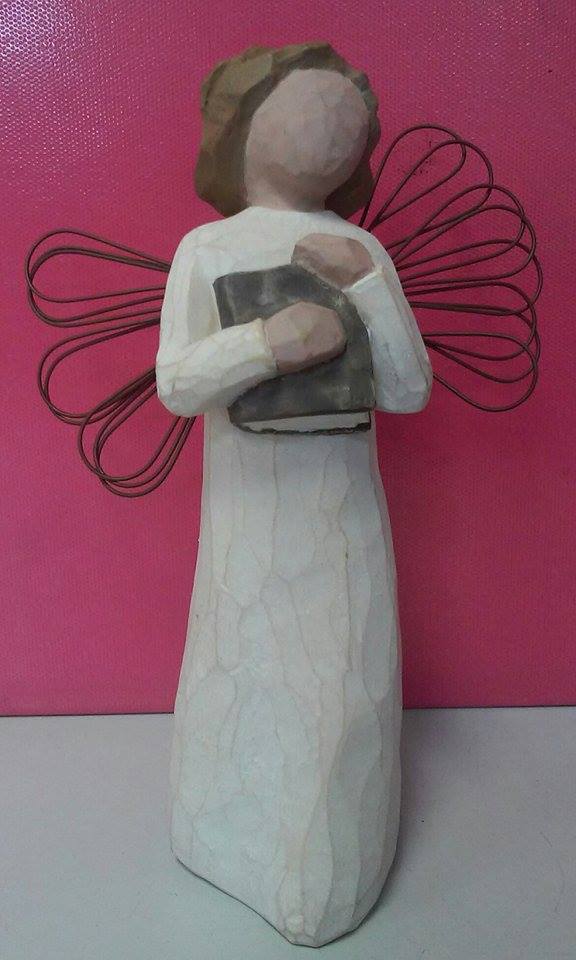
Later this afternoon, Stacey and I were walking around a thrift store. There were two Willow Tree angels sitting on the shelf. One of them was titled “thank you for the gift” the other was “angel of learning”. I don’t think those angels were there by chance. Our children are our gifts. The brightest blessings we could ever receive. And learning. Oh the things we’ve learned since losing our daughters. The biggest? How to live without them here.

I read once that our relationship with the deceased keeps developing as we learn more and we come to terms with their absence. I think I will forever search for answers. Answers about her death. Answers about all “the bigger questions” and that’s alright.

The searching keeps me moving forward.

Shores

This past weekend, I was lucky enough to spend a night on Mackinac Island. For those of you not familiar with this location, it’s an island off the northern tip of Michigan’s lower peninsula, with Lake Huron lapping it’s shores. We arrived in a small town at the edge of the Mackinac Bridge. Parking our car, we left our luggage with the porters and waited to board the ferry. The waters were a cold steel gray topped with fast moving whitecaps. I was scared. I’ve never been to the island, ridden the ferry, or been on one of the great lakes when the waves were so large.

Traveling with another bereaved mother, who’d been to the island many times, we boarded the boat. This trip was a sort of pilgrimage for her. Anxious about going somewhere she’d last been with her deceased child, she settled into her seat and looked out the foggy window. I ran my sleeve across the glass . . . trying to clear it enough to see outside. The ferry started to move and the swell of the waves grew larger as we pulled into open water.

My friend told me where the life vests and exits were “just in case”. Then, thinking it was funny, started to sing lyrics from “The Edmund Fitzgerald”. I looked at her with horror and she said “it’s a nurse’s sense of humor, dark”. Not long after that we hit a huge wave that lifted the boat about five feet into the air. Now, you have to know this boat seats nearly a hundred people and has two decks. Being tossed that high means the water was rough! For a moment, we hovered in the air as the boat fell. Then we slammed down into our seats. And I thought, if I die, I’ll see Becca. I think we lose our fear of death when we have a child that’s gone before us.

Either the captain slowed down or the waves calmed down as we approached shallower water, I don’t know which. I was then able to concentrate on the hazy shapes in the distance. I asked if the shape I saw was Mackinac Island. My friend said no, it was another island, but we were almost there.

My mind starting thinking about how grief is often times described as waves. How we are fighting the currents and just trying to stay afloat. I agree with this description. Then, a thought flashed into my head. She’d been here before. She knew what the islands looked like when the weather was sunny and the waters a clear blue calm. She’d never been here when the weather was as it was that day. But she knew that the mist covered shape in the distance was solid ground. Even though, at the moment, she couldn’t see it. The trip across this stretch of the lake wouldn’t last forever. She KNEW there was land.

Our ground was solid when our children were alive. When our child died, a tsunami swept across our land and wiped much of what we know away. On our good days, we stand on that ground, looking at the drastically changed landscape surrounding us. On the bad, the waters rise and sweep us to sea.

During these moments, the ones when we think of how easy it might be to slip below the surface and give in, we have to look across the water and find a familiar shape. We know there is land. Reaching it might be difficult . . . but it’s there! The waves rise and fall. When they carry you to their crest, find the land and swim towards it. Keep doing this, over and over. Until you make it to shore.

I think my friend was calmer than me on the ferry because she knew what lay ahead. I didn’t, therefore I was more anxious. We can help ourselves, and each other, by remembering what we stood on before our child died. Reminding each other that the maelstrom won’t last forever.

As we drew closer to the island, the soft shapes started to come into sharp focus. My friend pointed out a white church very close to the shore. She told me that her daughter, Mckenna, wanted to get married there some day. Now, she wouldn’t have the chance. Her mom was going to leave a rock, with her daughter’s name on it, outside of the church. Her pilgrimage.

The ferry slowed, we floated on the waves, and I took a picture of the church through a foggy window. A picture taken for a grieving mom, a daughter who’s future was stolen by someone else’s hand, and for me. Someone who didn’t know this shore existed, but felt blessed to visit it.

I don’t always know where my journey will take me. I do know that the journey can be better if you don’t always do it alone.

Mother’s Days After

18578515_10209592102466738_978814193_nI haven’t written a blog entry in a while. I’d have to check to see just how many days it’s been. The exact number isn’t important, but the reason I haven’t written is. To me. Mother’s Day just hits me like a punch in the stomach. The days leading up to it are full of anxiety, the day of is difficult, and the days following are full of sadness.

This past Sunday marked the tenth time the day of celebration for mothers passed without my daughter. As I’ve done since the first one, I pulled out a few things I have from past holidays, that she gave me. I ran my fingers over the paper of homemade cards as if they were made of precious materials. To me, they are. These things are irreplaceable. Let me take a moment to give you some advice: save it. Save it all. One day you might be happy you did.

Though this holiday is difficult for me . . . I know it’s harder, in a different way, for newly bereaved mothers. The first one is full of moments of denial. This can’t be real, you tell yourself. Images of last Mother’s Day flash into your mind as you line up the time, to a year before, and think about what you were doing with your child. Every piece of your soul aches to travel back to that day. Any day before your child died, really. Then the weight of the new reality crushes those memories with it’s truth.

On Sunday, I sat at a small Mother’s Day celebration that my friend’s family had. As we chatted, sitting in a circle in the shady backyard, I couldn’t help but notice the four kids sitting across the expanse of grass. Cousins, laughing with each other. Except, one of them was missing. You see, there used to be five. Until one was killed. Her mother, my friend, sat next to me, quiet. Curled into herself.

A few times, I asked her if she was alright. She said yes. We always say yes. The rest of the family, though aware of the huge hole that was left by murder, had all of their children around them. I know they carry immense and indescribable sadness but they can’t experience the pain that my fried carries for the loss of her daughter. I know they understand that holidays will be difficult . . . but I am not sure others can truly understand the depth of our pain on such days. Seeing my friend steeped in her pain, pain that was so real it flowed off of her in waves, broke my heart. I wish I could make it better for her. That I could make it better for all the bereaved moms I know. But I can’t. I can barely make it better for myself.

The Saturday night before Mother’s Day, my friend and I accompanied another mom to the site where her child died last year. She’d spread out a blanket under a huge pine tree, a tree that must have been over a hundred years old, and talked about her son’s last day. We listened to her as she shared her son’s death story. We all need to share the death story of our child. The creek slipped quietly by below us as tears fell upon our cheeks. There is sacredness in these moments. A connection to each other and to life. And death. It’s an honor when mothers share these stories with us . . . let us into their very small and intimate circle of pain.

Being a mother is a sacred act. Raising a child, caring for them, loving them, protecting them, teaching them . . . it’s the most important thing we can do with our lives. Both joy filled and heartbreaking.

The days that led up to Mother’s Day were filled with apprehension for me. I know it’s going to be hard . . . I just don’t know how hard. So I worry I might not make it through. The day of, though it’s been a decade, still brings memories from previous celebrations into my mind. I wonder if she knew how much I love her. If she knows the cards her little hands made were among the most precious gifts I ever could have received. Does she see me get them out every year and cry as I read them over and over. I hesitate as I look at the gifts from my sons, wondering if I should save them “just in case” and then think I am courting death if I do.
The days after are hollow and painful. There is a type of re-realization that Becca is gone for good. She’s not coming back. Even if I cry to the heavens that it’s been too long since I’ve seen her so she should be sent back. It’s a kind of bottoming out . . . again.

I’ve traveled far upon the path in my grief journey. I learn new things every day. But Mother’s Day will forever be one of things I circle back to again and again. One of the many times each year that I need to enter a space I’ve been in before, and work through it again.

Then I can use the knowledge I’ve gained to help the moms who are new to the grief of child loss. Next year, if you know someone who is a bereaved mother, please reach out to her. You will add some happiness to a sometimes very dark day by letting her know she is still a mom. And is remembered as one.

Dark Truths

There are things about grieving the loss of a child that are very ugly. Thoughts we have may seem cruel to outsiders. Honestly, they seem cruel to us, too. You don’t see the world through the shattered glass which covers our view now. The spidery cracks change the image we see. Like a kaleidoscope, when we move just a bit, everything looks different. Before, we knew how things appeared. In the after, we see sides and pieces we hadn’t realized existed.

Yesterday, I was taking a box of pictures out of my car to finally put in the house after my recent move. As moms usually do when photographs are near . . . I started to leaf through a few bunches of them. I came across a photo from the late eighties that started my mind down a very dark road. I’m not happy my thought process took the path it did, in fact, I’m a little ashamed. But pushing the shame aside, and examining the thoughts I had, is more important than any attempt to remain kind in appearance.

One of the biggest questions we have when we lose a child is why. Why? Why my child? Why in this way? Why did this happen? Why am I left living without my baby? Even if we were to be given the answer . . . would it be acceptable enough for us to completely understand and agree with the reason? To be alright with their absence? Never.

Yet we still ask.

The picture I found both instantly made me angry and guilty at the same time. I remember the day it was taken. If I close my eyes, I can hear the delicate laughter of two little girls. Second cousins who had basically grown up together. Both daughters of young single moms. Five year old girls who were more like sisters than anything else. When I read my daughter’s journal, after her death, she had a poem written about her cousin mixed in with those about life. Their relationship shaped them both, almost.

You see, one of the girls took Path A while the other, Path B. The girl who took “A” went to college, worked two jobs, and was building a future for herself. Path “B” led the other girl into a life of young motherhood, drug use, and criminal activity.

In the past, I’ve written about my inability to understand why my daughter died and my uncle who molested a large, unknown, number of young girls, still lives. When I verbalize this thought most people understand. Yes, they say. It’s unthinkable that a young innocent woman should be killed but a pedophile, recently released from prison (who has undoubtedly molested since) remains alive. It’s completely understandable that I think this man should have died long before my child, isn’t it? But what of my dark thoughts that Becca’s cousin should have died before her? Is that as easy for you to understand? Or does it make me a monster in your eyes?

As I held the photograph in my trembling hands, my mind ran a mental checklist and ticked off the accomplishments of both girls. I know both girls. I have loved both of them. Each was a small baby, held in my arms, that I kissed as she slept. So why does my mind keep saying it wishes the other had died in the place of my child?

The night Becca was killed, I sat a mile from the crash scene in my parents red pickup truck, waiting for my friend to come back after seeing my dead daughter. Waiting to hear if the woman that had been killed was really my child. I kept praying, pleading, begging that it not be Becca.

“But there is a dead girl up there. It’s someone’s daughter if it isn’t yours,” a voice in my head told me.

“I don’t want it to be Becca!!” I screamed.

The voice replied, “Then it’s another mother’s child down there.”

“I don’t want it to be anyone’s child,” I wept.

“It’s your child, or it’s the child of someone else. Which would you prefer?” it said to me.

Neither I kept saying to myself. I couldn’t imagine another mother finding out their child was dead. Yet, I can look at the picture of a child I loved, cared for . . . and can say, I wish it had been her, instead. You have no idea how difficult it is to have this thought and to have to admit to it. But there it is. My truth.

I don’t think I am a monster. I certainly don’t wish this young lady dead now. I haven’t talked to her in years. I don’t have much communication with my family so I am unsure as to what her life is like now. I hope she is doing well, I really do, because having a life is an incredible gift to waste. She’s friend requested me a few times on a popular social site but I’ve declined each time. It’s painful to see Becca’s friends attain life goals she’ll never get to . . . somehow, seeing this young woman do so would be utter anguish. Again, I’m not proud of this. It’s just my truth.

My daughter’s poem surfaces as I look at the photograph of two beautiful light haired little girls. Especially this part:

“She was my sister,
not by birth but in my heart.
Our days together consisted of
Play-Doh, swing sets, and Barbies.
And it was like the time would never end.”

Oh my Becca, I miss you so much my beautiful girl.

Healing Places

I’ve always been an artist. Not necessarily a good one, but drawing did something for me that nothing else could do. I was centered and no where else when I had a pencil in my hand and a sketchpad in my lap. After my daughter was killed, I spent hours silently on the couch. Doing drawing after drawing of rocks. My mind was soothed by the sound of the lead on paper. My body, wracked with pain, would turn it’s attention to the fine motor skills needed to draw, and I’d have a period of lessened physical torture. When I draw, or paint, I am nowhere but right there, in that moment. It’s the closest I come to meditating.

When we lose a child, our life is permanently divided into two distinct time frames. Before and After. The letters used to denote periods of time, BC and AD have a new meaning to me. Before Crash and After Death. It’s how our lives are segmented now. We exist in the after but long for the before. Living in this limbo is exhausting. We know we must participate in the life around us but we can’t help letting our minds wander to days long ago. Or maybe not so long ago. Days so close we can almost touch them.

The only place I’ve found, that gives me a reprieve, is in my studio.

Let me say this: writing helps me heal, as well. But, writing is where I purposely access the emotions and examine them. I have to allow them to wash over me and take over my mind so I can write, as truthfully as possible, about my experience. It’s a painful and exhausting activity. Often, I feel completely worn out need to just finish the day by going to bed immediately after I’m finished. I write because I HAVE to. There is a story in me that I need to share, to lighten it’s weight on my soul, and to hopefully help others not feel alone in this. But painting soothes my emotions instead of bringing them to the surface.

As I said above, we live in an world that has been dissected by the death of our child. We are continually assaulted with “used to be” and “should have been”. I know I often feel as if I am talking myself from the edge of a ledge that leads to all engulfing pain. My heart can only take so much, in one day, before all my closely held emotions spill free. The closest I’ve come to that ledge, lately, is when a pregnant girl and her mother stood at the deli counter where I work. They discussed the cravings they had in common during their pregnancies. A special bonding conversation for mother and daughter that nearly caused me to come unhinged. I’ve learned to hide these moments from others. Most don’t understand.

When I get home, after a day like this, I sit down at my easel and can feel a sense of calm enfold me. I’ve read that meditation helps us detach. It reduces stress and alleviates anxiety,but not for me. I have tried numerous times, over the years, to use meditation as a means to mental well being. Not once has it worked for me. My mind races and starts circling unpleasant thoughts. I begin to worry that I can’t do anything right, even meditation, like other people. I end up feeling worse than when I started. Let me add, I do know meditation works for people and I don’t want to sound as if I think it’s a waste of time. It isn’t. Fortunately, I’ve found my meditative activity.

In the past year, I’ve started doing something I never thought I would have, or could have. I lead painting events for groups of people. Some have been for profit, but the ones that mean the most to me are the ones that I donate my time to help raise funds. Because of being a grieving mom, I’ve met other bereaved moms who have foundations to help others, in the memory of their child. Generally, the painting we do is simple, only taking a few hours, but for those hours I am helping others learn about the healing quality to creating.

Creating, for me, isn’t about the end product (unless I am doing a commission for someone else.). It’s about the process. The journey, not the destination. I’m not looking at the two pieces of my life, the before and after, I am existing in the now. My daughter is with me, I haven’t forgotten her,she is happy because I have found a moment of peace.

The smell of the paint, feel of the brush in my hand, and the colors on the palette are all very soothing to me. My two dogs at my feet, the warmth of the cat on my lap, all work together to create harmony in my soul. Though these moments are brief, they can save a very difficult day from complete ruin.

I’m currently working on a series titled “Healing Places”, which for me, are always in nature. The image above is the canvas I am working on currently. Bringing the two types of healing together for me, being in them and painting them, is having a very uplifting effect on my soul. A peace I so very badly want to help other grieving mothers find. Whether it be painting, writing, running, gardening or meditating. Whatever it is. Our souls NEED this in order to heal. To remain strong. You deserve this time for yourself and your soul.

In that spirit, my studio is always open to anyone who feels the need to paint.

Pieces Of Her

In the spring of 2002, my daughter invited me to go on her senior spring break trip with her. It was a trip of a lifetime! While in Los Angeles, we visited the famous stretch of sidewalk outside of Grauman’s Chinese Theatre. Becca was beyond thrilled when her feet fit perfectly into the prints made by Marilyn Monroe. She was intrigued by the fact that she occupied the same space, for a moment, that the actress once had by standing in her footprints. My daughter had me take a picture from every angle! For months after that, she would casually throw out the fact that she and Marilyn shared the same shoe size. It was adorable. I’ll never forget that trip.

In a medium sized box covered in pink fabric, with Asian designs, I keep a half dozen very intimate pieces of my daughter’s life. Of those things, there are two that are the most difficult to hold, but give me the feeling of being where she once was. The space she inhabited while alive. Something like the feeling she had standing in those impressions, in the cement, years ago.

The hardest object to hold, I look at a lot, but pick up rarely. They were a part of her every day life. Of school. Her job. Of our hours together watching television. When I pick them up, and fold open the earpieces, I’m doing what she did every morning for years. I place her glasses on my nose, and KNOW, I am occupying the small space I saw her in every day of her last years. My eyes are looking out through the lenses she used to see her world. The tiny arch that rested on the bridge of her nose . . . now rests on mine. My eyes are where her beautiful long lashed ones used to be. And it makes my heart ache. So I don’t wear them often. But when I do . . . I feel closer to where she used to be.

The other object is so small, and seemingly insignificant, that it might surprise some that I cherish it. A simple cream cloth covered rubber band. Caught around the rubber band is some of my daughter’s soft brown hair. I don’t know how many times she used it to throw her long hair up into a ponytail or messy bun. I wish I could ask her. I’ll hold it and stroke the small bit of hair over and over, remembering how it felt to touch her hair when she put her head into my lap. I’m starting to be wary of touching the hair too much. What if it disintegrates from all of the handling and it disappears?? I can’t chance that. But I still need to stroke her hair some days.

There is one more object that is priceless to me. One afternoon, Becca and I helped the boys make hand prints in plaster of Paris as gifts for family members. There was a bit of it left over, so before it set, she poured it into an aluminum pan and made a print of her hand. I don’t remember how long after her death that I found it, but I am so grateful I did. I’m also grateful, that she decided to make it that day long ago. When I want to hold her hand, I place mine in the print she left. The surface isn’t white anymore. The edges aren’t as sharp. No longer can I see the lines from her skin. But when I place my hand in her’s, I feel a sense of peace. Of connection. This is the closest I will come to actually touching her again until I join her.

These small intimate pieces of her life, our life, will have to do until I hold her again in my arms. I want to cup her face with my hands and place a kiss on her forehead. Hear her laugh and call to me. Just hold my baby in my arms. For now, I have to visit the past to be with her again.

Take notice of the small pieces of each others lives. That’s where the love is. In the intimate moments in the tiniest of places. It really is the small things, I promise.

All Our Children

My entire life, I’ve not liked meeting new people. I carry matching luggage filled with insecurities and self doubt. Since I lost my daughter, I’ve added new contents to these bags, which go everywhere with me. Though there are many additions . . . tonight, I will talk about just one. But it’s a really big and difficult one. For most people meeting others, it’s a question that’s asked an answered without much anxiety. Not so for bereaved mothers. We grow to dread this particular inquiry.

The question? How many children do you have. A common question for those meeting each other for the first time. I don’t like having to answer it. The situation can go one of two ways and either is stressful for us. Only one is stressful for the other party. I’ve reacted both ways, but there is a price I pay either way.

At times, we can simply answer with the number of children we have and the conversation goes no further. Often, however, the follow up question is asking us to share the ages of our children. This is when grieving mothers really start to panic. How do we answer this?

We can simply give the ages of our living children, then the age our deceased child left this world.

Ages are a weird thing. My twin boys just turned the age their sister was when she was killed, twenty three. In fact, on January 11th, they passed the age when she was the oldest she was ever going to be. They are older than their older sister. I can barely wrap my mind around this truth. If I answered in the way I’ve mentioned above, it would seem I have triplets, which isn’t the case. And the thought of answering in this manner has always made me feel uneasy, so I’ve not chosen to do it. I don’t fault mothers who do. We each have to choose what is best for us, no judgment.

Sometimes, in an attempt to keep the follow up question from being asked about our dead child, we don’t mention them. At all. It’s just easier, we think, to not have to make anyone else feel uncomfortable with our reality. This is a dangerous way to go, I’ve learned from experience, because we are left with a new guilt. We carry enough guilt for not saving our child, somehow, and now we are being disloyal to their memory by not admitting their existence. Internally, we are bleeding to death because of their absence, but we don’t let this fact show on our faces lest we cause discomfort in another.

I’ve chosen this tactic, early on in my new life without Becca, I am ashamed to say. The pain I saved the other person from feeling was heaped upon that which I already carried. The half dozen times, maybe more, I’ve done this have left me crying in the dark begging my daughter for her forgiveness. I don’t hide the fact she existed anymore. Not for anyone’s comfort. Not anymore.

We can, and eventually do, answer the question in a truthful manner. Not ashamed of the fact we have a dead child. No attempt to soothe their nervousness.. I’ve seen the look in people’s eyes when I’ve said my child is deceased. A mix of panic and uneasiness. They don’t know how to respond. And, I’ve learned, it’s not up to us to care how they respond. They’ll figure it out, or they won’t, but either shouldn’t change whether we talk about our child or not.

This is how my most recent conversation with a new person went:

“How many children do you have, Diane?”

“I have three. Becca, Gabriel, and Matthew.”

“Beautiful names! How old are they?”
“The boys are twins, they turned twenty three late last year. My daughter would have been thirty three.”

“Oh . . . would have been?” (that’s when the panic first flickered in his eyes.)

“Yes, she was killed ten years ago, by a drunk driver, she was twenty three.”

I saw his face grow red and he stammered something about having to get back to work.

Generally, this isn’t how uncomfortable this conversation can be. Most times people say they are sorry for my loss. I thank them and we move on. I have learned I can either chance the possibility that the other person will not react well by my answering honestly or I can omit my daughter’s having existed by leaving her name off the list. For me, the choice has become quite simple.

I won’t ever keep the life of my daughter to myself because of how others may react. I don’t care anymore. She’s my child. She was here. Her life mattered. Her death happened. I will say her name any and every chance I get.

When we begin walking the path of child loss, we are still finding our way in everything, because all we know has been replaced by our new reality. It takes a while for us to become strong enough to stand up to society’s expectations of a grieving mother. We have to find our legs and stand again. We must find our voice and speak again. We are the keepers of our child’s life. There is no shame to be felt for this.

For those of you who are on the side of the conversation, where you could feel discomfort, please don’t let it overwhelm you. We know we make you uneasy. That our child’s death forces you to face the fact children die. That if it happened to us . . . it could happen to you. The horrifying fact is: it can.

It happened to us. Please don’t add pain to our already anguishing journey. Stay with us and let us talk about our child. It’s the greatest gift you can give us.

Still Mothering

Behind me, there is a red set of shelves. In it’s former life it was a dresser. When I no longer needed it as such . . . I took the drawers out and made them shelves. I couldn’t get rid of it because it is a piece of furniture my daughter knew me to own. On it’s top, I have photographs, candles, and the marble urn which holds my daughter’s ashes. I always keep fresh flowers next to her urn. I call them ‘Becca Flowers’. Every night, I kiss her picture and tell her I love and miss her. I am going to do this until the day I die.

Another bereaved mom I know goes to the cemetery, to visit her daughter’s grave, every day. She decorates for the approaching holiday and talks to her child. I was privileged enough to help her choose new flowers, in the colors of Mardi Gras, to put in the wreath she keeps there permanently. We spent about twenty minutes picking the right flowers and color combination. The mom took much care in making sure the bouquet was exactly what she wanted, what her daughter would like. I understand her desire to spend the time and care she did in this small task. I do the exactly the same thing when I choose flowers to put next to Becca’s ashes.

Last week, I was talking to someone at work about how much I admire this mother for going to the cemetery every day to see her child. In response, he asked “Do you think that’s healthy?”. My immediate answer was “Yes.”. He asked me to explain and it’s taken until tonight for me to be able to put my reasoning into words.

When our child is born, and placed into our arms, we accept the responsibility that comes with being a parent. We help them learn everything they need to learn along the way. We love them completely . . . most times more than we love ourselves. Every single aspect of their life . . . we are a part of. As they grow, our role in their life changes. What they need from us moves from one thing to another, but it lessens as they grow more self sufficient. Then comes the days when they seem to barely need us at all. Yet we still have the deep calling to care for our child. It never goes away. Even after our child dies.
Especially after our child dies.

Try to imagine, if you can, having your child’s full life narrow to the size of a burial plot. Or a marble urn. All your mothering, the love you still need to give them, has such a small place to physically fit. The younger the deceased child the longer the list of things they never had a chance to do. Graduate from school. Attend college. Fall in love. Marry. Become a mother. Our child is robbed of so much.

Bereaved mothers are robbed, as well. Instead of helping my daughter choose a wedding dress, I chose what she would wear for the visitation. Becca will never call for me, while she’s in labor, because she needs her mom. All of those things, the mothering I never got to give her, still need a place to go. Where do I put it? I keep fresh flowers next to her urn. A candle burns every night.

Where does my friend do it? She keeps her daughter’s plot neat and tidy. Adorned with all the gifts she will never be able to place into her hands. I watch her rub her palms lovingly over the winter grass. Hear the words of loss and longing she speaks, as she places a kiss over her daughter, and tells her she’ll be back to see her tomorrow.

Is it healthy you ask? I think it would be unhealthier to have all of this love, and loss, bottled up inside of us with no place to go. We are mothers. Our child died, but we did not cease being their mother. Caring for the final spot our child inhabits is what we can do to care for our child in their absence. This helps us heal.

I hope those who have not lost a child can understand the importance of our actions when it comes to this. I also hope, very sincerely, that they never truly understand the truth of my words.

Confronting Guilt

Guilt is a monster that demands to be fed. No matter the cost . . . it’s going to find what it needs and take it from you. We are better served by looking it in the face and asking it’s reason for existing. There is always a reason. Often times, the reason isn’t our responsibility. Especially the reason our child died. But, somehow, we still carry the guilt.

The moment my daughter was killed I was sleeping restlessly in my bed miles away. Earlier in the evening, while I was at work, an ominous feeling settled on my shoulders. I tried to shake the feeling of impending danger but I just couldn’t. Even going so far as to tell my manager I wouldn’t be back to work there again. How did my subconscious mind know this? And if it was going to warn me . . . why not go all the way and tell me exactly what was going to happen so I could stop it?

As I lay safely in my bedroom, as my sons slept downstairs, my child’s life was ended by a drunk driver. Why did I go to sleep? How could I not pay closer attention to the feelings I was experiencing? I knew my boys were home that evening. They had no plans. I should have called my daughter and made sure she was alright. I had time. I left work near midnight. She wouldn’t be killed for just over two hours. If I’d acted . . . she might still be alive. If I had demanded she tell me where she was, then driven to get her, she would still be alive. If I’d picked her up and brought her to my home, tucked her into bed next to me . . . she’d still be here.

As her mother, I should have known this was the possible outcome of the night. I didn’t. Was this because I am not a good mother? Or I didn’t love my child enough? I failed her. I cost my daughter her life. And I have to live with this truth for the rest of my life.

When talking to others, and expressing this thought, I’m always told I have no responsibility for her death. (But I do.) I wasn’t the driver who chose to drive after drinking. (But I could have changed the course of events.) Physically, I had no hand her dying. (But I should have known my child was in physical danger.) You see how our mind works? How we can find a way to feel responsible for something we had nothing to do with? The weight of the guilt we carry can crush us and force us to our knees. It lives in our chest so fully we can’t take a deep breath. Our heart beats are restricted and our blood flow is weak. We are dying, ourselves.

Guilt will take what it needs, and we are left to exist on what’s left, unless we confront it. It’s parasitic existence must be ended. In truth, we most likely, couldn’t have stopped our child from dying. In our heads, this fact is acknowledged. Our hearts, however, don’t always know this. We spend our life, our child’s life, keeping them safe and preparing them for a future of their own. We baby proof our homes, walk them to school, get vaccinations and physicals, feed them healthily. Teach them about strangers, lock our doors at night, talk to them about safe sex. Their safety is entirely our responsibility. Except, when it’s isn’t.

I’ve not met another grieving mother who didn’t carry some guilt. It’s part of the whole package. Emotions you didn’t know you would experience. That you don’t know how to deal with. As I’ve said before: you can’t heal what you don’t acknowledge. Find the source of the guilt. Where you tell yourself you went wrong. And look it in it’s eyes. Question it. Examine it.

When it doesn’t have an answer for you . . . tell it to go.