Two nights ago, I went down to the lake just to float. Dusk was still a couple of hours away, but the sun had softened. It wasn’t as relentless, and neither was I.
My favorite season at the lake is winter—on the deepest, windiest days. The sand turns to stone beneath my feet, frozen solid. The gulls scream into the sky like something primal and furious. And the waves? They don’t roll—they reach. They claw toward the shore, grabbing at the sand, dragging bits of it back to the cold, dark belly of the water. It’s stark. Wild. Beautiful in a way that feels honest.
My second favorite time is summer—just before the sun goes down. The heat has broken. Most of the crowd has packed up, leaving behind footprints and laughter in the air. It’s quieter then. The beach stops performing. The lake exhales. And in that softness, it’s easier to just be.
By the time I got there, the beach was near perfect. The sun had dipped low, casting gentler light. A few scattered people lingered. Small waves rolled in, steady and unhurried. The water was cool, not cold. A long shadow stretched across the lake from the lighthouse, like even the light had grown contemplative.
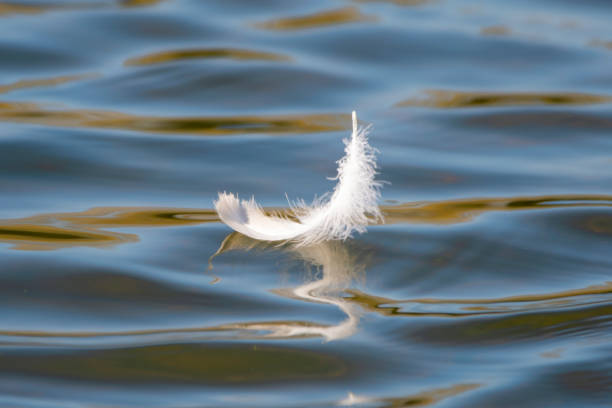
As I floated farther out, I saw a perfect white down feather drifting nearby. The waves swelled just enough to propel it forward without pulling it under. I thought, Well, that has to be a metaphor.
Ride the waves. Don’t let the grief drown you.
Then I thought, That’s too on the nose. Too tired. Surely that couldn’t be the lesson.
As I twirled gently in the water, I saw the lighthouse shadow growing closer. The real lighthouse stood in the distance, still and sure, casting a long dark shape across the surface.
Grieving parents live with the shadows of what life used to be, I thought. We have to find a way to stay in the light.
But that wasn’t it either. That thought didn’t feel right. It felt forced, too polished to be true.
The seagulls cried above me, their haunting screams echoing across the sky. Their voices always touch something in me. I’ve written about them before, about the winter lakeshore and how it mirrors my inner landscape. Grief, embodied. I’ve written about it enough to know that, in this moment, I had nothing new to say.
In all actuality, I didn’t figure out what – if anything – the lake had to teach me until later that night.
Not while I was floating. Not while I was squinting for messages in feathers or light. But much later, while I lay in bed.
The house was still. That kind of deep, sacred quiet that only comes when the day has finally given up. And maybe I had, too. I wasn’t hunting for meaning anymore. I wasn’t trying to pin purpose to every ripple.
I just was.
Earlier, as I had floated, I told myself to stop worrying about what I needed to learn. To stop dissecting every detail for meaning. I let my head fall back. I extended my arms beside me, closed my eyes, and let the moment hold me.
As I’d been taught in counseling, when feeling overwhelmed, I checked in with my five senses.
The smell of the lake was slightly fishy, yet clean.
Distant boats sped by in the background, their hum a kind of white noise beneath the occasional gull call.
I tasted a bit of lake water on my lips, gritty from the sand.
The light beyond my eyelids changed—soft pink to blue, then violet—as clouds passed across the low sun.
But it was the feel of the water that rooted me. The gentle rocking of the float beneath me. My arms lifted and fell with the swells. My feet dangled lower than the rest of me, brushing the colder waters below.
I felt weightless.
I felt cradled.
I felt peace.
Later that night, in bed, I could still feel it. The coolness of my skin. The sensation of water. It was as if the lake had rinsed something off of me, something that had been gathering on my surface for a while.
Grief residue. Thought loops. The ache of trying too hard to make sense of what may never be made sense of.
I felt… cleansed.
And that’s when the realization came.
Yes, we must find our own truth in this journey. Yes, we must seek meaning, search for signs, ask the unanswerable questions. We must question grief.
But we also have to stop chasing. We have to allow space not to know.
Yes, we grieving parents are seekers. We reach for answers. We demand meaning. We beg for signs: Why don’t I see them? Is my child mad at me? Do they still exist?
So many of us feel haunted by silence, wrecked by the absence of proof.
We want to believe our children are near, still part of us, still somewhere.
And yet, sometimes the deeper truth is this:
The burn to understand will exhaust us. The hunger for truth will leave us hollow. The endless grasping will not bring them back.
There is wisdom in the pause. There is grace in the unknowing.
Not trying to figure it all out is just as important as seeking answers. Maybe more important, for the soul.
We have to make space to be still. To unplug. To remain idle. To refill what grief depletes.
As I lay there that night, the peace was still with me.
The next day, I tried to call it back. Tried to summon that sense of floating, of being held.
It was already harder.
And today, it’s harder still.
That’s the nature of moments like that. They aren’t permanent. They don’t live inside us unless we choose to keep making space for them.
The lake held me longer than I expected—but only because I stopped reaching.
Some truths can only be heard in the silence after we stop asking.

 Words Can Express