On Floating And Other Forms Of Stillness

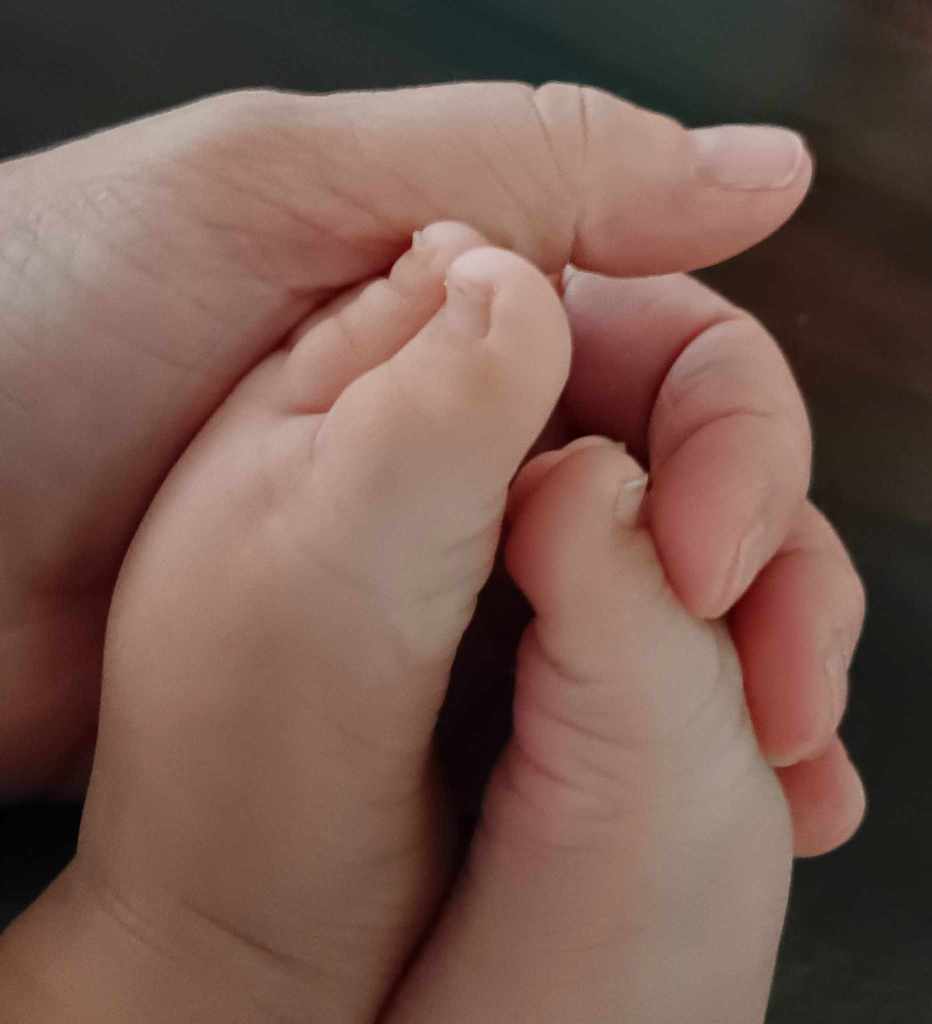
Not my photograph. Free image.

Two nights ago, I went down to the lake just to float. Dusk was still a couple of hours away, but the sun had softened. It wasn’t as relentless, and neither was I.

My favorite season at the lake is winter—on the deepest, windiest days. The sand turns to stone beneath my feet, frozen solid. The gulls scream into the sky like something primal and furious. And the waves? They don’t roll—they reach. They claw toward the shore, grabbing at the sand, dragging bits of it back to the cold, dark belly of the water. It’s stark. Wild. Beautiful in a way that feels honest.

My second favorite time is summer—just before the sun goes down. The heat has broken. Most of the crowd has packed up, leaving behind footprints and laughter in the air. It’s quieter then. The beach stops performing. The lake exhales. And in that softness, it’s easier to just be.

By the time I got there, the beach was near perfect. The sun had dipped low, casting gentler light. A few scattered people lingered. Small waves rolled in, steady and unhurried. The water was cool, not cold. A long shadow stretched across the lake from the lighthouse, like even the light had grown contemplative.

As I floated farther out, I saw a perfect white down feather drifting nearby. The waves swelled just enough to propel it forward without pulling it under. I thought, Well, that has to be a metaphor.

Ride the waves. Don’t let the grief drown you.

Then I thought, That’s too on the nose. Too tired. Surely that couldn’t be the lesson.

As I twirled gently in the water, I saw the lighthouse shadow growing closer. The real lighthouse stood in the distance, still and sure, casting a long dark shape across the surface.

Grieving parents live with the shadows of what life used to be, I thought. We have to find a way to stay in the light.

But that wasn’t it either. That thought didn’t feel right. It felt forced, too polished to be true.

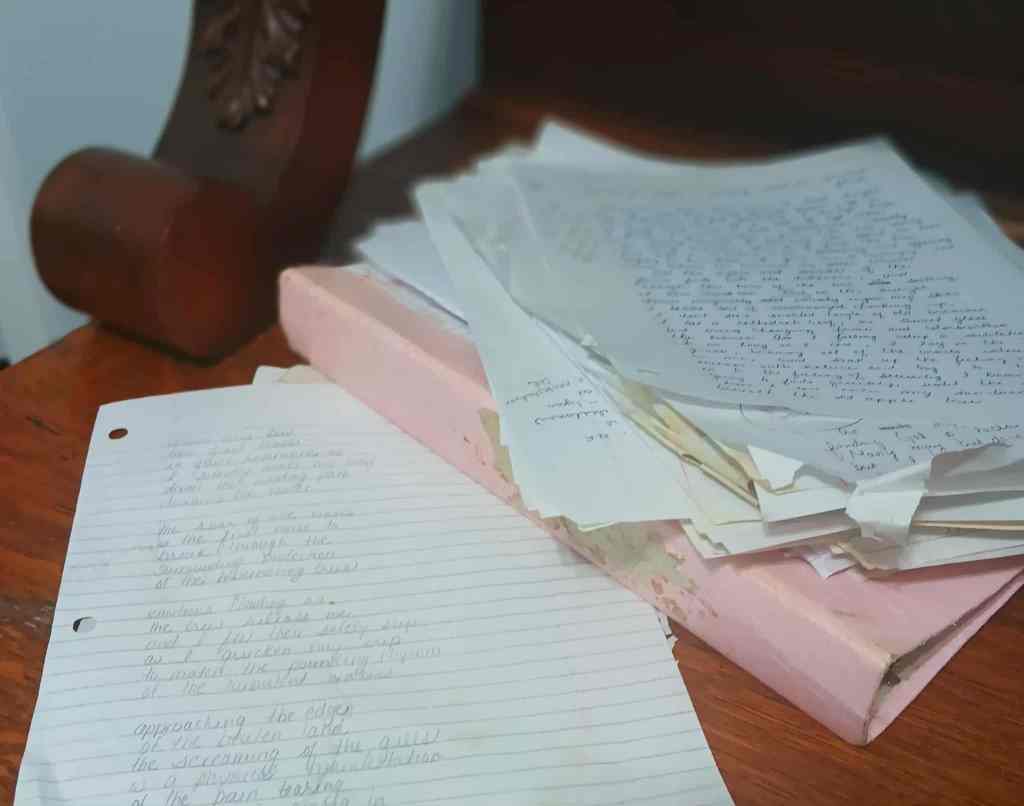
The seagulls cried above me, their haunting screams echoing across the sky. Their voices always touch something in me. I’ve written about them before, about the winter lakeshore and how it mirrors my inner landscape. Grief, embodied. I’ve written about it enough to know that, in this moment, I had nothing new to say.

In all actuality, I didn’t figure out what – if anything – the lake had to teach me until later that night.

Not while I was floating. Not while I was squinting for messages in feathers or light. But much later, while I lay in bed.

The house was still. That kind of deep, sacred quiet that only comes when the day has finally given up. And maybe I had, too. I wasn’t hunting for meaning anymore. I wasn’t trying to pin purpose to every ripple.

I just was.

Earlier, as I had floated, I told myself to stop worrying about what I needed to learn. To stop dissecting every detail for meaning. I let my head fall back. I extended my arms beside me, closed my eyes, and let the moment hold me.

As I’d been taught in counseling, when feeling overwhelmed, I checked in with my five senses.

The smell of the lake was slightly fishy, yet clean.

Distant boats sped by in the background, their hum a kind of white noise beneath the occasional gull call.

I tasted a bit of lake water on my lips, gritty from the sand.

The light beyond my eyelids changed—soft pink to blue, then violet—as clouds passed across the low sun.

But it was the feel of the water that rooted me. The gentle rocking of the float beneath me. My arms lifted and fell with the swells. My feet dangled lower than the rest of me, brushing the colder waters below.

I felt weightless.

I felt cradled.

I felt peace.

Later that night, in bed, I could still feel it. The coolness of my skin. The sensation of water. It was as if the lake had rinsed something off of me, something that had been gathering on my surface for a while.

Grief residue. Thought loops. The ache of trying too hard to make sense of what may never be made sense of.

I felt… cleansed.

And that’s when the realization came.

Yes, we must find our own truth in this journey. Yes, we must seek meaning, search for signs, ask the unanswerable questions. We must question grief.

But we also have to stop chasing. We have to allow space not to know.

Yes, we grieving parents are seekers. We reach for answers. We demand meaning. We beg for signs: Why don’t I see them? Is my child mad at me? Do they still exist?

So many of us feel haunted by silence, wrecked by the absence of proof.

We want to believe our children are near, still part of us, still somewhere.

And yet, sometimes the deeper truth is this:

The burn to understand will exhaust us. The hunger for truth will leave us hollow. The endless grasping will not bring them back.

There is wisdom in the pause. There is grace in the unknowing.

Not trying to figure it all out is just as important as seeking answers. Maybe more important, for the soul.

We have to make space to be still. To unplug. To remain idle. To refill what grief depletes.

As I lay there that night, the peace was still with me.

The next day, I tried to call it back. Tried to summon that sense of floating, of being held.

It was already harder.

And today, it’s harder still.

That’s the nature of moments like that. They aren’t permanent. They don’t live inside us unless we choose to keep making space for them.

The lake held me longer than I expected—but only because I stopped reaching.

Some truths can only be heard in the silence after we stop asking.

On Sunday

This morning started full of intentions. After a full night’s sleep, I felt rested and upbeat. The kind of rested that feels rare. The kind that makes you believe in possibility again.

A whole day stretched out before me like clean canvas – quiet, unhurried, entirely my own. Paint. Write. Read. Maybe fit in a load or two of laundry. Little things, but meaningful. Pieces of a day that might have felt whole.

I got up and got ready to meet two friends for breakfast – an old coworker and my manager. Familiar faces. Easy conversation.

Stuffed peanut butter French toast. A warm cup of coffee. Laughter. The comfort of people I’m familiar with. 

Sunday was off to a good start. By the time I got home around 11 a.m., I felt light, maybe even hopeful. Like maybe this would be one of the soft Sundays.

And then – quietly, inexplicably – everything shifted.

It’s like grief and memory sometimes wait until you’re standing still. Until your guard is down, the coffee’s settled, and the toast has been digested. They don’t always arrive with fanfare.

Sometimes they just . . . slip in. Quiet as breath. Heavy as fog.

I had a beautiful, warm morning. And then – without warning – the air changed.

Sitting on my bed, I felt a heaviness settle over me. Not like sadness exactly. More like inertia. Like something unseen had layered itself over my shoulders and made movement feel pointless.

The light in the room looked the same, but I didn’t feel the same in it. It was as though a curtain had been pulled between me and the day I’d planned.

Nothing loud. Nothing dramatic. Just a soft detachment. Like I was watching the hours move from the other side of the glass.

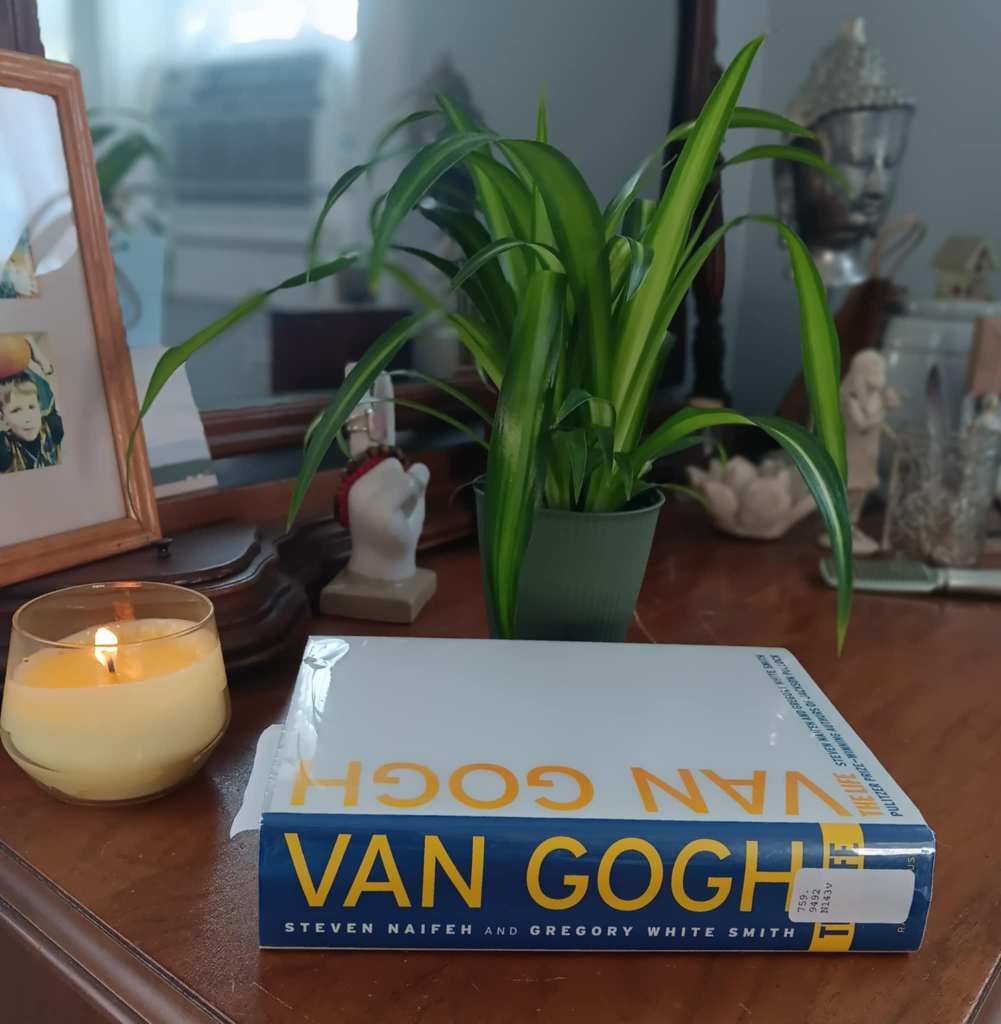
I glanced at the book on my dresser – Van Gogh: The Life – his story calling out in color and ache. But I couldn’t bring myself to open it. I couldn’t carry his sorrow today alongside my own.

I dipped a brush in paint, hoping muscle memory might override the fog. But nothing came out the way I wanted. The colors felt wrong. The strokes were clumsy. The image in my mind never made it to the page.

Still, I pushed through—because it felt like I should accomplish something. I wanted the act of finishing to save me. To prove I hadn’t wasted the day. But the finished piece wasn’t what I’d hoped for. It wasn’t what I needed.

And that’s when the familiar voice crept in—the one that says, Why bother? The one that dresses itself in logic but reeks of loss. The one that pretends to be practical, but is really just grief in disguise.

Because here’s the truth I keep learning. Grief doesn’t need permission. It doesn’t need a trigger or a tidy narrative arc. It doesn’t even need a reason.

Sometimes it’s just Sunday. And sometimes Sunday is enough.

Maybe it’s the echo of all the Sundays that came before. Those restless childhood days when Becca felt a sadness she couldn’t name. She’d act out, and I, not yet knowing how to read the language of her heart, mistook it for misbehavior.

It wasn’t until she was older that I understood: She was never trying to be difficult. She was just feeling too much. She was just being human on a day that always seemed to ache.

And maybe it’s the Sundays I carry from my own memory.  The ones when the boys were little. Sundays when I didn’t have to work, when we could stay in our pajamas too long, when the house was filled with their laughter and bickering and cartoons and pancakes and the soundtrack of a life I loved.

Sundays meant all three of them were with me. No school. No rush. No obligations. Just the soft kind of togetherness that mothers memorize without even meaning to.

But even then, Sunday evenings brought their own kind of grief. Because I knew Monday was coming. They’d go back to school. The world would take them again. And I would miss the way the house felt when we were all inside it, breathing the same air.

So maybe the sadness doesn’t just come from loss. Maybe it also comes from love. From having had something beautiful and knowing what it felt like to hold it. From remembering the sacredness of the ordinary.

And maybe it’s that Sunday too—the one that began just after 2 a.m., with a phone call. A shattering. A dividing line between the life I had and the life I live now.

Even when I don’t consciously think about it, my body remembers. My spirit remembers. And sometimes the weight of remembering outweighs the joy of intention.

That doesn’t mean the morning was a lie. It means that joy and sorrow can live side by side. That a day can begin in light and still gather shadow by nightfall.

And maybe that’s okay.

Maybe all that’s asked of me today is to name it. To say: It shifted. To acknowledge that I did what I could. To forgive the rest.

And to let that be enough.

On The Ones That Are Discarded

A Gentle Warning:
This piece tells the story of a very small life lost far too soon. It includes descriptions of a dying puppy and the emotional toll such losses take. I’ve written it with deep tenderness, but I know how hard these stories can be. If you need to protect your heart today, I understand.

Each of us saw the box as we pulled into the clinic parking lot that morning. Set right at the front door. Not the back, where donations of pop bottles or dog food are usually left. The front door placement felt intentional, like someone needed to leave something behind but couldn’t bear to face what they were doing.

We entered the clinic in silence. My coworker and I locked eyes, and neither of us had to say it aloud: this wasn’t going to be good. We headed through the clinic to the front door and unlocked it. 

You learn to read the signs in this line of work. A sealed cardboard box. No air holes. No note. A little too quiet. Sometimes they hold trash. Sometimes they hold trauma. And sometimes, both.

We went out together. That’s an unspoken rule in vet med—you don’t open death alone. You brace one another. In case it’s a kitten thrown out like garbage. A turtle frozen solid. Or a puppy someone couldn’t be bothered to keep warm.

We opened the flaps. Inside was a mound of old towels, rumpled and damp with the kind of moisture that comes from breath, or fear. She reached in first and slowly picked up a corner. Just enough to peek beneath.

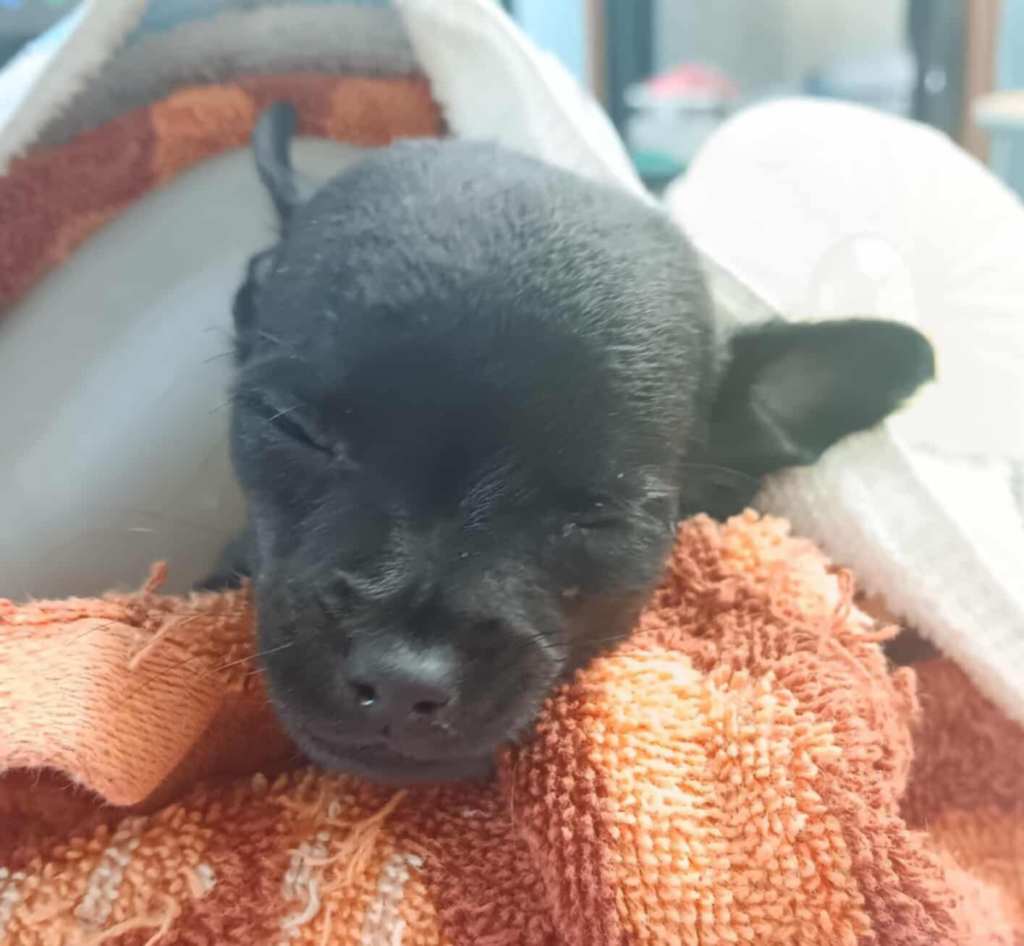
And then – black fur. A tiny tail.

And then – movement.

Just the smallest tremble. A twitch, really. And then, a slow, gentle wag.

That tail moved like it had been waiting for us. Like our voices woke up something that had nearly gone still. It wasn’t frantic. It wasn’t afraid. It was… happy.

That was the moment my throat closed.

“Oh fuck,” I said, because what else do you say when a dying animal greets you like a friend? When the thing you feared was dead is worse—almost dead—and still trusting?

My coworker reached in and lifted him out. I grabbed the box and followed her inside. We didn’t talk much. We didn’t need to. Everyone in the clinic started getting the things ready we needed to save a life. We just moved—fast, practiced, a kind of muscle memory that overrides heartbreak until there’s time to feel it.

In surgery, we laid him on the warming table and unwrapped the towel. And there he was. A miniature black Chihuahua, maybe a month old. Bones pressing sharp beneath thin skin. Eyes dull but still trying to track movement. A body almost out of fight. But still – somehow – alive.

He should’ve been curled up in a nest of littermates, belly full, dreaming about nothing at all. Instead, he was dumped outside a clinic in the dark, left to shiver and fade. Alone.

And still – he wagged his tail. Each of us talked to him. Willing him to stay with us.

We named him Sherman.

It’s the name of the street our clinic sits on, and it was the only thing we could give him that morning besides warmth and presence. But it mattered. No animal should pass unnamed. Unseen. Unloved.

Sherman died surrounded by hands that tried. Hands that moved fast and knew what they were doing, but were still too late. And when he left, I leaned down and kissed the top of his tiny head. His fur was still damp from warming towels. His body impossibly small.

“I’m so sorry,” I whispered. “I’m sorry we couldn’t save you.” Every one of us said our goodbyes to him. 

Then we had to get up.

Because it was minutes before 9 a.m., and the door had to be unlocked. The phones were about to ring. Clients would be arriving with their pets – dogs pulling on leashes, cats in carriers, questions in their eyes, trust in their voices. We didn’t have the time to grieve. There was no room to cry. Not even ten minutes to sit down and let it all land.

So we stood.

We reset our faces. Wiped our hands. And stepped into the day.

For the next seven hours, we kept moving. Cleaned kennels. Drew blood. Trimmed nails. Reassured nervous owners. Checked vitals. Delivered test results. Scheduled surgeries. Celebrated recoveries. Held space for the dying. Smiled. Nodded. Spoke softly.

We did the job.

And inside, we were still holding that box. Still hearing the shuffle of a tail on old towels. Still seeing that tiny flicker of joy in the final minutes of a life discarded.

That’s the hidden part of this work—what we carry between exam rooms. The grief we stuff into pockets so it doesn’t spill in front of clients. The anger we swallow because there’s no space for rage when you’re talking someone through puppy vaccines. The sadness that gets pushed down so far it sometimes takes days to find it again.

Sherman became part of that inner terrain. One more name stitched onto the quiet quilt of losses we never really get to lay down.

Each of us who does this work – this quiet, often invisible labor of care – has to find a way to carry the weight without letting it break us. We don’t always talk about it, but we feel it: in our backs, our bones, our dreams. In the moments between appointments when the room is quiet and we finally exhale.

As for me—pain is a language I already speak. I carry it every day.

But I’ve learned something over the years: some sorrow doesn’t stack heavier on the old grief. Instead, it folds in, becomes part of the whole. My soul doesn’t shatter under the weight—it expands. Makes room. Not because I’m stronger than anyone else, but because I’ve had to. Because there was no other choice but to find space where there wasn’t any.

That doesn’t mean it doesn’t hurt. It does. Deeply.

But I no longer fear the pain. I know how to hold it. I know how to whisper goodbye and still move forward. I know how to bend without breaking.

We go on because they deserve that. Every small life. Every discarded soul. Every wag of a tail that says, I still believe in you.

Sherman’s gone. But he was not unloved. Not unseen. Not unnamed.

He was here. His story is now part of my story. 

And I will remember.

On A Small Kind Of Magic

The next generation held gently in mine.

The house was full. Full of children, full of noise, full of that particular kind of wild that only happens after time spent on the shore of Lake Michigan. They were sun-kissed and overtired, yelling over each other in bursts of joy and complaint. One of the little ones had begun to cry—too much fun always spills over somewhere.

Amid the chaos, I sat quietly, holding a cup in my hands like an anchor. It was one of those moments where the edges blur and something deeper stirs beneath the surface. I watched it all like a woman half in this world and half in another—the chaos around me a blur, the stillness inside me something hard-won. I used to dread moments like this, where joy and absence collided. Now, I just breathe through them.

Gabriel was seated across from me, his shoulders soft with fatigue. Julia, his partner, walked up behind him and wrapped her arms around him. I heard them exchange quiet I-love-yous—just for each other, but not hidden. A small, sacred thing passed between them.

Moments later, Alexa emerged from the kitchen with something she’d made for Matthew. He looked up and said, “Thank you, love,” without hesitation. The kind of love that doesn’t need ceremony. The kind that has settled in, becomes part of the rhythm.

And right then, in the middle of the noise and the movement and the mess of real life, I felt the room bend toward something holy.

The sunlight, low and golden, flickered through the trees and spilled through the window, stretching across the wooden floor. And for a moment, I saw her.

My Becca. Smiling. Standing in that beam of light as if it had carried her in. I didn’t move. I was afraid if I blinked, she’d disappear. But I wasn’t afraid of her. I was afraid of losing the moment.

Her eyes followed the children as they ran and tumbled and squealed through the house. She laughed—not aloud, but with her whole face. I didn’t hear her voice, only the faint melody of a wind chime from outside, like a sound remembered rather than heard.

My breathing slowed. My heartbeat quickened. And then she turned to me.

That smile—her enormous, heart-splitting smile—lit her face like it always had. Like she had never left. Like she was just standing on the other side of time.

And then she was gone. But not really. Not ever.

Later, when the children had calmed and the night began to stretch out soft and tired, I went home. 

Sitting alone in my room I thought: This is what remains. Not just the grief. Not just the missing. But this—the life that still surrounds me, the love that grows, the magic that still dares to show up.

And here’s the part I couldn’t have imagined, years ago: That I’d be able to see it. Because in the early years, I couldn’t.

Grief narrowed my vision to what was gone, what would never be. Every joyful moment was filtered through the ache of Becca’s absence. Her missingness sat at the center of every gathering, louder than the laughter, sharper than the light.

But something changes—not quickly, and not easily. And, more importantly, never completely. 

Over time, grief loosened its grip just enough to let in other things. Love. Laughter. Sunlight. Not instead of Becca, but alongside her.

I didn’t stop grieving. I never will. But I learned to hold both truths at once: That she is gone. And that there is still good.

And in that moment last night—children spinning, love spoken quietly across the room, and Becca in the light—I didn’t just see the beauty. I accepted it.

Not as a betrayal of her memory. But as an offering she would want me to receive.

It’s not that the ache has gone. It never will. But it has made room. And when moments like this arrive—when love spills out of my sons, when my grandchildren’s laughter fills the air, when Becca visits on a beam of sunlight—I don’t brace myself. I open. I accept. And I thank her for staying near.

On The Death Of A Man I Already Grieved

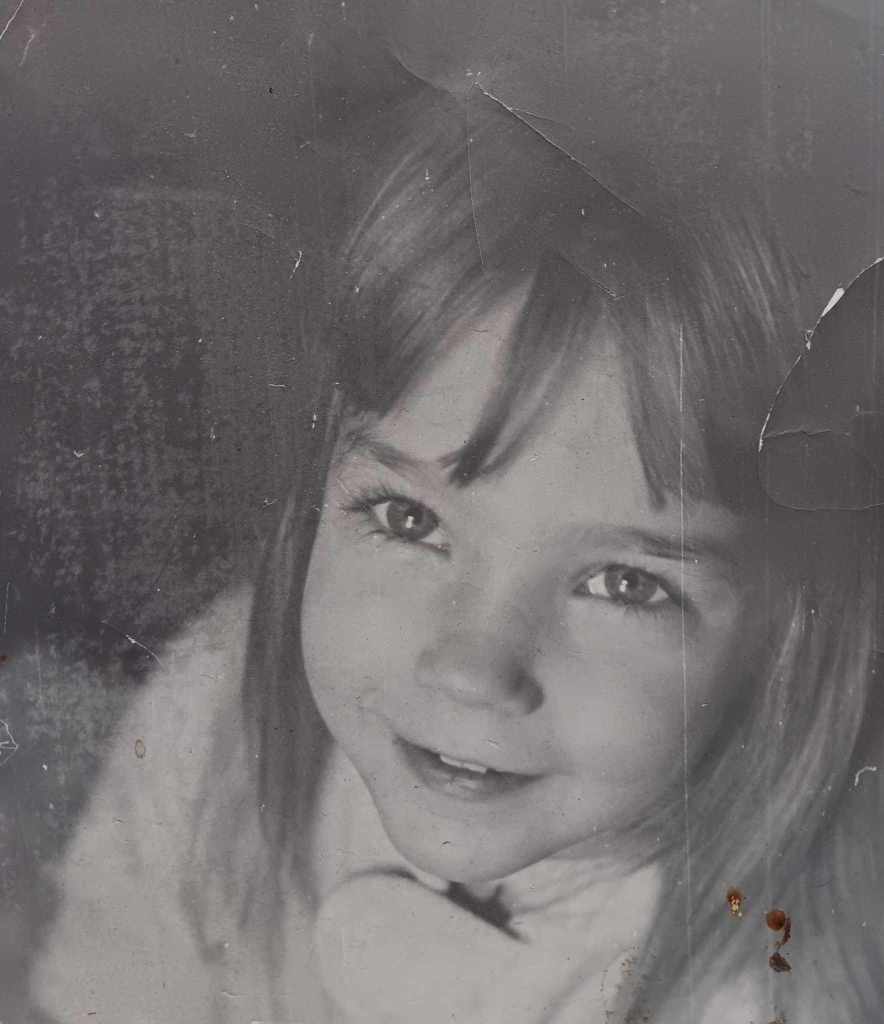
Me, around four years old. Smiling for the camera while carrying things no one yet knew.

When my father died, the grief had already passed through me. Not the grief of losing him—but the grief of never having him in the way a daughter deserves.

The loss wasn’t new. It had begun in my late teen years, deepened in early motherhood, and sealed itself the day I realized silence and blame were his only language.

There was harm. He was physically abusive to me—not as a child, but later, as an adult. He broke my nose more than once. He choked me to the edge of unconsciousness. And each time, I was told it was my fault. That I didn’t know when to be quiet. That I pushed too far. That I brought it on myself.

And even earlier, when my uncle molested me, my parents responded the best way they knew how at the time. They found someone—a student counselor they trusted—and sent me to her. But it didn’t help. Later, when I sought true therapy as an adult, my father raged again.

“Leave the past in the past,” he said. As though silence could erase pain. As though survival meant forgetting.

And then, when Becca died, they swooped in — rushing to offer what they called help.

The truth is, I couldn’t help myself in those early days. I was drowning. But their help wasn’t comfort. It was control. The same old patterns, wearing the costume of concern. And soon enough, their version of help shifted into blame. They held me responsible — for her death, for how I had raised her, for daring to walk a different path than the one they wanted me to walk.

That was the final rupture. A day near the first anniversary of Becca’s death. The day I chose distance was the day I chose life. To protect my sons. To protect what was left of me. To begin again.

But not everything was broken. There was one moment I carry still — a memory that lives untouched by all the rest.

When Becca was born, I had planned to release her for adoption. I believe my parents thought it was the best choice. After her birth, she was taken from me immediately. My father never went to the nursery to see her — I learned later he thought it would be too painful.

But a few weeks later, when I chose to bring her home, everything changed. I rode back with the adoption agency representative, returning to my house in the deep cold of a Michigan January. And as we pulled into the long, snowed-in driveway, I saw him waiting.

He stood near the road, afraid the car carrying his granddaughter might get stuck or slide into the trees. He had never seen her face, but as he lifted the car seat from the back seat, he could hear her soft cooing under the blanket. The air was too frigid to pull it back, so he carried her carefully, listening to the little sounds she made as he walked her up through the snow.

In that moment, he allowed himself to love her. In that moment, there was only the simple, pure act of a grandfather carrying his granddaughter safely home.

When word came that his life was ending, my sons gently asked if I wanted to speak with him. If I needed closure. But I didn’t. The closure had already come—not in words, but in the space I had built between us. I think if you had asked him, it was they, my family, who chose to walk away from me. That’s fine. Maybe it was. 

When he passed, a distant cousin sent a single heart emoji. That was the message. As I told my sons, my throat tightened—not for him, but for the ache of what never was.

There were no tears. The grieving had been done long before. Those were my son’s exact words. “You grieved him a long time ago mom”. 

But as I spoke to each of them I realized this truth:  They are fathers now—present, kind, steady. They are everything he could not be for me. Their children know safety. They know tenderness. They know unconditional love.

The cycle ended with them. And in them, something new grows: The kind of fatherhood that heals what once was broken.

Some grief comes like a sudden storm. Some arrive like a drought you’ve already survived. His death was the latter. But my sons — they are the rain that followed. Proof that love can grow where harm once tried to root itself.

And still — I allow for this:

I know his childhood was hard. Maybe he did the best he could. Maybe not. Maybe he simply failed. But wherever he is now — wherever we all eventually find ourselves — I believe the bigger picture is finally clear to him. He sees his mistakes. He sees mine, too.
 

And I believe this: Becca was there to meet him. Her arms wide open. Because that is who she is.

I hope he has found peace. I truly do.

On The Communion Of Grief

There is a ritual I have come to recognize, and hold dear, among grieving mothers. It is not held in temples or churches or under official signs. It happens in parking lots, across chipped coffee cups, beside hospital beds, in Facebook comment threads at 2 a.m. It happens when you least expect it, but it is entirely appropriate. It happens when one mother says the name of her child, and another doesn’t look away.

Most people do. They look down, or change the subject, or fill the silence with something too bright. I used to take it personally, but now I know—it’s not cruelty. It’s fear. Grief, especially the grief of a mother, terrifies them. 

But every once in a while, grief finds someone who understands.

It happened once while I was working the front desk at the clinic. A woman I knew came in, usually bright and chatty, but that day she was unraveling—red-blotchy face, trembling voice. She tried to hold it together just long enough to buy flea prevention for her dogs.

When I asked gently if she was okay, she stammered. Quietly, like a confession, she said: I lost my son. He committed suicide.

Without thinking, I stood up and walked around the counter. I wrapped my arms around her, right there in the middle of the lobby. People stared. I didn’t care. She mattered. Her loss mattered. She needed someone to hold the weight of it with her, even for a minute. She needed to say his name.

I saw her again about a month later. She thanked me for my kindness, but more than that—for not flinching when she said the word suicide.

She told me how much it meant to be able to say her son’s name without watching someone recoil. I nodded, and told her what I know to be true: You deserve to speak his name.

She reminded me of something I already knew but needed to feel again: we carry the need to speak our children’s names like breath.

We tell the story of our child innumerable times. Again and again and again.

Sometimes I only say, “My daughter died in a crash.” Sometimes I say her name and let it hang. Sometimes, when someone really wants to know, I tell them about the poetry, the joy, the light she left behind. I remember one time in particular—we were on a farm, she was around five, riding on the back of a pony while I led it by the reins. I looked back at her. The wind was blowing her blonde hair, her head thrown back, and she was laughing—that laugh. A whole-body laugh. Pure joy. The kind of joy you don’t forget, even after everything else is gone. I want people to know about my daughter. Not just how she died but how she lived.

We are good at listening, too. Knowing what the other person is willing to hear. We don’t need to take that into consideration when talking to another bereaved mother. 

With them, we don’t have to scan the room for exits. We don’t have to explain why we still cry years later, or why certain dates crush our lungs. We just speak. And they nod. It’s the rarest kind of ease. Grief without apology.

Not because we’re afraid we’ll forget. Not because we haven’t accepted the death of our child. But because the story is what we have left. It’s how we mother, now. It’s how we include our child in our everyday life still. It’s how we survive. 

There’s a rhythm to it—an inhale when we say their name, an exhale when we reach the moment they left. Some of us tell it with clinical precision, like an autopsy report. Others spin it like poetry, fractured and strange. Some cry every time. Some haven’t cried in years. But we all need to tell it.

Because grief unspoken calcifies. Because their life deserves an audience. Because silence is too heavy to carry alone.

When another mother listens—really listens—not with sympathy but with knowing, something sacred passes between us. We become witnesses for each other. We say: Yes, I hear you. Yes, that was real.

Being witnessed doesn’t undo the grief. It doesn’t fix it. But it makes it bearable. It makes it human. It reminds me I’m not just a mother who lost a child—I’m still Becca’s mother. I’m still here. 

We are midwives to memories. Midwives don’t just deliver—they guard, soothe, hold steady when the pain comes. So do we. We breathe with each other through the contractions of memory. We place gentle hands on old wounds to remind each other we’re still here, still real. We whisper, You’re not alone. You can do this. I’m right here. And when the story breaks open again, we help gather the pieces, wrap them in warmth, and say, Look. Look what love made.

And in the telling, a tiny burden lifts. The story never gets lighter. But we get stronger from the lifting.

And when I tell Becca’s story—when I speak her name into a world that keeps moving forward without her—I am drawing her back into it. Not as a ghost, not as a shadow, but as a force. A daughter. A person who was and is, because I remember.

Because I say her name.

Because I tell the story

And because I tell it, she remains.

On The Love That Outlives Safety

This photo was taken just hours before her life was taken. I share it not to mourn what was lost, but to honor who she was.

She was five the first time she disappeared. Just long enough for my body to forget how to breathe. Just long enough to taste what it might mean to lose her. I got her back that day. Years later, I wouldn’t.

I was at work when I was told I had an important phone call. Panic didn’t set in until the new babysitter said Becca had never made it to her house after school. This was a babysitter Becca had met her a few times. She’d been at the house once. She was to be dropped off at the front door by the school bus. For whatever reason . . . this failed to happen.

This was the first time I knew: the world would not keep my child safe. 

Hurried phone calls were made. From the bus garage I learned the driver had not let my daughter off in front of the babysitter’s house as was the normal protocol. Instead, she let a five year old get off the bus at an intersection more than half a block from where she needed to be. The driver did not tell my child which direction to go. The bus door was shut and the driver pulled away. Leaving a scared confused little girl standing vulnerably at a busy crossroads.

All I could see in my mind was the smallness of a five-year-old girl and the indifference of a school bus door shutting behind her. My hands trembled as I hung up the phone, only to pick it back up and dial the police.

I was frantic. Words spilled out in the wrong order—too many at once, none of them calm. It took a full minute before the voice on the other end could piece together what I was trying to say.

Officers would be dispatched immediately, I was told.

But that didn’t bring peace.

My daughter had been missing for nearly an hour. That meant she’d been wandering—alone, scared—for far too long.

It was a teenage girl who saved her.

Walking home from school, she saw my daughter—small, crying, and clearly lost. She didn’t ignore the scene. She didn’t keep walking. She took Becca’s hand and walked her slowly through the neighborhood, up and down the streets, until they came upon the right house.

A police car was parked out front.

The moment they saw my daughter, they knew it was her. The clothes matched the description I had given them. A puffy pink winter jacket with fur. White boots. She was safe.

Later, Becca told me a man had pulled up in a car and asked her to get in. Said he would help her find the house.

She didn’t get in.

To this day, I don’t know if he meant to help or if something darker lived behind that invitation. I try not to let my mind go there, but it does.

Two hours passed from the time the bus driver let her off to the moment she was found.

Two long hours when it was hard to breathe. Hard to move. Hard to speak.

One hundred and twenty minutes in which I did not know if my daughter was dead or alive. Or whether I would ever see her again.

I got her back that first time.

I wrapped her in my arms and promised she was safe now. That I would never let anything happen to her again.

But safety is a fragile thing. It only stretches so far.

There would come another day. Another phone call. Another stretch of time where I didn’t know if my daughter was dead or alive.

Forty-five minutes. Not as long as those two hours when she was five, but infinitely heavier.

Because part of me already knew.

I knew she was in trouble. I knew it was bad. But until someone said the words out loud—until they confirmed it was her—there was still that small, desperate hope. The kind that gasps for breath. The kind that claws at time. The kind that doesn’t survive the truth.

I kept her safe when she was small. I fed her, clothed her, and taught her to look both ways. But I could not teach the world to love her the way I did. I could not make it hold her life as sacred.

I knew this wasn’t going to end like it had when she was five.

That night, unease wrapped itself around me and wouldn’t let go. I couldn’t name it, but something inside me knew: something was about to happen, and it would change my life. Irreversibly.

The call came in the early morning hours.

But before the phone ever rang, I felt her.

Becca sat on the side of my bed and stroked my leg the way she always did when she wanted to wake me gently. I stirred, confused—why would she have come over in the middle of the night?

I opened my eyes, expecting to see her. Expecting the outline of her body, the glow of the hallway light behind her.

But there was no one there. No shape. No shadow. Only the certainty of her presence.

I could feel her. I could smell her.  She had touched me. And I knew.

I sat up in bed, searching for her. But I already knew I wouldn’t find her there.

The air was too still. The silence too loud. And then I looked at the phone. The message light was blinking. That blinking light. It felt like a countdown. Like the final seconds before the world collapsed.

The message was from my parents.

“Becca’s been in a crash,” my mother said, her voice uneven. “And it doesn’t look good.”

I would later learn that another driver had seen the accident and ran to help. He reached the car, saw her, and knew she was beyond help. She was already gone.

He found her phone and pressed redial. The last number she had called. My parents.

I can’t explain why, but I find comfort in that – that one of the last things her phone did was reach for the people who loved her. That someone was there, even for a moment, trying to reach back.

Again, I found myself in a space of time when I didn’t know, for certain, if my daughter was alive.
A stretch of minutes where I held that fragile hope like I had eighteen years earlier, when she was a lost child.

Hope is cruel in those moments. But it’s all we have. Hope keeps you upright, even when it rips through your insides like glass.

It asks you to imagine your child still breathing. And then punishes you when she’s not.

There’s something that happens to a mother’s body when she spends time in that liminal space. Between the not-knowing and the knowing. Between she might still be alive and she is dead.

It rewires you.

Something primal stretches thin. The nerves stay coiled. The heart never really goes back to beating in rhythm with the world.

After the first time, when she was five and lost, I learned that safety is a myth. That all it takes is one careless act – a bus door closing too soon, a turn in the wrong direction—for everything to unravel.

After the second time, when she was killed, I stopped believing the world cared about keeping anyone safe at all. 

I walk through life differently now. Suspicion hums under the surface. Joy feels like a dare.
Trust has to be earned in ways I can’t always explain.

The truth is:

Even when everything looks okay – even when the sun is shining and the news is good and the children are laughing – my body is always half-ready to grieve again.

It’s not anxiety. It’s memory. A memory so deep it lives in my marrow.

Because I have stood in that unbearable place where a phone might ring and everything might end.

After she was found at five, I never again assumed she’d be safe just because she was supposed to be. After she died, I never again believed the world had any interest in protecting what I loved.

Grieving mothers wait. We wait for hope to return only to feel it slip through our fingers like mercury – impossible to hold. Impossible to let go. 

I’m sorry I didn’t keep you safe my Becca. 

But I never stopped loving you with every part of me that remains.

On The Things I Say Instead Of Telling You My Daughter Is Dead

Unfiltered survival. Taken on a night I didn’t know how to keep going—but did anyway. Image credit: Diane Neas

Note to the reader: This piece is about the coded ways grieving mothers speak. It’s about what we say to survive the unbearable, and what we leave unsaid. If you’ve lost a child, I hope this helps you feel less alone. If you haven’t, I hope you’ll read with an open heart.


I have a list of answers I give when someone asks me how I am doing. They vary depending on how close to the surface my grief is that day. Well, truthfully, it’s always just beneath my skin like a bruise that never fades. Press too hard and it pulses to the surface.

I say “fine,” even when I’m not.

I say “hanging in there,” even when I’m unraveling. 

I say “stabilized, eating, eliminating”. That is considered a good outcome in the animal world. 

I say “living, laughing, loving,” and you laugh, which is the goal—because if you laugh, you won’t ask what I really mean.

I have an entire vocabulary now. Most bereaved mothers have learned this language. One that says just enough to end the conversation, but not so much that it opens us wide.

Because the truth? The truth is that she died. And I didn’t.

And I still don’t know what to do with that.

So instead, I answer in code. I give you the version of me you can handle. I’ve learned to protect your comfort at the cost of my truth. Because if I told you what it’s really like…you would never ask again.

But I’m protecting myself, too. There are days when telling the truth would cause me to implode on the spot. Days when I’m just trying to make it from sunup to sundown. I’m not lying to you. I’m giving myself space to take a breath.

When I say “alive” I mean: unwilling to die even if I wanted to. 

When I reply “functional” I mean: still broken but making it through.

When I sarcastically say “living, laughing, loving”  I mean: I’m not doing any of those things right now. Or maybe I am, but not in the way you think. Not the Hallmark version. This is survival with a grimace, not a glow. This is gallows humor in a forced lighthearted tone. 

So you can laugh, not be uncomfortable and I can stay hidden. 

Most people don’t want to know that children die. That love isn’t always enough. If they let it in—even for a moment—it would ruin the myth that our children are safe. That we can protect them. That we’re in control.

As much as I wish that were true… it simply isn’t.

And that truth is so devastatingly huge, so unbearable, that most people have no choice but to ignore it. Because how could anyone live every moment of every day waiting for their child to die?

I live on the other side of that coin. I am waiting for my child to come back to life.

Child loss grief isn’t tidy. It isn’t neat. It’s infinite. All consuming. Not to say other deaths don’t shake us. They do. But the death of a child tears through the center of our lives. It shatters the order we were promised. The order we were prepared to follow.  

And our society doesn’t do well with grief, either. Friends, neighbors, coworkers, even well-meaning strangers – they want us to be done with it. They want us back to normal. Quickly. Quietly. Without disrupting the world around us too much. Or, maybe more accurately, without touching their world for any length of time. As if, somehow, child death is contagious. 

As if proximity to our sorrow might summon tragedy of their own.

We are the cautionary tale no one wants to hear. The proof that it can happen. The walking reminder that love doesn’t guarantee survival.

We are the poster parents for dead children. We are what happens when the nightmare doesn’t end, when there’s no miracle, no second chance, no waking up.

When the life you lived with your child has come to its unnatural end.

Then comes the quiet aftermath. People stop asking—at least, not in the way they used to.
They stop wondering how you’re doing in this new life. Because they can’t hear it.

To truly listen would make it tangible. And they don’t want to know.

To hear it again—to really hear it—feels heavy to them.
Too much.
Too dark.
Too real.

To ask is to invite the specter of child death into their lives,
as if their own child might be noticed and taken.

We are wreckage that still breathes. We are left in a darkened theater, the spotlight fades, and we clutch our child’s life story to our chest. 

Still, we get up. We feed the pets. We answer emails. We smile at the barista. We make it to work. We carry our grief like an extra organ. Heavy, but vital. And we find strange, sacred comfort in others who carry it, too. Not because we’re healing, exactly—but because we’re still here. And being here means something. It has to.

Eventually, people start asking again – but differently. The urgency fades. The specificity disappears. You’re no longer asked how you are in relation to the death of your child. You’re asked the way we ask a dozen people in a single day.

“How are you?”

Like there’s only one possible answer.  Like the biggest thing that ever happened to you isn’t sitting right behind your eyes, waiting. So, instead of being honest, we speak in our code. Speaking in code is its own kind of fluency. 

And sometimes – on the rare, quiet days – we say “fine,” and it’s almost true.

Not because the grief is gone, but because, for a moment, it isn’t the loudest thing in the room. 

And, that too, is survival.

If this resonated with you:
I see you. Whether you’re speaking in code or holding your story in silence, you are not alone. Take your time. Grief has no outline you need to follow.

On The Quiet Work Of Still Mothering

Mothering doesn’t stop after the death of a child. It simply shifts into a kind of prayer. We find a way to carry love beyond the edges of this life.

Their life begins with us in the most intimate way, and sometimes, it ends this way, too. Even when death separates us, nothing can sever the otherworldly tether. Our bodies knew theirs. Our hearts shaped theirs. That intimacy doesn’t end—it just becomes invisible to everyone else.

After she died, my mothering didn’t disappear. It just had nowhere to go.

I didn’t realize this for a long time. That deep need to keep mothering my deceased child was all-consuming. I went from expansive, all-encompassing mothering to the implosion of that care after loss—and the desperate need to put it somewhere.

Before, mothering was in everything: meals, plans, worries, dreams. Death collapses all that vastness. And when it does, the absence doesn’t feel quiet—it feels feral. This can feel like madness. It did for me.

Without knowing I was doing it, I began creating a space where I could still care for my daughter. It started with a simple instinct—the same quiet rhythm I once used to fold her clothes or lay out her favorite books beside her bed. I began gathering things. Placing them near her urn. Not with ceremony, just with care.

Little by little, a kind of altar formed. Not to worship. Not to heal. Just to keep mothering.

In my home, I’ve made a small altar for Becca. It sits on my dresser. 

Her urn is marble—cool, smooth, solid. It rests behind a photo of her as a little girl, maybe three years old, with her sweet, mushy lips and soft cheeks. Just looking at it makes my heart skip. Her glasses are nestled at the bottom of the frame. A gift from a friend, the angels on the frame cradle her image like a relic.

To the left is a mason jar filled with fairy lights. I turn them on for her when the nights feel heavy. Behind it stands a white metal statue of a young girl with wings, a bird resting in her hand. My sister gave it to me, saying it reminded her of Becca. We don’t speak anymore, but I’ve kept the statue. Some things still belong.

There’s a peaceful Buddha head that sits nearby—not for religion, but for the sense of calm it offers me when I look at it. On top of her urn is a tiny ladybug house she received as a gift when she was young. Next to that there is a small smooth stone I brought home from Sicily. I know she was there with me. 

There’s also a delicate, flower-shaped votive holder. I don’t use it for candles. I tuck inside it the jewelry I’ve been given by my children—gifts from the ones still here, resting beside the one who isn’t.

Behind it, there’s a tiny glass jar filled with cat whiskers. I can’t seem to throw them away. When I find one, I keep it. I don’t fully know why—but it feels like something sacred. Something she’d understand.

This is one of the ways I keep mothering.

I mother through my work, too—through the animals I care for, especially the ones who have been hurt or forgotten. I mother in quiet, invisible ways every day.

But this… this is different.

This is the intimate space between mother and daughter. The one place where I am still doing only for her. No one else. Just her. Just me. Just love that hasn’t stopped.

I’m not the only mother who does this. We all find our own ways to keep mothering.

Some visit their child’s grave weekly, sometimes daily, tending the space as carefully as they once tended their child’s room. I’ve seen mothers kneel beside headstones, gently scrubbing away moss with water and a soft cloth, whispering as they work. Sometimes they lie down on the earth itself—stretching their bodies across the grass, as if to wrap themselves around the child who rests below.

Others return to the place where their child took their last breath—a roadside, a quiet clearing, a stretch of sidewalk—and turn it into a sacred place. Flowers are left. Rocks are painted. Names are written again and again. These places, transformed by love and grief, say: You were here. You mattered. You still do.

These acts may seem small to outsiders. But they are essential. They give us something to hold. Something to clean. Something to protect. A place for our hands to go when our arms are empty.

One does not simply stop being a mother when the child is gone. That’s one of the hardest truths of child loss—we are still mothers, just with no child to mother in the ways the world recognizes.

We are left with silence in the space our child once filled. A silence so loud it can feel like it might break us. And into that silence, we pour what remains of our care. We light candles. We straighten photos. We gather little trinkets, or brush leaves off gravestones, or place our hands on the earth and whisper, I’m still here. I will always be here.

This is not denial. It’s not unhealthy. It is love, made visible.

Continuing to mother after death is not holding on too tightly. It is holding on rightly—to the truth that love does not end when life does. And so we build our small altars. We tend them as we once tended scraped knees and tangled hair. They are not substitutes. They are sacred spaces where we place the mothering that still lives in us.

And in doing so, we remember: we are not alone in this.

All over the world, in quiet corners and sacred places, other mothers are still mothering too. There are small altars. Sacred shelves. Sun-warmed headstones. Jars of buttons. Half-folded blankets. Unopened birthday cards. There are mothers who tuck notes into the soil, who leave offerings at crash sites, who talk to the sky in whispers only their child would recognize.

We each find our own way. We create places where our mothering can still live. Places where we can do, when so much was taken. Places where we can say, again and again, I remember. I still love you. I always will.

These acts may be quiet. They may be unseen. But they are not small.

They are the threads that keep us tethered—not just to our children, but to ourselves. And to each other.

This is how we keep mothering.