On Care That Doesn’t Save

Reader note: This essay addresses animal injury and end-of-life care.
Photograph by the author.


I couldn’t believe what I was seeing—a tiny animal moving near the curb. I swore out loud, because I already knew it wouldn’t end well.

I believe that when you see an animal in need, it becomes your responsibility to respond. You don’t get to turn away. Maybe that’s why dying things find me. Or maybe they’re placed in my path.

Late last summer, during an unbearable heatwave, I was driving home from a long day at the clinic. Sick animals, a euthanasia, broken air conditioning—everything had frayed me thin. I just wanted to go home. I didn’t have the emotional energy to deal with another animal in need. Instead of passing by and doing nothing, I rounded the block and came back.

Before I even reached the street, I saw the remains of a rabbit nest dragged across a freshly mowed strip of lawn between the sidewalk and the road. I was immediately angry. Someone had to have seen it—if not before, then after—and still left its inhabitants scattered and helpless.

Before I could do anything, a crow swooped down, picked up a squirming baby bunny in its beak, and flew into a nearby tree. It settled on a branch beside another crow. I turned away before I had to witness what would happen next. I yelled. I started to cry.

Frantic, I searched the grass and didn’t see any other babies. Then I peered over the edge of the curb into the street, where I’d first noticed movement. One tiny rabbit was still alive, trying to right itself. Afraid the second crow would spot it, I scooped it up and wrapped it in the hem of my scrub top. It was covered in ants. Blood trickled from its nose. Both eyes were missing. I knew it wasn’t going to live.

I could have left it there, or I could take it with me—to the clinic—and help it pass quickly and completely.

I called the vet and told her what had happened. She wasn’t there anymore, but she told me to meet her back at the clinic. The fact that she came back speaks volumes about her integrity.

During the drive, I wailed. I told the baby I was sorry it would never get to live its life. I cried for the one carried away by the crow. I cried for the others I knew must have been in the nest, too.

When I arrived, my coworker had turned on the surgery table so it was warm—maybe comforting. We laid the baby down. The vet examined him. Breathing was labored and uneven. We all knew. She prepared the euthanasia solution and injected it. The three of us stood quietly around the table, hands resting on or near him. Tears fell. We waited. We listened for a heartbeat. He was gone.

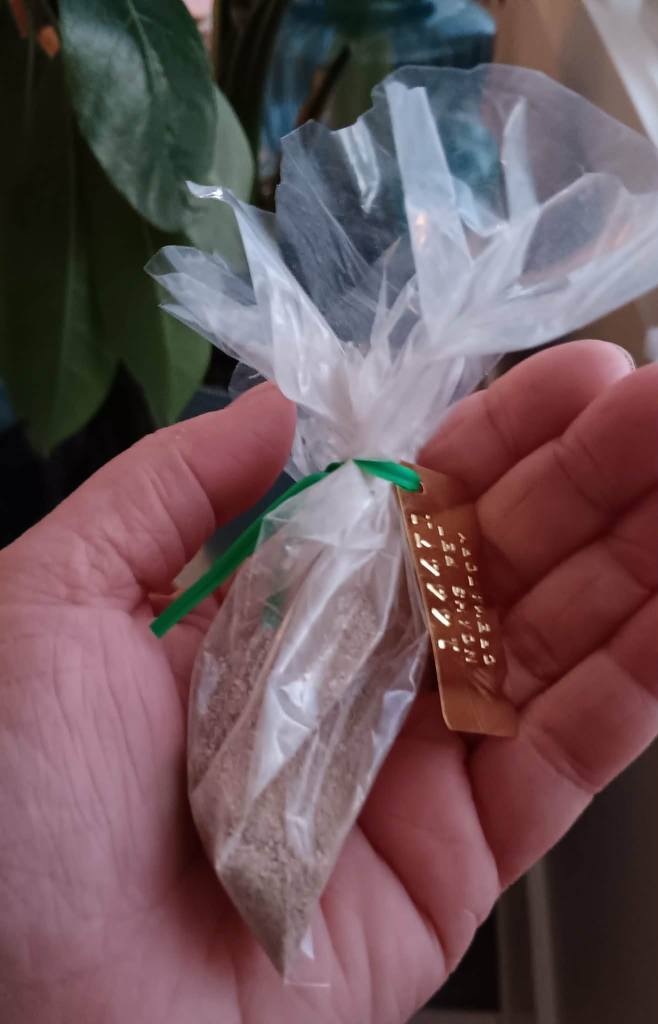
My coworker prepared his body for cremation. I didn’t know she’d requested the ashes be returned. When they came back, the label read: Steve — baby bunny. She had cared enough to give him a name. I brought him home.

The bag inside the tin held the smallest amount of ashes I have ever seen. They fit easily into the palm of my hand. They’re still on my dresser, next to my daughter’s ashes. I had planned to scatter the bunny’s ashes under some flowers, but part of me felt I was rushing his life into and out of mine too quickly.

I needed him to exist a little longer.

I had planned to scatter my daughter’s ashes, too. That was always the intention. It’s been nearly twenty years, and I still can’t. I know she isn’t in the urn. I know the rabbit isn’t in the tin. But I can’t. Not yet.

This spring, I plan to buy a flowering bush and plant it over the bunny’s ashes, placing a small stone rabbit nearby. No one else will know he’s there. But I will.

The earth held his body once before, in the nest. It will hold him again. There is something right about that—about returning him to the ground that tried, briefly, to keep him alive.
On The Ones That Are Discarded

A Gentle Warning:
This piece tells the story of a very small life lost far too soon. It includes descriptions of a dying puppy and the emotional toll such losses take. I’ve written it with deep tenderness, but I know how hard these stories can be. If you need to protect your heart today, I understand.

Each of us saw the box as we pulled into the clinic parking lot that morning. Set right at the front door. Not the back, where donations of pop bottles or dog food are usually left. The front door placement felt intentional, like someone needed to leave something behind but couldn’t bear to face what they were doing.

We entered the clinic in silence. My coworker and I locked eyes, and neither of us had to say it aloud: this wasn’t going to be good. We headed through the clinic to the front door and unlocked it. 

You learn to read the signs in this line of work. A sealed cardboard box. No air holes. No note. A little too quiet. Sometimes they hold trash. Sometimes they hold trauma. And sometimes, both.

We went out together. That’s an unspoken rule in vet med—you don’t open death alone. You brace one another. In case it’s a kitten thrown out like garbage. A turtle frozen solid. Or a puppy someone couldn’t be bothered to keep warm.

We opened the flaps. Inside was a mound of old towels, rumpled and damp with the kind of moisture that comes from breath, or fear. She reached in first and slowly picked up a corner. Just enough to peek beneath.

And then – black fur. A tiny tail.

And then – movement.

Just the smallest tremble. A twitch, really. And then, a slow, gentle wag.

That tail moved like it had been waiting for us. Like our voices woke up something that had nearly gone still. It wasn’t frantic. It wasn’t afraid. It was… happy.

That was the moment my throat closed.

“Oh fuck,” I said, because what else do you say when a dying animal greets you like a friend? When the thing you feared was dead is worse—almost dead—and still trusting?

My coworker reached in and lifted him out. I grabbed the box and followed her inside. We didn’t talk much. We didn’t need to. Everyone in the clinic started getting the things ready we needed to save a life. We just moved—fast, practiced, a kind of muscle memory that overrides heartbreak until there’s time to feel it.

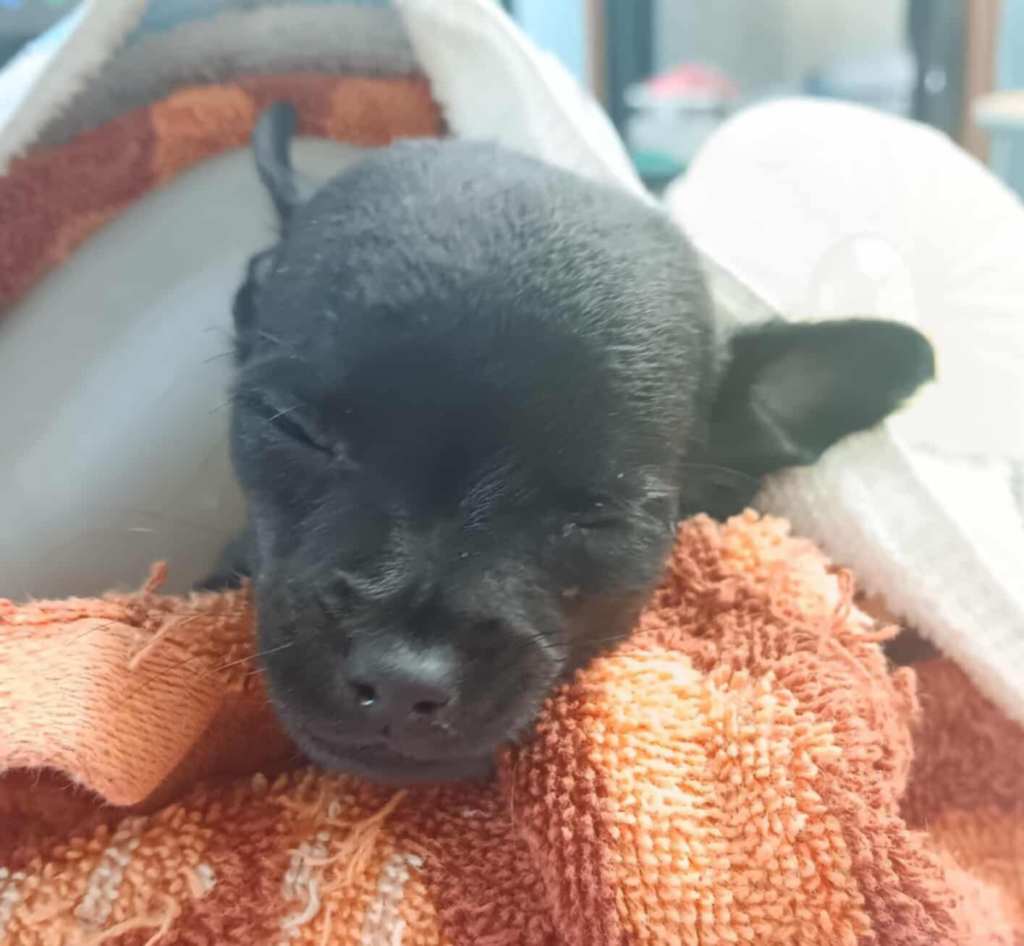
In surgery, we laid him on the warming table and unwrapped the towel. And there he was. A miniature black Chihuahua, maybe a month old. Bones pressing sharp beneath thin skin. Eyes dull but still trying to track movement. A body almost out of fight. But still – somehow – alive.

He should’ve been curled up in a nest of littermates, belly full, dreaming about nothing at all. Instead, he was dumped outside a clinic in the dark, left to shiver and fade. Alone.

And still – he wagged his tail. Each of us talked to him. Willing him to stay with us.

We named him Sherman.

It’s the name of the street our clinic sits on, and it was the only thing we could give him that morning besides warmth and presence. But it mattered. No animal should pass unnamed. Unseen. Unloved.

Sherman died surrounded by hands that tried. Hands that moved fast and knew what they were doing, but were still too late. And when he left, I leaned down and kissed the top of his tiny head. His fur was still damp from warming towels. His body impossibly small.

“I’m so sorry,” I whispered. “I’m sorry we couldn’t save you.” Every one of us said our goodbyes to him. 

Then we had to get up.

Because it was minutes before 9 a.m., and the door had to be unlocked. The phones were about to ring. Clients would be arriving with their pets – dogs pulling on leashes, cats in carriers, questions in their eyes, trust in their voices. We didn’t have the time to grieve. There was no room to cry. Not even ten minutes to sit down and let it all land.

So we stood.

We reset our faces. Wiped our hands. And stepped into the day.

For the next seven hours, we kept moving. Cleaned kennels. Drew blood. Trimmed nails. Reassured nervous owners. Checked vitals. Delivered test results. Scheduled surgeries. Celebrated recoveries. Held space for the dying. Smiled. Nodded. Spoke softly.

We did the job.

And inside, we were still holding that box. Still hearing the shuffle of a tail on old towels. Still seeing that tiny flicker of joy in the final minutes of a life discarded.

That’s the hidden part of this work—what we carry between exam rooms. The grief we stuff into pockets so it doesn’t spill in front of clients. The anger we swallow because there’s no space for rage when you’re talking someone through puppy vaccines. The sadness that gets pushed down so far it sometimes takes days to find it again.

Sherman became part of that inner terrain. One more name stitched onto the quiet quilt of losses we never really get to lay down.

Each of us who does this work – this quiet, often invisible labor of care – has to find a way to carry the weight without letting it break us. We don’t always talk about it, but we feel it: in our backs, our bones, our dreams. In the moments between appointments when the room is quiet and we finally exhale.

As for me—pain is a language I already speak. I carry it every day.

But I’ve learned something over the years: some sorrow doesn’t stack heavier on the old grief. Instead, it folds in, becomes part of the whole. My soul doesn’t shatter under the weight—it expands. Makes room. Not because I’m stronger than anyone else, but because I’ve had to. Because there was no other choice but to find space where there wasn’t any.

That doesn’t mean it doesn’t hurt. It does. Deeply.

But I no longer fear the pain. I know how to hold it. I know how to whisper goodbye and still move forward. I know how to bend without breaking.

We go on because they deserve that. Every small life. Every discarded soul. Every wag of a tail that says, I still believe in you.

Sherman’s gone. But he was not unloved. Not unseen. Not unnamed.

He was here. His story is now part of my story. 

And I will remember.