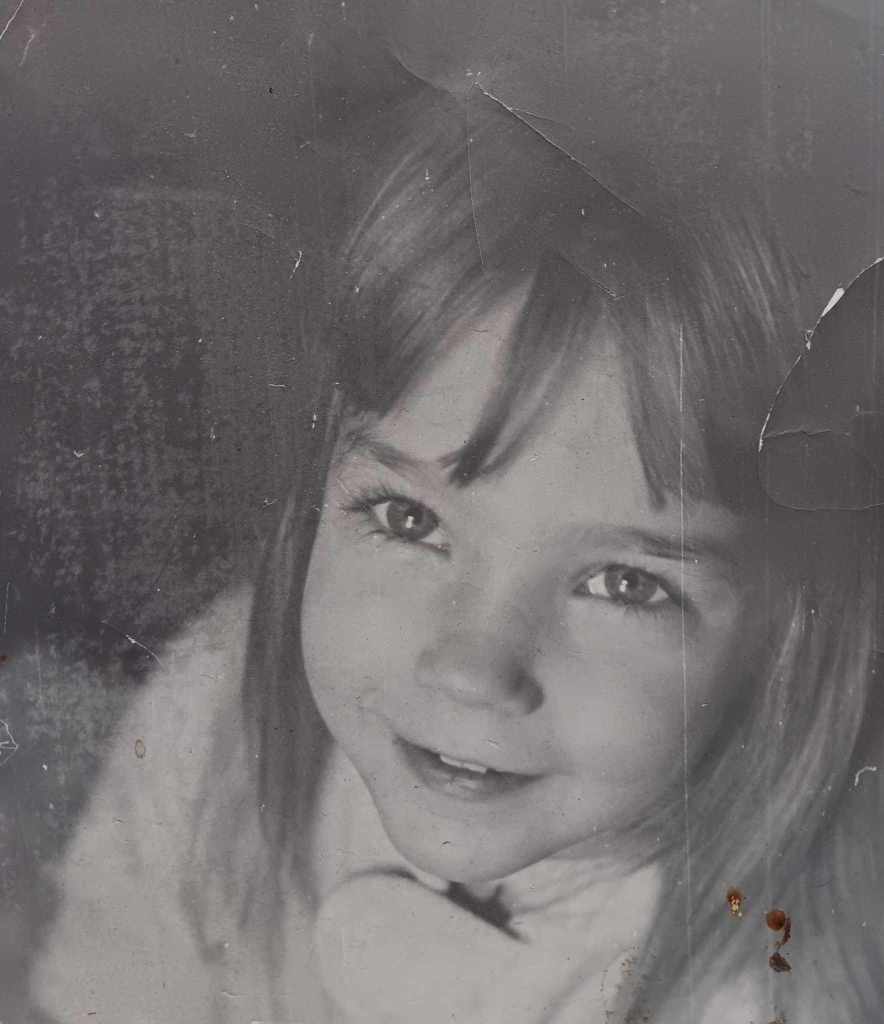
Me, around four years old. Smiling for the camera while carrying things no one yet knew.
When my father died, the grief had already passed through me. Not the grief of losing him—but the grief of never having him in the way a daughter deserves.
The loss wasn’t new. It had begun in my late teen years, deepened in early motherhood, and sealed itself the day I realized silence and blame were his only language.
There was harm. He was physically abusive to me—not as a child, but later, as an adult. He broke my nose more than once. He choked me to the edge of unconsciousness. And each time, I was told it was my fault. That I didn’t know when to be quiet. That I pushed too far. That I brought it on myself.
And even earlier, when my uncle molested me, my parents responded the best way they knew how at the time. They found someone—a student counselor they trusted—and sent me to her. But it didn’t help. Later, when I sought true therapy as an adult, my father raged again.
“Leave the past in the past,” he said. As though silence could erase pain. As though survival meant forgetting.
And then, when Becca died, they swooped in — rushing to offer what they called help.
The truth is, I couldn’t help myself in those early days. I was drowning. But their help wasn’t comfort. It was control. The same old patterns, wearing the costume of concern. And soon enough, their version of help shifted into blame. They held me responsible — for her death, for how I had raised her, for daring to walk a different path than the one they wanted me to walk.
That was the final rupture. A day near the first anniversary of Becca’s death. The day I chose distance was the day I chose life. To protect my sons. To protect what was left of me. To begin again.
But not everything was broken. There was one moment I carry still — a memory that lives untouched by all the rest.
When Becca was born, I had planned to release her for adoption. I believe my parents thought it was the best choice. After her birth, she was taken from me immediately. My father never went to the nursery to see her — I learned later he thought it would be too painful.
But a few weeks later, when I chose to bring her home, everything changed. I rode back with the adoption agency representative, returning to my house in the deep cold of a Michigan January. And as we pulled into the long, snowed-in driveway, I saw him waiting.
He stood near the road, afraid the car carrying his granddaughter might get stuck or slide into the trees. He had never seen her face, but as he lifted the car seat from the back seat, he could hear her soft cooing under the blanket. The air was too frigid to pull it back, so he carried her carefully, listening to the little sounds she made as he walked her up through the snow.
In that moment, he allowed himself to love her. In that moment, there was only the simple, pure act of a grandfather carrying his granddaughter safely home.
When word came that his life was ending, my sons gently asked if I wanted to speak with him. If I needed closure. But I didn’t. The closure had already come—not in words, but in the space I had built between us. I think if you had asked him, it was they, my family, who chose to walk away from me. That’s fine. Maybe it was.
When he passed, a distant cousin sent a single heart emoji. That was the message. As I told my sons, my throat tightened—not for him, but for the ache of what never was.
There were no tears. The grieving had been done long before. Those were my son’s exact words. “You grieved him a long time ago mom”.
But as I spoke to each of them I realized this truth: They are fathers now—present, kind, steady. They are everything he could not be for me. Their children know safety. They know tenderness. They know unconditional love.
The cycle ended with them. And in them, something new grows: The kind of fatherhood that heals what once was broken.
Some grief comes like a sudden storm. Some arrive like a drought you’ve already survived. His death was the latter. But my sons — they are the rain that followed. Proof that love can grow where harm once tried to root itself.
And still — I allow for this:
I know his childhood was hard. Maybe he did the best he could. Maybe not. Maybe he simply failed. But wherever he is now — wherever we all eventually find ourselves — I believe the bigger picture is finally clear to him. He sees his mistakes. He sees mine, too.
And I believe this: Becca was there to meet him. Her arms wide open. Because that is who she is.
I hope he has found peace. I truly do.
 Words Can Express