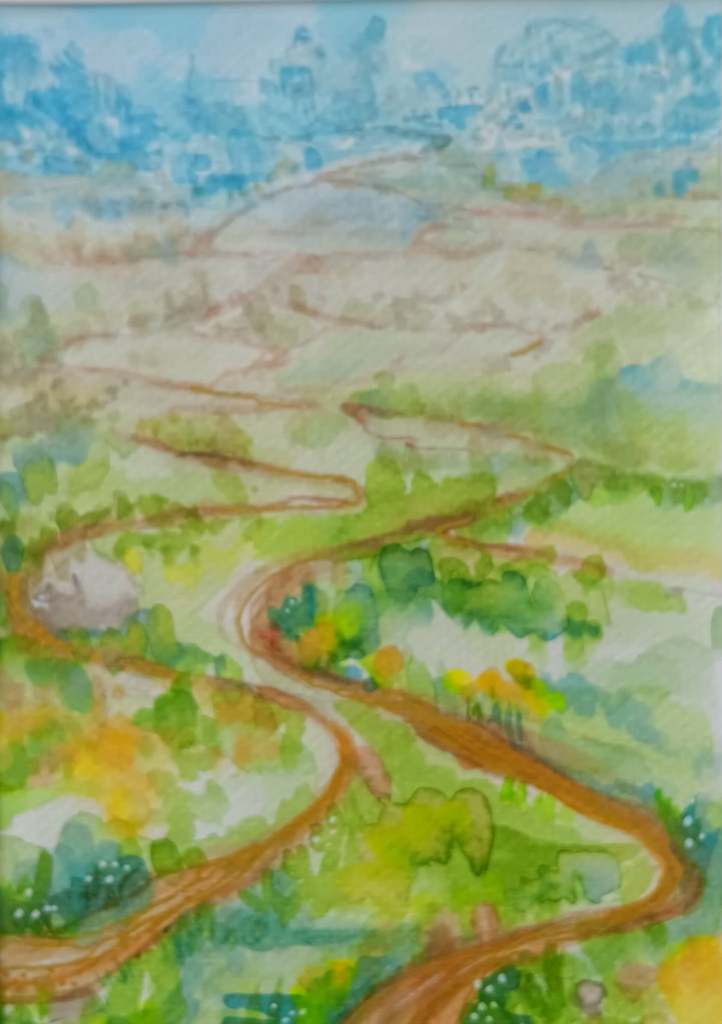
Original watercolor study by the author for a larger painting.
As I enter the nineteenth year of living without my daughter, I took a moment to look back at the landscape behind me. From where I stood, I could see the distance I’ve traveled since this journey began. I could see other things, too.
On the horizon, the skyline of my former world still rises. Not as it once was, but as it remains. The skeletal dome of a grand building. The bases of structures that once held entire lives. The outline of something magnificent, now hollowed. The smoke has long since cleared. The dust has settled. What’s left are ruins—quiet, stable, undeniable.
Closer in, the destruction is more intimate. A section of wall without a room attached to it. A doorway twisted slightly out of true, opening into nothing. These are the remnants I once moved among, back when looking up was still impossible. They no longer threaten collapse. They simply exist. Like a ghost, the old world remains—visible if I turn my head, no longer pulling me toward it.
Laid out below me are the paths I have traveled. Seen from this distance, they no longer resemble lines on a map, but something more like a tapestry—its pattern only visible now that enough thread has been laid down.
Closest to the ruins, the weave is rough and uneven. These are the rocky paths that lead out of the detonation zone, their direction dictated by damage rather than intention. Some of these paths end abruptly, blocked by debris I could never move. Entire directions closed off to me from the beginning. Not because I lacked will, but because the passage simply no longer existed.
Other paths continue for a while before thinning. The vegetation has begun to reclaim them—not thick enough yet to erase their shape, but the growth signals they are no longer meant to be walked. They carried me only so far. I can still trace their outline, still recognize where I once stepped, even as they quietly return to the land.
Then there are the paths that appeared without warning. The ones that don’t follow logic or planning, but necessity. Like the shortcuts pedestrians make across grass when the designed walkways fail them. These routes sprang up where no road had been intended. Awkward at first. Barely visible. Born of urgency, not choice.
Farther out, I can see walkways that were once wild and unknown to me. Terrain I never imagined entering. Over time, my walking has worn them down. What was once unfamiliar now holds the imprint of repetition. These paths are becoming permanent, their lines darkening, their direction clarifying. They are no longer accidents. They are part of the pattern.
From here, I can see how the tapestry has changed as I have changed. The early weave is survival. The later weave shows skill—not mastery, but familiarity. An understanding of tension. Of which threads must hold, and which can loosen without the whole thing coming undone.
I am still walking.
The ruins remain.
My pattern continues to form.
 Words Can Express