There is a change in the air when summer knows it’s time to begin to say goodbye and make space for the next season. It’s a dance as old as time and the earth moves in practiced step as each of them move forth. And somewhere, just beyond the edge of the clearing, my old friend waits – leaning against an ancient pine, his coat made of fog, his breath heavy with the scent of pine needles and rain. He doesn’t rush me. He knows I’ll come. The blues is patient like that, knowing that when the air thickens and the light tilts, I’ll see him standing there, waiting for me.
I feel him before I see him. Dusk arriving early is always the first sign. My chest tightens; my steps falter – not because I don’t know him, but because I do. He is expected, familiar, but in the early days I wasn’t ready for his company. Our connection is different now. Looking forward to seeing him is too strong but there is a comfort when he’s near.
I nod when I reach him. He nods back. There’s no need for greetings – we have known each other too long. We fall into step, side by side, our pace slow enough to notice the damp grass bending beneath us. The crows follow, black shadows skipping from branch to branch, their wings beating the measure of our walk. He doesn’t speak at first. He never does. It’s me who breaks the silence, asking the same questions I always ask – why now, why again, how long will you stay? He only shrugs, the fog shifting around his shoulders like a cloak. The crows answer in his place, sharp cries echoing through the thinning light.
In those early years, the first decade or so after Becca was killed, his presence horrified me. Haunted was how I felt, as if grief were stalking me – waiting around every corner, slipping into every room. He existed only to remind me that my daughter was never coming back. And I hated him for it. His footsteps echoed in mine, heavy and relentless, and no matter how quickly I tried to walk, he was always there. The crows circled above, not companions then but omens, their cries sharp enough to flay. I lived in dread of his visits, even as I knew he would always return.
The season changed quickly this year. I thought I had more time before he appeared. But summer was ready to leave, and autumn was insistent.
We walk for a while in silence before I finally break it. “You’re back early this year,” I say. He shrugs, disturbing the fog around his shoulders. I watch until it settles again. Then he speaks.
“The seasons change when they will. You know that.”
“I do,” I reply. “But sometimes I wish you’d skip a year.”
He chuckles, low and hollow. “You wouldn’t know what to do without me.”
I glance at him. “That used to be true. In the beginning, you terrified me. You felt like a stalker, like grief itself walking at my side. I hated you.”
“And now?” he asks, his voice quieter, like rain slipping through pine needles.
“Now…” I pause, watching the crows settle above us. “Now you’re an old friend I don’t exactly look forward to, but I don’t dread either. You remind me I can still feel. You remind me Becca mattered enough to make me ache.”
He nods, and for a moment, even the crows fall silent. “Then I’ve done my work,” he says.
I don’t answer right away. Part of me wants to snap, to tell him his work was cruel. Part of me wants to thank him, for not letting me forget. What comes out instead is a sigh, heavy as the dusk around us. “Maybe. But you’ll be back again. I don’t think your work is truly ever finished.”
Above us, the crows scatter in all directions, their shrieks falling like shrapnel, leaving the air torn open between us. We stand there, he and I, in the deepening indigo light. For a moment I think of asking him to leave. To never return. But, I know I would miss his companionship.”
I look at my old friend. Once a foe who I felt was here to torment me, now as a trustworthy part of my life. Knowing there is nothing else to say we turn away from each other.
As we move in step, his scent lingers – moss and damp bark, the quiet perfume of things breaking down and beginning again. Comforting, in its way. A reminder that even endings feed the soil. He carries the cycle of life and death in his presence.
We walk until the last light drains from the sky. The crows settle into the branches above, silent now, as if even they know it’s time to rest. He will leave when he chooses, as he always has. But for now, we walk together, and the evening feels less empty with him beside me.
Initially, this piece of writing does not seem to belong with the rest. The writing I have done around loss of a child and the healing journey I am traveling. Trust me. It belongs here.
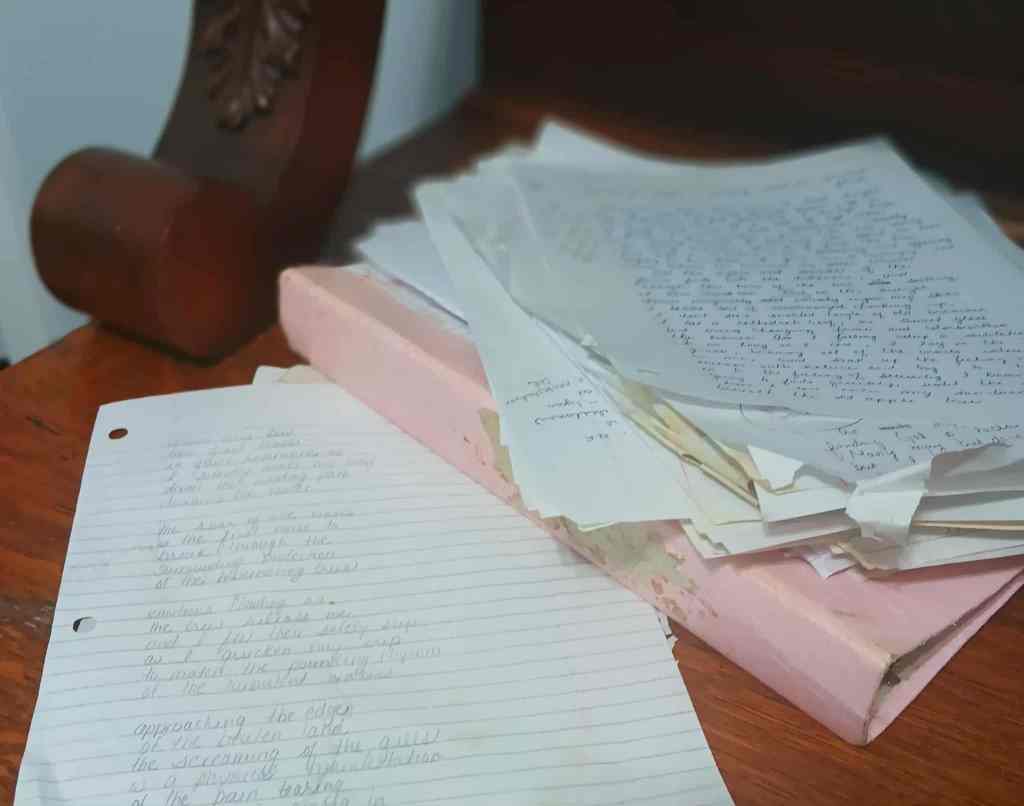
I can’t remember what I was looking for in the boxes in the basement last week. We moved nearly a year ago and most of the packed items remain that way. Last October, when we were packing, I threw away a large amount of things I no longer needed. There were, however, other things I could not bear to part with as they had a connection to my daughter. Or, my boys when they were small. And, to my surprise (and delight) there was a pink hard covered binder that I thought I had lost years ago. Handwritten words on college ruled paper were crammed inside. Relics of a former life.
On these faded and crumpled sheets were dozens of poems I had written over two decades ago. Before I lost my Becca. Prior to the before and after divide her death caused in our lives.
I was happy I had found them as I thought they had been lost forever. And, in truth, I felt kind of alright with that because they had been written about love. Melancholy musings about love lost pale in comparison to the grief one feels after the death of a child.
Carrying them upstairs I placed them on the small desk next to my bed. I was happy I found them but I wasn’t ready to read them yet. I am not sure why. Part of me felt they did not matter anymore. They were of the past. Another part felt as if they would be silly to me after having been through the things I have experienced. I can remember how much I ached when I wrote them but I didn’t truly know what aching loss was. I let them sit there for a few days. Eyeing them every time I entered my room. I felt embarrassed, somehow. Nearly a week passed before I sat down, took the pink binder into my lap, and opened the cover.
The first poem I read pulled me backward through time. My younger self spilled across the page, desperate, raw, convinced that heartbreak was the deepest wound a body could know.
I saw the heartache everywhere. Page after page carried the same refrain: unloved, unlucky, unwanted. I poured it out with the certainty of someone who believed it was her truth.
The emotions were unfiltered, splashed across the page crudely. Anger, sadness, emptiness—they tumbled out without grace, without restraint. I wasn’t writing poetry so much as carving open wounds onto paper. There was nothing polished about it. Just the desperate scrawl of someone who believed she was unworthy and wanted the world to see her ache.
As I was reading them I thought: oh, I would write this so much differently now. Or, would I even write them at all? I can think of little as profound as losing a child. Surely, writing about romantic love lost is superficial. Yet, there were truths I could see between the written words.
Meaning always seems to reside in the space between.
There was anger. Anger is the flame that kept me moving. It burned at men for not loving me the way I thought I deserved. It burned at myself for being “too much” or “not enough.” But beneath it all, anger was a shield – a way to keep from admitting how much I wanted to be loved but I didn’t understand how.
Sadness is the ache I poured into poems, believing I was destined to be unwanted. It sat heavy in my chest, a familiar companion. Sadness told me the lie was truth and convinced me to keep repeating it.
Loss is not just the end of relationships—it is the empty space I carved out myself. It is love I could not hold, because I didn’t believe it belonged to me. I grieve the men I pushed away, but I also grieve the version of myself who never felt safe enough to stay.
Emptiness is the echo of my uncle’s words: you will never be worth loving. I let that sentence hollow me out, and then I kept filling the hollow with chaos. The chaos felt familiar.
Unworthiness is the thread that tied all the others together. I wore it like a second skin, invisible and suffocating. I believed it so completely that I made it real, even when love stood right in front of me and asked me to trust.
Taken together, these emotions painted the story I lived by.
Between the scrawled lines of heartbreak, I saw the girl who believed she was unloved. I saw the anger, the sadness, the emptiness that poured out of her, unfiltered. But I also saw something else—the way she kept writing, kept trying to name her ache. Even then, she was reaching for love, even if she couldn’t recognize it when it stood in front of her.
The truth is, I was loved. There were men who gave me their full hearts, and I could not stay. I read those poems now and feel the grief of that too—the grief of turning away, the grief of sabotaging love that was real.
The harder truth is this: I was not only hurting, I was hurtful. I was the mean one. I lashed out at men who offered me tenderness, cutting them with words sharper than I care to remember. Destroying all in their path. I turned cold when they needed warmth, distant when they reached for closeness. I sabotaged what could have grown, convincing myself that chaos was safer than vulnerable intimacy.
It shames me to admit this, but it is the truth: I drove away the very love I claimed I longed for. I didn’t understand how to stay, how to rest in gentleness. Meanness became my defense, and I used it every chance I could. Looking back now, I see the cruelty was not born of malice but of fear—the fear that if I let love root itself in me, it would reveal my unworthiness all over again.
I saw myself as the victim. And though there were times I truly was, I also made victims out of others. This is the hardest confession: that pain, when left unspoken, when left unhealed, becomes something we pass on. My cruelty was the echo of wounds I carried from childhood, but it did not feel like an echo to the men who received it. To them, it was sharp, cutting, real.
This is what I regret most—that I repeated what had been done to me, even as I swore I wanted love. That I became the one who hurt, even while drowning in my own pain. That there are some who deserve apologies I won’t ever see again.
The grief I feel at this realization is sharp. But it does not live alone. None of my griefs ever have. They are threaded together, one pulling on the next, like pearls on a single strand.
When I grieve the loss of love—the men I pushed away, the tenderness I couldn’t bear—I feel the weight of losing my daughter too. When I ache for Becca, I also ache for the girl I once was, scribbling poems in pink binders, believing she was unworthy. Each grief stirs the others, until I cannot tell where one ends and the next begins.
This is the truth I have come to see: grief is not separate. It belongs to the same necklace, the same life. To touch one pearl is to feel the whole strand tremble.
And yet, even as the strand trembles, I feel something else. The act of holding one pearl, of turning it gently in my hand, seems to soften the weight of them all. Each grief touches the others, but so does each act of healing.
It is not only sorrow that travels along the necklace. When I polish one pearl with honesty, the others catch the light too. Naming my meanness does not excuse it, but it loosens the knot of silence that held it in place. Weeping for my Becca does not lessen the ache of lost love, but it teaches me how to live with a broken heart and still keep loving.
The necklace is heavy, yes, but it is mine. A whole life strung together: love, loss, regret, tenderness. To carry it is to admit I cannot separate the parts of me. I can only tend to them, one by one, until the strand gleams with all that is unbearable and all that is beautiful too.
I don’t think it’s an accident that I found these poems now. If they had surfaced years ago, I might have rolled my eyes at my own melodrama, or stuffed them back into a box. But now I can read them differently. I can see what I never wrote: the fear, the unworthiness, the deep longing that sat beneath every line. Timing matters. The binder waited until I was ready to face not only the lies I believed, but also the truths I could not see.
Between the lines, I found not just sorrow, but myself.
Two nights ago, I went down to the lake just to float. Dusk was still a couple of hours away, but the sun had softened. It wasn’t as relentless, and neither was I.
My favorite season at the lake is winter—on the deepest, windiest days. The sand turns to stone beneath my feet, frozen solid. The gulls scream into the sky like something primal and furious. And the waves? They don’t roll—they reach. They claw toward the shore, grabbing at the sand, dragging bits of it back to the cold, dark belly of the water. It’s stark. Wild. Beautiful in a way that feels honest.
My second favorite time is summer—just before the sun goes down. The heat has broken. Most of the crowd has packed up, leaving behind footprints and laughter in the air. It’s quieter then. The beach stops performing. The lake exhales. And in that softness, it’s easier to just be.
By the time I got there, the beach was near perfect. The sun had dipped low, casting gentler light. A few scattered people lingered. Small waves rolled in, steady and unhurried. The water was cool, not cold. A long shadow stretched across the lake from the lighthouse, like even the light had grown contemplative.
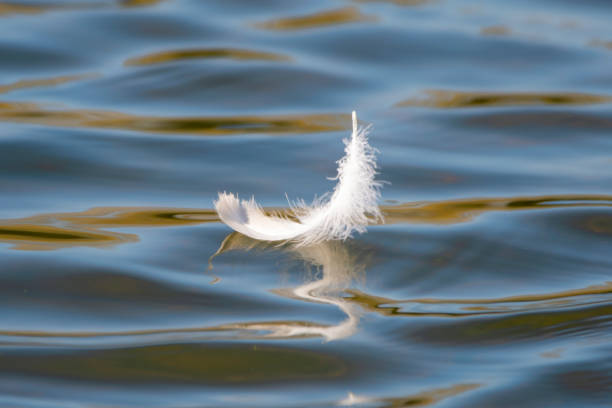
As I floated farther out, I saw a perfect white down feather drifting nearby. The waves swelled just enough to propel it forward without pulling it under. I thought, Well, that has to be a metaphor.
Ride the waves. Don’t let the grief drown you.
Then I thought, That’s too on the nose. Too tired. Surely that couldn’t be the lesson.
As I twirled gently in the water, I saw the lighthouse shadow growing closer. The real lighthouse stood in the distance, still and sure, casting a long dark shape across the surface.
Grieving parents live with the shadows of what life used to be, I thought. We have to find a way to stay in the light.
But that wasn’t it either. That thought didn’t feel right. It felt forced, too polished to be true.
The seagulls cried above me, their haunting screams echoing across the sky. Their voices always touch something in me. I’ve written about them before, about the winter lakeshore and how it mirrors my inner landscape. Grief, embodied. I’ve written about it enough to know that, in this moment, I had nothing new to say.
In all actuality, I didn’t figure out what – if anything – the lake had to teach me until later that night.
Not while I was floating. Not while I was squinting for messages in feathers or light. But much later, while I lay in bed.
The house was still. That kind of deep, sacred quiet that only comes when the day has finally given up. And maybe I had, too. I wasn’t hunting for meaning anymore. I wasn’t trying to pin purpose to every ripple.
I just was.
Earlier, as I had floated, I told myself to stop worrying about what I needed to learn. To stop dissecting every detail for meaning. I let my head fall back. I extended my arms beside me, closed my eyes, and let the moment hold me.
As I’d been taught in counseling, when feeling overwhelmed, I checked in with my five senses.
The smell of the lake was slightly fishy, yet clean.
Distant boats sped by in the background, their hum a kind of white noise beneath the occasional gull call.
I tasted a bit of lake water on my lips, gritty from the sand.
The light beyond my eyelids changed—soft pink to blue, then violet—as clouds passed across the low sun.
But it was the feel of the water that rooted me. The gentle rocking of the float beneath me. My arms lifted and fell with the swells. My feet dangled lower than the rest of me, brushing the colder waters below.
I felt weightless.
I felt cradled.
I felt peace.
Later that night, in bed, I could still feel it. The coolness of my skin. The sensation of water. It was as if the lake had rinsed something off of me, something that had been gathering on my surface for a while.
Grief residue. Thought loops. The ache of trying too hard to make sense of what may never be made sense of.
I felt… cleansed.
And that’s when the realization came.
Yes, we must find our own truth in this journey. Yes, we must seek meaning, search for signs, ask the unanswerable questions. We must question grief.
But we also have to stop chasing. We have to allow space not to know.
Yes, we grieving parents are seekers. We reach for answers. We demand meaning. We beg for signs: Why don’t I see them? Is my child mad at me? Do they still exist?
So many of us feel haunted by silence, wrecked by the absence of proof.
We want to believe our children are near, still part of us, still somewhere.
And yet, sometimes the deeper truth is this:
The burn to understand will exhaust us. The hunger for truth will leave us hollow. The endless grasping will not bring them back.
There is wisdom in the pause. There is grace in the unknowing.
Not trying to figure it all out is just as important as seeking answers. Maybe more important, for the soul.
We have to make space to be still. To unplug. To remain idle. To refill what grief depletes.
As I lay there that night, the peace was still with me.
The next day, I tried to call it back. Tried to summon that sense of floating, of being held.
It was already harder.
And today, it’s harder still.
That’s the nature of moments like that. They aren’t permanent. They don’t live inside us unless we choose to keep making space for them.
The lake held me longer than I expected—but only because I stopped reaching.
Some truths can only be heard in the silence after we stop asking.
The house was full. Full of children, full of noise, full of that particular kind of wild that only happens after time spent on the shore of Lake Michigan. They were sun-kissed and overtired, yelling over each other in bursts of joy and complaint. One of the little ones had begun to cry—too much fun always spills over somewhere.
Amid the chaos, I sat quietly, holding a cup in my hands like an anchor. It was one of those moments where the edges blur and something deeper stirs beneath the surface. I watched it all like a woman half in this world and half in another—the chaos around me a blur, the stillness inside me something hard-won. I used to dread moments like this, where joy and absence collided. Now, I just breathe through them.
Gabriel was seated across from me, his shoulders soft with fatigue. Julia, his partner, walked up behind him and wrapped her arms around him. I heard them exchange quiet I-love-yous—just for each other, but not hidden. A small, sacred thing passed between them.
Moments later, Alexa emerged from the kitchen with something she’d made for Matthew. He looked up and said, “Thank you, love,” without hesitation. The kind of love that doesn’t need ceremony. The kind that has settled in, becomes part of the rhythm.
And right then, in the middle of the noise and the movement and the mess of real life, I felt the room bend toward something holy.
The sunlight, low and golden, flickered through the trees and spilled through the window, stretching across the wooden floor. And for a moment, I saw her.
My Becca. Smiling. Standing in that beam of light as if it had carried her in. I didn’t move. I was afraid if I blinked, she’d disappear. But I wasn’t afraid of her. I was afraid of losing the moment.
Her eyes followed the children as they ran and tumbled and squealed through the house. She laughed—not aloud, but with her whole face. I didn’t hear her voice, only the faint melody of a wind chime from outside, like a sound remembered rather than heard.
My breathing slowed. My heartbeat quickened. And then she turned to me.
That smile—her enormous, heart-splitting smile—lit her face like it always had. Like she had never left. Like she was just standing on the other side of time.
And then she was gone. But not really. Not ever.
Later, when the children had calmed and the night began to stretch out soft and tired, I went home.
Sitting alone in my room I thought: This is what remains. Not just the grief. Not just the missing. But this—the life that still surrounds me, the love that grows, the magic that still dares to show up.
And here’s the part I couldn’t have imagined, years ago: That I’d be able to see it. Because in the early years, I couldn’t.
Grief narrowed my vision to what was gone, what would never be. Every joyful moment was filtered through the ache of Becca’s absence. Her missingness sat at the center of every gathering, louder than the laughter, sharper than the light.
But something changes—not quickly, and not easily. And, more importantly, never completely.
Over time, grief loosened its grip just enough to let in other things. Love. Laughter. Sunlight. Not instead of Becca, but alongside her.
I didn’t stop grieving. I never will. But I learned to hold both truths at once: That she is gone. And that there is still good.
And in that moment last night—children spinning, love spoken quietly across the room, and Becca in the light—I didn’t just see the beauty. I accepted it.
Not as a betrayal of her memory. But as an offering she would want me to receive.
It’s not that the ache has gone. It never will. But it has made room. And when moments like this arrive—when love spills out of my sons, when my grandchildren’s laughter fills the air, when Becca visits on a beam of sunlight—I don’t brace myself. I open. I accept. And I thank her for staying near.
There is a ritual I have come to recognize, and hold dear, among grieving mothers. It is not held in temples or churches or under official signs. It happens in parking lots, across chipped coffee cups, beside hospital beds, in Facebook comment threads at 2 a.m. It happens when you least expect it, but it is entirely appropriate. It happens when one mother says the name of her child, and another doesn’t look away.
Most people do. They look down, or change the subject, or fill the silence with something too bright. I used to take it personally, but now I know—it’s not cruelty. It’s fear. Grief, especially the grief of a mother, terrifies them.
But every once in a while, grief finds someone who understands.
It happened once while I was working the front desk at the clinic. A woman I knew came in, usually bright and chatty, but that day she was unraveling—red-blotchy face, trembling voice. She tried to hold it together just long enough to buy flea prevention for her dogs.
When I asked gently if she was okay, she stammered. Quietly, like a confession, she said: I lost my son. He committed suicide.
Without thinking, I stood up and walked around the counter. I wrapped my arms around her, right there in the middle of the lobby. People stared. I didn’t care. She mattered. Her loss mattered. She needed someone to hold the weight of it with her, even for a minute. She needed to say his name.
I saw her again about a month later. She thanked me for my kindness, but more than that—for not flinching when she said the word suicide.
She told me how much it meant to be able to say her son’s name without watching someone recoil. I nodded, and told her what I know to be true: You deserve to speak his name.
She reminded me of something I already knew but needed to feel again: we carry the need to speak our children’s names like breath.
We tell the story of our child innumerable times. Again and again and again.
Sometimes I only say, “My daughter died in a crash.” Sometimes I say her name and let it hang. Sometimes, when someone really wants to know, I tell them about the poetry, the joy, the light she left behind. I remember one time in particular—we were on a farm, she was around five, riding on the back of a pony while I led it by the reins. I looked back at her. The wind was blowing her blonde hair, her head thrown back, and she was laughing—that laugh. A whole-body laugh. Pure joy. The kind of joy you don’t forget, even after everything else is gone. I want people to know about my daughter. Not just how she died but how she lived.
We are good at listening, too. Knowing what the other person is willing to hear. We don’t need to take that into consideration when talking to another bereaved mother.
With them, we don’t have to scan the room for exits. We don’t have to explain why we still cry years later, or why certain dates crush our lungs. We just speak. And they nod. It’s the rarest kind of ease. Grief without apology.
Not because we’re afraid we’ll forget. Not because we haven’t accepted the death of our child. But because the story is what we have left. It’s how we mother, now. It’s how we include our child in our everyday life still. It’s how we survive.
There’s a rhythm to it—an inhale when we say their name, an exhale when we reach the moment they left. Some of us tell it with clinical precision, like an autopsy report. Others spin it like poetry, fractured and strange. Some cry every time. Some haven’t cried in years. But we all need to tell it.
Because grief unspoken calcifies. Because their life deserves an audience. Because silence is too heavy to carry alone.
When another mother listens—really listens—not with sympathy but with knowing, something sacred passes between us. We become witnesses for each other. We say: Yes, I hear you. Yes, that was real.
Being witnessed doesn’t undo the grief. It doesn’t fix it. But it makes it bearable. It makes it human. It reminds me I’m not just a mother who lost a child—I’m still Becca’s mother. I’m still here.
We are midwives to memories. Midwives don’t just deliver—they guard, soothe, hold steady when the pain comes. So do we. We breathe with each other through the contractions of memory. We place gentle hands on old wounds to remind each other we’re still here, still real. We whisper, You’re not alone. You can do this. I’m right here. And when the story breaks open again, we help gather the pieces, wrap them in warmth, and say, Look. Look what love made.
And in the telling, a tiny burden lifts. The story never gets lighter. But we get stronger from the lifting.
And when I tell Becca’s story—when I speak her name into a world that keeps moving forward without her—I am drawing her back into it. Not as a ghost, not as a shadow, but as a force. A daughter. A person who was and is, because I remember.
Unfiltered survival. Taken on a night I didn’t know how to keep going—but did anyway.Image credit: Diane Neas
Note to the reader: This piece is about the coded ways grieving mothers speak. It’s about what we say to survive the unbearable, and what we leave unsaid. If you’ve lost a child, I hope this helps you feel less alone. If you haven’t, I hope you’ll read with an open heart.
I have a list of answers I give when someone asks me how I am doing. They vary depending on how close to the surface my grief is that day. Well, truthfully, it’s always just beneath my skin like a bruise that never fades. Press too hard and it pulses to the surface.
I say “fine,” even when I’m not.
I say “hanging in there,” even when I’m unraveling.
I say “stabilized, eating, eliminating”. That is considered a good outcome in the animal world.
I say “living, laughing, loving,” and you laugh, which is the goal—because if you laugh, you won’t ask what I really mean.
I have an entire vocabulary now. Most bereaved mothers have learned this language. One that says just enough to end the conversation, but not so much that it opens us wide.
Because the truth? The truth is that she died. And I didn’t.
And I still don’t know what to do with that.
So instead, I answer in code. I give you the version of me you can handle. I’ve learned to protect your comfort at the cost of my truth. Because if I told you what it’s really like…you would never ask again.
But I’m protecting myself, too. There are days when telling the truth would cause me to implode on the spot. Days when I’m just trying to make it from sunup to sundown. I’m not lying to you. I’m giving myself space to take a breath.
When I say “alive” I mean: unwilling to die even if I wanted to.
When I reply “functional” I mean: still broken but making it through.
When I sarcastically say “living, laughing, loving” I mean: I’m not doing any of those things right now. Or maybe I am, but not in the way you think. Not the Hallmark version. This is survival with a grimace, not a glow. This is gallows humor in a forced lighthearted tone.
So you can laugh, not be uncomfortable and I can stay hidden.
Most people don’t want to know that children die. That love isn’t always enough. If they let it in—even for a moment—it would ruin the myth that our children are safe. That we can protect them. That we’re in control.
As much as I wish that were true… it simply isn’t.
And that truth is so devastatingly huge, so unbearable, that most people have no choice but to ignore it. Because how could anyone live every moment of every day waiting for their child to die?
I live on the other side of that coin. I am waiting for my child to come back to life.
Child loss grief isn’t tidy. It isn’t neat. It’s infinite. All consuming. Not to say other deaths don’t shake us. They do. But the death of a child tears through the center of our lives. It shatters the order we were promised. The order we were prepared to follow.
And our society doesn’t do well with grief, either. Friends, neighbors, coworkers, even well-meaning strangers – they want us to be done with it. They want us back to normal. Quickly. Quietly. Without disrupting the world around us too much. Or, maybe more accurately, without touching their world for any length of time. As if, somehow, child death is contagious.
As if proximity to our sorrow might summon tragedy of their own.
We are the cautionary tale no one wants to hear. The proof that it can happen. The walking reminder that love doesn’t guarantee survival.
We are the poster parents for dead children. We are what happens when the nightmare doesn’t end, when there’s no miracle, no second chance, no waking up.
When the life you lived with your child has come to its unnatural end.
Then comes the quiet aftermath. People stop asking—at least, not in the way they used to. They stop wondering how you’re doing in this new life. Because they can’t hear it.
To truly listen would make it tangible. And they don’t want to know.
To hear it again—to really hear it—feels heavy to them. Too much. Too dark. Too real.
To ask is to invite the specter of child death into their lives, as if their own child might be noticed and taken.
We are wreckage that still breathes. We are left in a darkened theater, the spotlight fades, and we clutch our child’s life story to our chest.
Still, we get up. We feed the pets. We answer emails. We smile at the barista. We make it to work. We carry our grief like an extra organ. Heavy, but vital. And we find strange, sacred comfort in others who carry it, too. Not because we’re healing, exactly—but because we’re still here. And being here means something. It has to.
Eventually, people start asking again – but differently. The urgency fades. The specificity disappears. You’re no longer asked how you are in relation to the death of your child. You’re asked the way we ask a dozen people in a single day.
“How are you?”
Like there’s only one possible answer. Like the biggest thing that ever happened to you isn’t sitting right behind your eyes, waiting. So, instead of being honest, we speak in our code. Speaking in code is its own kind of fluency.
And sometimes – on the rare, quiet days – we say “fine,” and it’s almost true.
Not because the grief is gone, but because, for a moment, it isn’t the loudest thing in the room.
And, that too, is survival.
If this resonated with you: I see you. Whether you’re speaking in code or holding your story in silence, you are not alone. Take your time. Grief has no outline you need to follow.
Mothering doesn’t stop after the death of a child. It simply shifts into a kind of prayer. We find a way to carry love beyond the edges of this life.
Their life begins with us in the most intimate way, and sometimes, it ends this way, too. Even when death separates us, nothing can sever the otherworldly tether. Our bodies knew theirs. Our hearts shaped theirs. That intimacy doesn’t end—it just becomes invisible to everyone else.
After she died, my mothering didn’t disappear. It just had nowhere to go.
I didn’t realize this for a long time. That deep need to keep mothering my deceased child was all-consuming. I went from expansive, all-encompassing mothering to the implosion of that care after loss—and the desperate need to put it somewhere.
Before, mothering was in everything: meals, plans, worries, dreams. Death collapses all that vastness. And when it does, the absence doesn’t feel quiet—it feels feral. This can feel like madness. It did for me.
Without knowing I was doing it, I began creating a space where I could still care for my daughter. It started with a simple instinct—the same quiet rhythm I once used to fold her clothes or lay out her favorite books beside her bed. I began gathering things. Placing them near her urn. Not with ceremony, just with care.
Little by little, a kind of altar formed. Not to worship. Not to heal. Just to keep mothering.
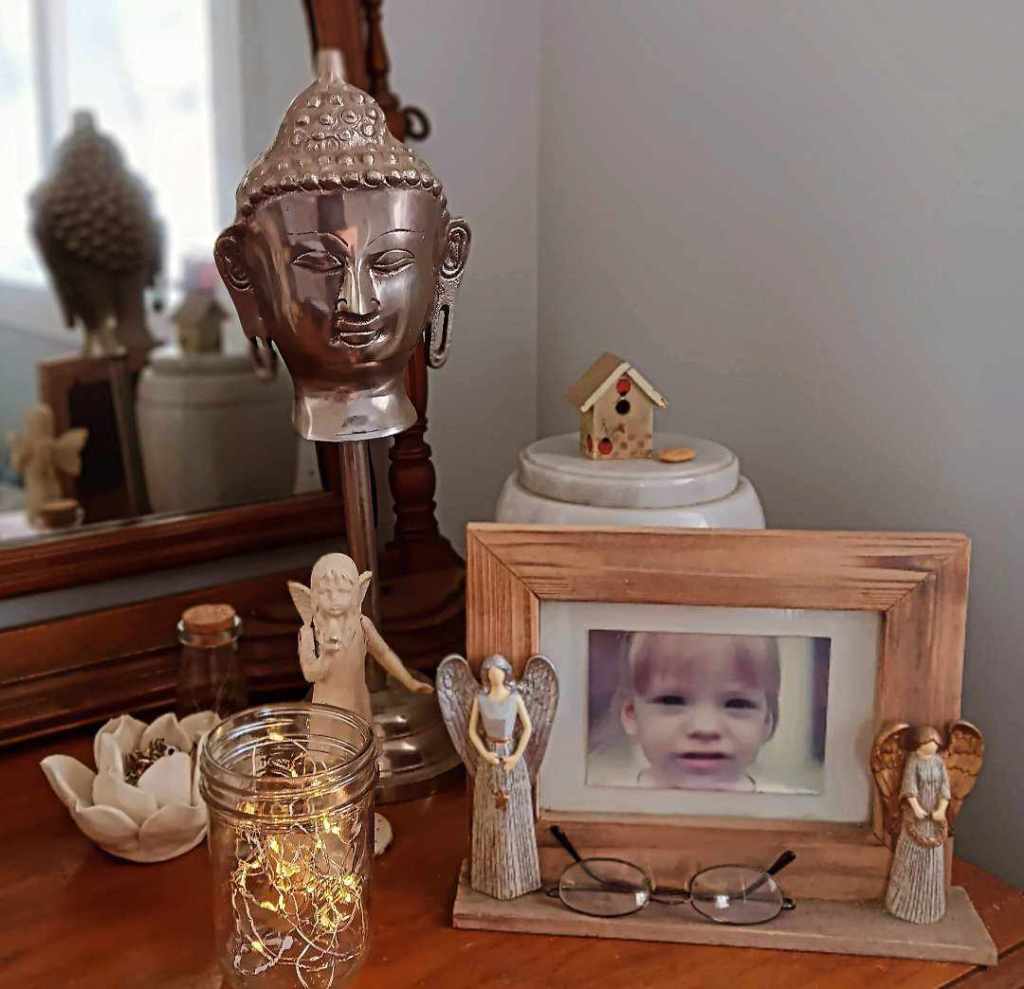
In my home, I’ve made a small altar for Becca. It sits on my dresser.
Her urn is marble—cool, smooth, solid. It rests behind a photo of her as a little girl, maybe three years old, with her sweet, mushy lips and soft cheeks. Just looking at it makes my heart skip. Her glasses are nestled at the bottom of the frame. A gift from a friend, the angels on the frame cradle her image like a relic.
To the left is a mason jar filled with fairy lights. I turn them on for her when the nights feel heavy. Behind it stands a white metal statue of a young girl with wings, a bird resting in her hand. My sister gave it to me, saying it reminded her of Becca. We don’t speak anymore, but I’ve kept the statue. Some things still belong.
There’s a peaceful Buddha head that sits nearby—not for religion, but for the sense of calm it offers me when I look at it. On top of her urn is a tiny ladybug house she received as a gift when she was young. Next to that there is a small smooth stone I brought home from Sicily. I know she was there with me.
There’s also a delicate, flower-shaped votive holder. I don’t use it for candles. I tuck inside it the jewelry I’ve been given by my children—gifts from the ones still here, resting beside the one who isn’t.
Behind it, there’s a tiny glass jar filled with cat whiskers. I can’t seem to throw them away. When I find one, I keep it. I don’t fully know why—but it feels like something sacred. Something she’d understand.
This is one of the ways I keep mothering.
I mother through my work, too—through the animals I care for, especially the ones who have been hurt or forgotten. I mother in quiet, invisible ways every day.
But this… this is different.
This is the intimate space between mother and daughter. The one place where I am still doing only for her. No one else. Just her. Just me. Just love that hasn’t stopped.
I’m not the only mother who does this. We all find our own ways to keep mothering.
Some visit their child’s grave weekly, sometimes daily, tending the space as carefully as they once tended their child’s room. I’ve seen mothers kneel beside headstones, gently scrubbing away moss with water and a soft cloth, whispering as they work. Sometimes they lie down on the earth itself—stretching their bodies across the grass, as if to wrap themselves around the child who rests below.
Others return to the place where their child took their last breath—a roadside, a quiet clearing, a stretch of sidewalk—and turn it into a sacred place. Flowers are left. Rocks are painted. Names are written again and again. These places, transformed by love and grief, say: You were here. You mattered. You still do.
These acts may seem small to outsiders. But they are essential. They give us something to hold. Something to clean. Something to protect. A place for our hands to go when our arms are empty.
One does not simply stop being a mother when the child is gone. That’s one of the hardest truths of child loss—we are still mothers, just with no child to mother in the ways the world recognizes.
We are left with silence in the space our child once filled. A silence so loud it can feel like it might break us. And into that silence, we pour what remains of our care. We light candles. We straighten photos. We gather little trinkets, or brush leaves off gravestones, or place our hands on the earth and whisper, I’m still here. I will always be here.
This is not denial. It’s not unhealthy. It is love, made visible.
Continuing to mother after death is not holding on too tightly. It is holding on rightly—to the truth that love does not end when life does. And so we build our small altars. We tend them as we once tended scraped knees and tangled hair. They are not substitutes. They are sacred spaces where we place the mothering that still lives in us.
And in doing so, we remember: we are not alone in this.
All over the world, in quiet corners and sacred places, other mothers are still mothering too. There are small altars. Sacred shelves. Sun-warmed headstones. Jars of buttons. Half-folded blankets. Unopened birthday cards. There are mothers who tuck notes into the soil, who leave offerings at crash sites, who talk to the sky in whispers only their child would recognize.
We each find our own way. We create places where our mothering can still live. Places where we can do, when so much was taken. Places where we can say, again and again, I remember. I still love you. I always will.
These acts may be quiet. They may be unseen. But they are not small.
They are the threads that keep us tethered—not just to our children, but to ourselves. And to each other.
My inner safe place is often different each time I visit. The way it appears to me carries the nuances of where my mind is at the time. But there is one thing that is always there, no matter how my sanctuary shifts and changes: the memory of the first time I held her.
I wasn’t supposed to keep her. She was meant to be released for adoption. She was taken away from me immediately after her birth, as planned. But somewhere in the hush of the hospital night, a nurse — not knowing the arrangement — brought her to me for a feeding.
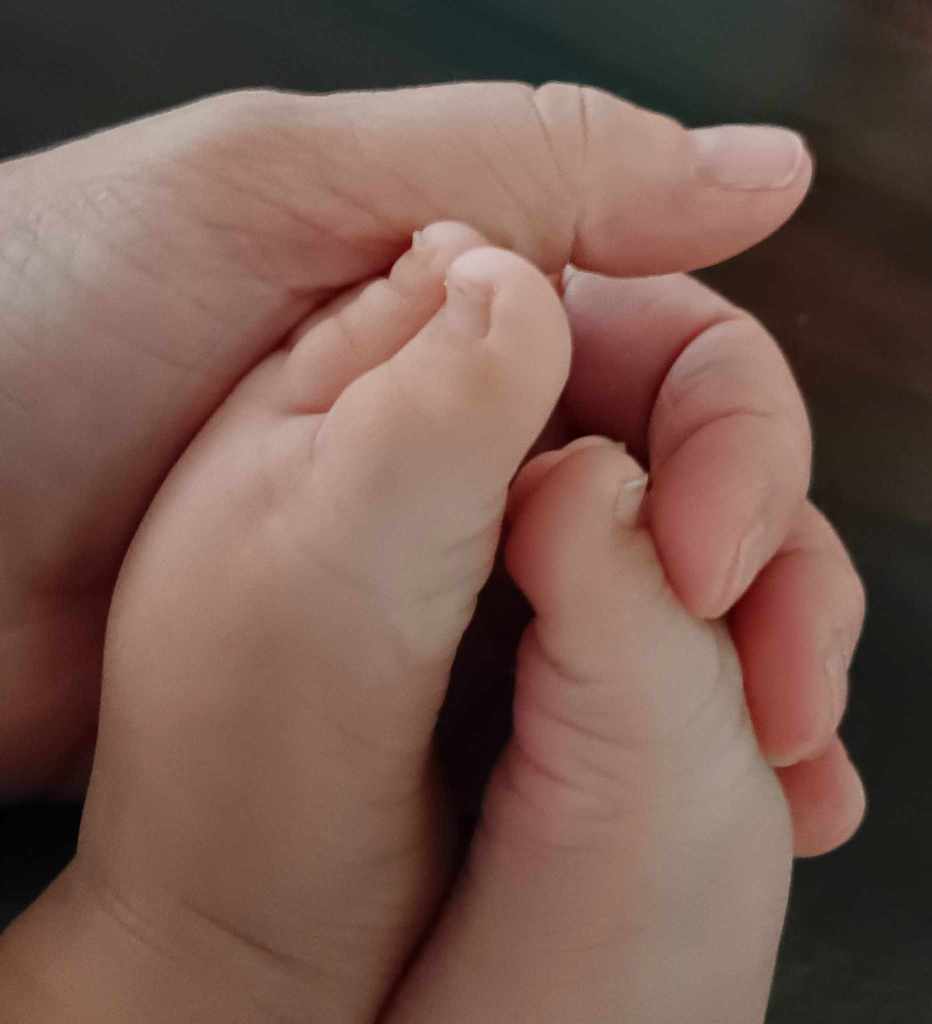
And I touched her. And in touching her, something deeper rooted itself inside me.
It wasn’t logical. It wasn’t planned. It was something far older than paperwork, older than fear. It was a bond sealed in the space between heartbeats, before anyone could stop it.
That moment created the foundation of my sanctuary. It is the place inside me where no one else’s decisions could reach. Only she and I existed there, beyond anyone’s plans or expectations.
No matter what other objects are in my sanctuary, this truth is always here.
It is my anchor.
Those first months after her death, I spent entire days there.
The first time I found my sanctuary, it wasn’t soft. It wasn’t comforting. It was a small, dark hole.
The walls were jagged — rough enough to slice open my skin if I reached out to steady myself. The floor was wet and cold, with no place to sit, no comfort to be had. There was no light. No warmth.
Just the truth — the simple, terrible truth — that she was gone.
Gone and never coming back.
The space was small, because that truth was everything. A single, shattering moment that collapsed the rest of my life beneath it.
But over time, as I began to see not just her death but the destruction it left behind, the space changed.
It grew.
It opened into something cavernous, and that was almost worse.
There were ledges, sudden drop-offs. Unstable footing. The air smelled like warm earth and something ancient — the faint scent of decomposing plant matter, like the forest floor in late autumn.
The sounds I made — the screams, the sobs, the broken words — bounced off the stone walls and came back to me louder than I meant them to be. They shattered against the cavern walls and tumbled into the darkness below, as if even my grief had to fall somewhere.
But then, one day, something shifted.
I heard a voice — a woman’s voice — echoing softly from around a bend. It wasn’t calling out to me exactly, but I recognized it. Somewhere deep in my bones, I knew it.
It was her. The night nurse. The one who unknowingly undid everything. The one who, by accident or grace, brought my daughter to me that first night.
She didn’t know the plan. She just saw a baby and a mother and did what made sense.
Her voice in my memory is gentle but clear, like light catching the edge of a wall in the darkness. I follow the sound through the cavern, around the bend, and suddenly — I’m there again.
Back in the hospital. Back in that moment. Back in the quiet where I first held her.
And that moment — that simple, sacred, accidental moment — becomes the first thing in the sanctuary that offers me comfort.
And it’s the one thing that is always there when I visit.
The first time I held her. The moment I didn’t mean to have. The moment I’ll never let go of.
Though there were times I entered the sanctuary and found memories waiting — uninvited, unexpected —there were other times when I carried them in with me.
Some memories refused to be avoided. They planted themselves firmly in my path, and so I picked them up and descended, holding them close.
Not just the worst memories — but the ordinary ones. The small, intimate ones. Those hurt more, somehow, than the life-shattering moments.
A mischievous smile. A shared joke. Her voice saying “I love you” in that way that shattered my heart all over again.
Yet through the pain, I was learning how to be again.
Bringing memories down into that space helped me understand them better. I would sit in the small places worn smooth from previous visits and cradle them to my chest. Places to rest — places where I didn’t crumble under the truth of her death.
I think that’s where healing begins. Not in the outside world, but in the stillness of rest.
And so it went, for years and years. Thousands of visits. Each one reshaping my soul, turning it — slowly, faithfully — back toward the light.
Grief made room for memory. And memory made room for life.
Over the years since her death, my inner sanctuary has undergone immense change. Years passed as the architecture softened and shifted.
As I changed.
Sharp edges wore down as memories and emotions continually washed over them. Towering stone cliff faces — once solid and impenetrable — cracked in places, allowing small beams of sunlight to slip through. The light reached the cavern floor and revealed things I needed to see.
But only when I was ready.
My soul allowed me to acknowledge what it could bear to carry, in its own time.
And then one day, not long ago, I noticed something new.
The gathered light — once scattered and hesitant — had begun to rise. It spread upward, casting a warm illumination, and for the first time, it touched nearly the entire space.
And I could see. Not just the grief. But the shape of who I had become inside it.
Dozens of memories are nestled among the moss that now covers the stone floor and climbs up the walls. Not all of those moments are happy ones. But I am content they are there. This is how it must be.
I never want to forget anything connected to Becca.
More often these days, though, I see something new. Something from my life since losing my daughter. And there is room for those, too, in my sanctuary. There is a necessity that they exist among the past.
My core self is still different every time I venture within. I think it will always be this way — until the day I am no longer here. Shifting as my relationship with grief continues to deepen and expand.
I am perpetually becoming.
Becoming as life draws me in and forces me to make changes, and acknowledge there is still a future for me.
This piece of writing contains a death of an animal. The photo above is not the puppy who passed but the one who is doing well.
Roughly ten days ago, I brought home a foster dog from the shelter affiliated with the veterinary clinic where I work as a vet tech. Her backstory was sad, as most of them are. Though she appeared well cared for, she was pregnant. And appeared close to term. A pregnancy-terminating spay was not going to be performed, so she had her puppies in the isolation unit of the shelter. Seven babies for a very small chihuahua-dachshund mix.
Caring for such fragile creatures is daunting. Unfortunately, momma wasn’t producing enough milk to feed them all. The decision was made to supplement their feeding and pull them through the first critical days. Numerous people were involved in this endeavor. The physical work is exhausting as they need to be fed every two hours, stimulated to both urinate and defecate, and kept at a very exact temperature. Mentally, it’s brutal. Lack of sleep. Intense worry. Trying to make the right decisions then second-guessing yourself. Animal care is not for the weak.
There were various genetic issues as well as being premature; the odds were stacked against them from the beginning. A dozen people were involved in her, and their, care but sometimes there is just nothing that can be done. Unfortunately, five of the puppies passed in a matter of days. I have nothing but respect for my coworkers who tried so valiantly to save such fragile creatures. Knowing, though this battle was lost, they won’t give up when the next one comes to the door.
Momma remained at the shelter, in the isolation room, fiercely protecting her two remaining babies: one girl and one boy. It was decided that the three of them might do better if they were in a quieter environment without so much activity. That’s where I came in. I was asked if I would take them home for “a while.” To say I didn’t think about saying no would be a lie. My heart already hurt for the babies who’d passed. As well as the mom who kept losing her pups. A job in animal welfare is fraught with pain nearly every single day. I didn’t know if I wanted to add the possibility of more to my already heavy load.
I carry, as most bereaved mothers do, monumentally heavy emotional pain. I think the only time of my existence when I am not acutely aware that my child is dead is when I am asleep. Even that isn’t a safe place because this truth often weaves its way into the storyline of my dreams. The mornings after nights filled with those dreams I awake exhausted, as if I have had no rest at all. Those days my mood is darker, my temper is short, and I am close to tears until it’s time for bed again. What would taking home a new mom with critical puppies do to my mental health?
But, of course, I drove to the shelter to pick up momma and babies. Still wondering if I could give this dog what she needed.
I walked through the main area where the majority of adoptable dogs are kept. Noisy and full of commotion as always. I thought some quiet might do momma good. I could provide quiet. I would set her up in my bedroom in a pen. My dogs would stay out of the room, except to sleep at night. The room gets a lot of sun and is warm. Perfect for tiny puppies. I’ll take the opportunity to mention that every puppy weighed less than half a pound at birth, so they were truly tiny. Our house is generally quiet unless our big dog sees something he doesn’t like outside. Otherwise, it’s relatively calm. I could provide an environment that would be better for a new mom than a loud shelter.
I followed the shelter director through the door that led to the isolation rooms. The door to momma’s room had a window in it and she lunged up to the window when she saw me. I was told that she had become extremely protective as each puppy had disappeared. She was going to do everything she could to keep the remaining two safe. I thought, how am I going to care for her and the babies when she wants to eat me?
When the door was open she rushed out and started jumping up and tried to bite my hands. Not mean bites but bites that were meant to tell me not to mess with the babies. She was warning me. I understood. I would have protected my daughter if I had been able to. After losing Becca I was terrified that something was going to happen to my twin boys and I had an excruciating time in letting them go out into the world for anything. I completely understood where this little fifteen-pound momma was coming from. I knew I would have to go slow.
We managed to get her into a carrier by placing the pups inside while she was outside. She came in, realized her babies were snuggled in the blankets, and got right in. I was afraid, however, to pick up the carrier and get my fingers anywhere near where she could reach them. I loaded everything I would need to care for them into the car then loaded momma and babies up last.
The drive home was short and momma growled the entire way. She was pissed, I get that. She was unsure. I understand. She was scared, of course. And, she was grieving. I didn’t know how to help a grieving creature that I couldn’t hold a conversation with.
Setting up her area was easy. Getting her to stay in the pen was hard. I was told she was a jumper but I didn’t realize she could have won a medal in the sport! I am not exaggerating when I say that she cleared the side of a three-foot-high pen with ease in one leap. Her short chi-doxie legs did not slow her down one bit. It was impressive. Except, when she got out she came right at me. Every time. I kept talking to her, calmly, telling her I wasn’t going to let anything happen to her babies. Begrudgingly, she started to trust me. Not completely, I could tell, but enough to change out her food and water and pick up each pup for a weight check twice a day.
The first few nights with her I slept lightly. Getting up often to be sure I could see both babies and making sure momma had plenty of water or if a pad needed changing. We finally got into a routine and I felt more at ease. Enough that I slept through the night without waking with worry. Everything was going great . . . until it wasn’t.
Monday morning I woke up and weighed both babies as I did daily. They’d been gaining about half an ounce overnight regularly, so I was a bit surprised to see the little girl hadn’t gained that much. I fed momma, my dogs, then left for work. At work, I talked to the vet and told her about the very small weight gain the female had overnight and asked what I should do, when should I worry. She gave me a few suggestions and I pushed the worry to the back of my mind because there were other animals that needed my attention that day.
When I got home, the first thing I did was weigh the pups. The girl had lost weight and her stomach wasn’t as full and round. I pinched her skin and it tented, meaning she was dehydrated. I know an animal can crash quickly once they are dehydrated, so I started care right away. I warmed subcutaneous fluids. Stimulated her. Helped her urinate and defecate. Syringe fed. Karo syrup on her tongue. I stayed awake with her nearly the entire night.
I begged her to live. I told momma, who by this time knew (I think) that I was trying to help her baby, that I was sorry. I kept saying, “I’m so sorry momma, I’m so sorry.” As a bereaved mother, I did not want another mother (no matter the species) to lose a baby on my watch. I knew the baby was fading. I could tell by her breathing that she was dying. There was literally nothing else I could do but let nature take its course.
At four a.m., I fell asleep in the pen with the little family. When I awoke, I could tell she was gone. She had passed. She was still tucked up next to her mother who was giving her little licks on her head. I was devastated.
I just sat there and cried. For her, for the baby who died, and for the loss of my daughter. All of these emotions were whirling over each other in my soul and I felt broken. I did the only thing I could, which was to take care of the puppy’s remains with love and let momma say goodbye.
I used a hand towel as a shroud for the baby. I held her tiny body, still warm from her mother’s body, and let momma sniff her. I told her I was going to wrap her baby up and take care of her and I wanted her to understand what was happening. She looked at me as if she did understand. She really did. I felt a spiritual connection with her at that moment. I knew the pain of losing a child and she did, too. I believe momma knew I did my best and that she was thankful for me being there.
Exhausted from no sleep and raw with emotion I wrapped the baby in the towel that was wet from my tears. I was sad. I was angry. I was full of guilt that I didn’t do enough. I had failed.
There is a sacredness in tending to such fragile life. Holding a tiny body against your chest, coaxing breath and warmth into it with trembling hands. It feels like a ritual, an act of communion between species who share an understanding of grief. Caring for her babies was more than just an act of duty; it was something holy. I was witnessing life in its most vulnerable form, grasping to survive against the cruel indifference of nature.
I know that I often transfer human emotion onto animals. Anthropomorphism is the word. I just looked it up because I couldn’t remember it. I’ve heard it isn’t healthy to give animals human emotions. I think it’s ridiculous not to understand that animals have many of the same emotions we have as humans. Momma dog lost a baby. She’d lost multiple babies. I could see the sadness in her eyes, in the way she kept grooming her baby. I did not have to speak the same language as another grieving mother, animal included, because there is a universal language that transcends any barrier.
Maybe she needed to be with me so I could be the one who cared for her after this loss. To hold vigil over her grief, acknowledging her pain without expectation of healing. Perhaps it was the only way to lessen the heaviness of both our burdens. There was a connection forged between us, stronger than words, rooted in shared loss.
My daily morning and night weigh-ins turned into four times a day. I didn’t want to miss any change in weight before it got too far for me to be able to intervene successfully. It’s been four days since the little female puppy passed. I am happy (and guardedly optimistic) to say the little boy pup isn’t so little anymore. Two important thresholds were crossed: weight over a pound and the two-week-old mark. He’s chubby and becoming very mobile. Everything a little pup should be doing.
I’ve often written about the healing I find in working with animals. Being able to be a part of helping a sick animal become better. Of being present when an owner chooses humane euthanasia. And now, the healing in being in the sacred space with a mother who has lost her child. Being present in this situation has brought a facet to my understanding of the acceptance of death and the fragility of life.
As I write this I am sitting on my bed and can see momma happily grooming her only remaining baby. Both of my dogs are curled up against me, asleep, and it’s peaceful as the rain falls outside in the dark night. Momma is happy. Her baby is healthy and content next to her. All is perfect in her small world.
My boys and their families are healthy and happy. They have grown into men I am deeply proud of—kind, resilient, loving. They have navigated their own grief, carried their own pain, and still managed to carve lives of joy and purpose. They are strong in ways I sometimes feel I am not. They have families of their own now, children whose laughter fills the spaces Becca left empty. I watch them as fathers and feel a warmth that is almost painful, a joy intertwined with sorrow.
They are here. Alive. Their faces reflect fragments of Becca at times—a tilt of the head, a shared smile, some subtle likeness that leaves me breathless. I have to steady myself, to remind myself that life continues to grow around the scar her absence left.
But that scar is part of me now. It always will be. And I have come to accept that my world will never be truly whole again. There is a piece missing—a child who will never grow older, who will remain forever young and vibrant only in memory. A loss that echoes beneath everything, constant and unyielding.
Yet, I have also learned that the beauty of life is not erased by loss. It is complicated by it. Made richer, somehow, by the acknowledgment of what is gone and what still remains. It is the recognition that grief and joy can exist side by side, tangled and inseparable. It is the understanding that healing doesn’t mean forgetting or even moving on. It means learning to carry both the weight of pain and the lightness of love.






 Words Can Express