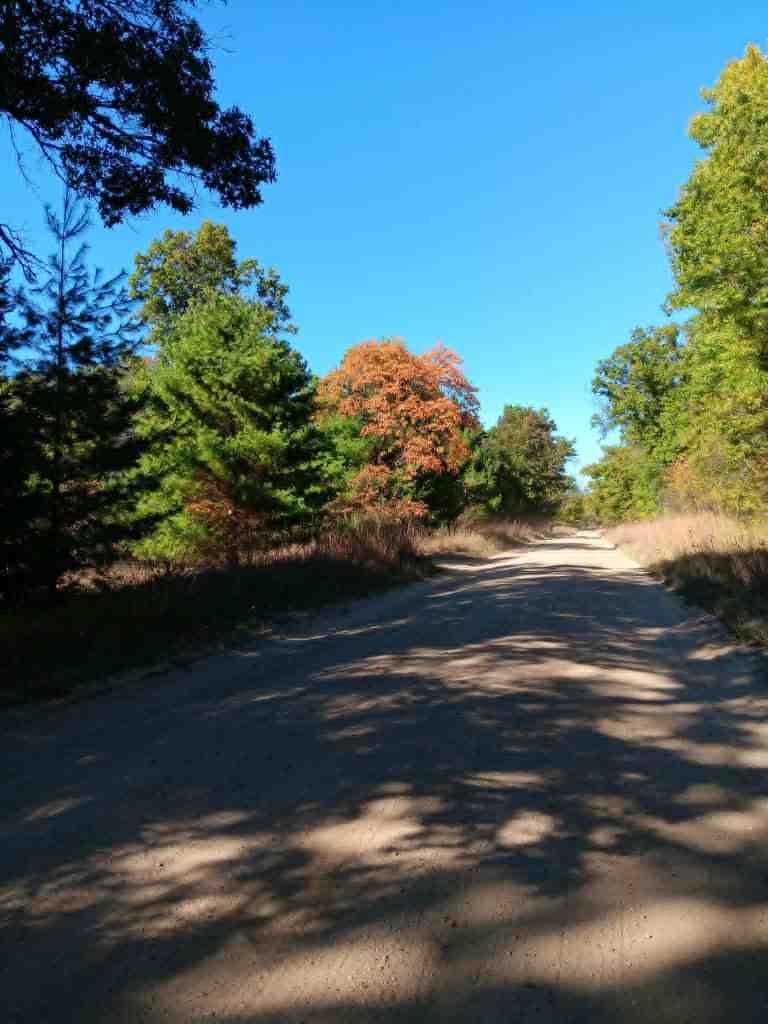
A picture of Lester Street. The street where we lived. Where I brought my Becca home. I drove back up there today just to get this photo because I knew it had to be the image I used with this piece of writing.
Whenever I am up at the farm, caring for the animals while the owners are away, I feel myself pulled north. Where I live now, fifty miles from the town I grew up in, I never feel the urge to return. But the farm sits only sixteen miles away, and it feels almost wrong not to go. As if the town has its own orbit, and once I step this close, I’m caught inside it.
I don’t know why I am drawn to the town I gladly left. The farm is less than twenty miles from the street where I lived. A short ride in physical distance, but the time I travel into the past is much farther. Usually, by the second or third day of farmsitting, I drive to the stop sign at the end of the road and turn the car north.
The flickering of sun through the trees unsettles me, making it too easy to slip into the past, to see the landscape as it was forty years ago. Enough has changed, but just enough remains to trick me into believing I’m heading back to the place I once left.
The curve in the road, to the left, and the bridge traversing the Muskegon River. The Manistee National Forest sign. The intersection where a bar stood in the 70’s, and the urban legend of a girl hit there one night—her remains scraped from the asphalt. A factory that promised jobs for the people in the impoverished area. The big sign welcoming drivers to the spot “where the north begins and pure waters flow.”
By the time I reach that sign, my stomach knots. My hands grip the steering wheel tighter. A lump rises in my throat. Why do I do this to myself? As always, I turn right down the street that takes me to the millpond where I spent many summers swimming. It’s gone now—the dam must have broken.
I park in the small lot across the street and let my mind slip back to those summer days—the long, hot walk from my house, the dread that certain kids from school would be there waiting to bully me, the immense relief when they weren’t. Always on guard, always scanning. And then the cool shock of the water when I finally dove in, the pruned fingers and tired muscles after a day spent trying to swim myself clean.
When I leave the lot I drive a block or two north and turn left, passing the old co-op. The building I remember on the right is gone now. The one on the left still stands. How many times did a younger me push through that door, the smell of goat feed my parents had specially mixed hanging in the air. The voices of gruff old farmers rose and fell around me, and the woman at the desk, gruff herself, always lowered her voice when she spoke to me, slipping me a wink. And each time the door opened, the bell gave its jingle, marking my passage in and out.
The car bumps over the railroad tracks and I am back at the main road.
I pull to a stop at the red light, waiting to turn left and go through town. Was there even a light here when I was young? Or just a blinking yellow for those passing through? My eyes fix on the dark wood building half a block up. It used to be Smith’s Tavern; now it’s a fireworks store.
A horn blasts behind me and I’m yanked forward into today.
I notice Rosenberg Hardware has moved, though the name endures. The old courthouse—huge, ornate, proud—is gone, replaced by a flat, forgettable building with no character. The post office is unchanged, and I realize I’m going through a kind of checklist: this is still here, this is gone. Why do I keep doing this?
And then the library. How could I forget? That place was my escape, my portal. Until the day a worker said: Let her bring that baby in here and I’ll be able to tell who the father is. Even remembering it now makes my chest burn. I was angry then, heartbroken. This had been the place where summer reading programs lit me up. My name filled the checkout cards again and again, proof that I belonged here. For years, it was safe—the one place the bullies never followed. It turned out it wasn’t children I had to fear, but an adult. I never went back.
Decades later, it still presses against me. The library full of books and worlds became hostile ground. And even now, I feel the old surge—to shield my daughter, even her memory, from a town that once wanted to cut her down. A town that kept telling me I was an outsider.
The weight of that pain presses against me as I turn onto Lester Street. One block in, I reach the corner where I was ripped off my bike after school. Not the only time I was jumped there, but the one that stays: the day I lost the bike that had been a gift, something precious in a childhood where little came easy. The shame of walking home empty-handed, of trying to explain it to my parents, pressed heavier than the bruises.
Another memory rises. A car full of girls circling the dirt road, one furious because she thought I’d spoken to her boyfriend. I can’t remember if I had, but I can still see myself – legs flashing, weaving through trees, sprinting for home while they prowled the road. Branches whipped my arms and face. My chest burned with breath and shame, the crunch of dried leaves and twigs underfoot loud in my ears. Anger pushed me forward, but hopelessness chased me harder.
Driving it now, decades later, I see her again, that blur of motion. And my heart aches for her—for the small, scared girl running faster than she should have had to.
I spent so much time in this town just trying to keep myself invisible, unseen. Maybe that’s why I drive back now—to prove I’m no longer hidden, no longer theirs to erase.
Still, not everything in that town was shadow. When I turn toward the land where our house once stood, the grass grown over, the best of me rises. I see the apple tree where I lost myself in books, its heavy branches dripping with blossoms, bees humming above me. April, my sheep, followed close—nibbling my fingers, laying her head in my lap as if she belonged to me alone. And my horse, steady as breath, carrying me bareback through the woods with nothing but her mane to guide us, taking me where no one else could find me.
And then—the brightest memory of all. The day I carried my daughter home, small and perfect in my arms. I remember the weight of her, the way the house seemed to hold its breath as I crossed the threshold. For a moment, the world was only light. That single joy outshines so much of the darkness, and it always will.
Maybe this is why I keep coming back. To test the balance of shadow and light. To remind myself that even in the hardest years, there were creatures who loved me, beings I cared for who, in their quiet way, healed me. And there was her. Always her.
I return to measure what still presses against me and what has loosened. To trace the outline of the girl who once ran unseen, and the woman who refuses invisibility now.
Maybe I drive back not to punish myself with memory, but to claim it. To say, with both ache and defiance: this was mine, too.
And when I leave again, heading back toward the farm, I feel the orbit release me. For a while I am free, until the next time I drift close enough to be pulled in again.

 Words Can Express