Spring makes me sad, but it used to make me rage. Because what season dares to bloom when your daughter is dead?
Spring is the season of renewal. Months earlier, the earth slowly closed down for a long, cold slumber, with the promise of new life as the seasons turned. As the blanket of winter snow melts the air warms up, and storms start to form. Delivering the rain needed for the new growth bursting forth across the land.
Spring—and its promise of new beginnings—seemed obscene to me in the years following Becca’s death. The only season that felt comfortable to me was winter. Even though it held hard days and anniversaries, I made sense in the frigid days and lengthy nights. My soul was in its own winter, and I accepted this truth.
The first spring after losing my daughter was brutal.
Not only did it betray my idea of the world, it also held court proceedings for the drunk driver who killed my child. So much of it is a blur, memories spinning into each other, but I do remember seething when the sun shone brightly and splashed warmness all around me.
No. Not acceptable.
My world was still in the deepest part of winter.
I was rage-filled because my daughter did not have the hope of a future.
Hers was stolen from her that January night on the dark highway.
Her life was finished. Completed in a way that was not her choice.
Any dreams she had for her life were wiped out in a split second.
Yes, I lost her—but she lost herself.
I had years of this anger. Spring promised what we couldn’t have.
This is our first spring in the new house, so the budding and flowering plants are new to me. There was a rhythm in the old house I was accustomed to watching unfold — including which plants came to life first. Next to the driveway there were five flowering bushes that would show the first buds, then blooms, of the season. I had found them in the dumpster outside a local nursery, small and half-dead, so I dug them out and brought them home.
I had no idea they would take off and grow so big when I planted them.
I felt like I had saved their lives, so I was always happy when I saw them bloom
Various other plants and flowers would arrive shortly thereafter — Tiger Lilies, Lilacs. The Bridal Wreath Spirea was one of my favorites. Its long slender branches spilled over the brick half-wall onto the front porch. The flowers were delicate, but their existence was fleeting.
Much like my daughter’s time here on earth.
I’d sit near them, on a rocker, when I had a chance, because I knew they would soon be gone.
The new house has a whole different variety of plants — a new variety, but much fewer in number. I have a clean slate, of sorts, to plant what we choose.
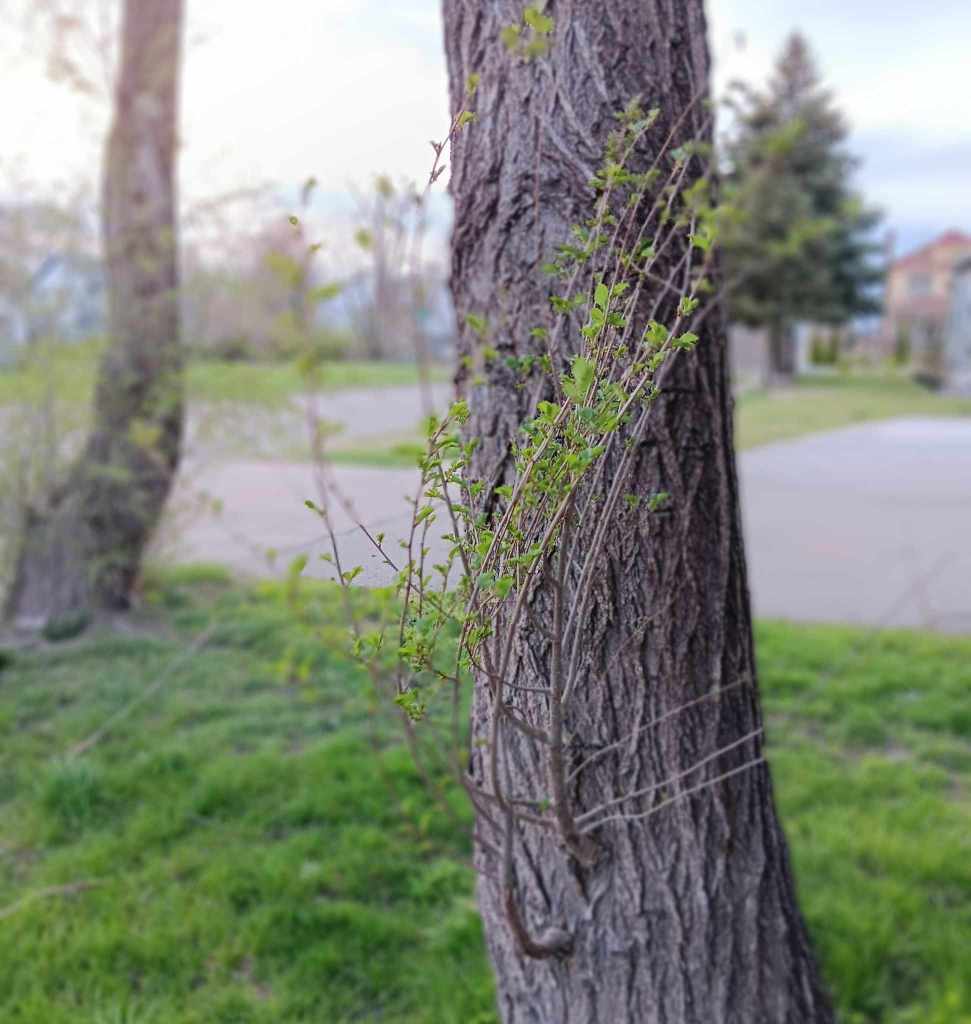
I was sitting on the front steps and noticed a tree on the corner of the yard and the alleyway. It’s a good-sized tree. I’m not sure of the type. The main trunk is probably twenty-two to twenty-four inches in diameter, so I am unsure of the age. Multiple limbs have been removed over the years because they came too close to the roof, we were told. My roommate, the actual owner of the house, mentioned that she might take the whole tree down.
As I was sitting there looking at the tree, pondering its past, I wondered if it hurt when its limbs were removed.
Were the round scars, where life used to be, sensitive?
I felt a sadness because in a few weeks the entire tree might be gone.
Then I noticed something I had not seen before — dozens of thin branches growing from near the base of the tree. I had seen them in the winter when everything was bare, but now they had little bursts of tender green leaves along each one.
Had I thought they were dead and not just in hibernation?
The thought struck me that though the tree had been cut, vital parts of its whole taken away, it still believed in life.
The tree resonated with the innermost parts of who I am as a grieving mother.
Wounded, but still sprouting. Still trying to make something of the light.
To most, I think, those spindly, defiant branches would need to be trimmed off.
They are unsightly, I was told. Left would be dozens of tiny new injuries for the tree to scar over. The hopeful defiance in reaching toward life would end. How tragic.
Losing a child is much the same.
Child loss doesn’t break you. It un-makes you.
You’re no longer who you were before — it’s like every cell was burned down to ash, and only some are able to rebuild. Like the tree, you lose vital parts.But in child loss, it’s not a limb — it’s the roots. Somehow you’re still expected to stand.
And, miraculously, you do stand.
You exist. Waiting.
Waiting for your child to come back.
For all of it to make sense.
To breathe without suffocating from the grief.
I think winter understands this resting — the space between.
The life that held your child and this one that doesn’t. The holding steady.
That is where healing begins, I believe. Not in the exuberant insistence of spring. But in the small places of hibernation. Unseen places.
Our winter of the soul is a different length for each of us. Often, we can spend years in this season. I did. Over a decade, truthfully. Well over.
There is a strange safety in winter. You know what to expect — the bare branches, the muted sky, the sharp air that cuts when you breathe.
You don’t trust spring at first when it comes. You feel the sun one day, unexpected and gentle on your face, and you think — maybe.
Maybe the hold is loosening.
Maybe it’s time to stretch toward life again.
And then the dark clouds gather on the horizon. The temperature drops.
The wind returns with that certain smell — the one that tells you snow is coming, even before you see it. Pushing back against the warmth you dared to welcome.
It reminds you: winter isn’t finished with you yet.
Grief is like that, too.
Just when you think you’ve found your footing again, it howls through the empty places inside you, knocking you off balance. But maybe — just maybe — those moments of warmth aren’t lies. Maybe they are promises.
Not that winter is over — but that spring will, eventually, outlast it.
Then there comes a day when you realize: spring came earlier this year.
Not in the physical world, but in your own. Though it seems the two seasons cannot possibly co-exist… they somehow do. And you find yourself walking through them both at the same time. Winter and Spring. Sorrow and joy.
And maybe this is how healing begins. Life overlaps the pain. We don’t leave winter behind. Instead, we learn to turn toward the sun more often.
To take the places deep inside where our child’s death slaughtered us —
and let the new green shoots of healing take root, and have a chance to grow.
Just like the branches at the base of the tree — too wild for some, too unkempt — that is how healing can appear to the world.
Not pretty.
Not curated.
Not understandable to those who don’t know.
As I sit and admire the tree at our new house, I am struck at how alike we are.
I didn’t plan to survive after Becca died.
I didn’t know how anyone could survive this unimaginable loss.
But survival, it turns out, isn’t always a choice you make.
Sometimes it’s what happens while you are lying broken on the ground. When your soul is in hibernation.
I look at the tree’s tangled base — the low, rough branches, the scars twisting its trunk — and I realize: It didn’t grow that way to be admired. It grew that way to stay alive.
So did I.
Healing didn’t make me prettier.
It made me wilder.
And maybe that’s the truest thing about surviving the unbearable:
You don’t grow back into the person you were.
You grow into someone the world might not recognize —
someone rougher, braver, rooted deeper than before.
Someone who knows that new life doesn’t erase the scars.
It rises up through them.

 Words Can Express
One thought on “On Becoming Wild”