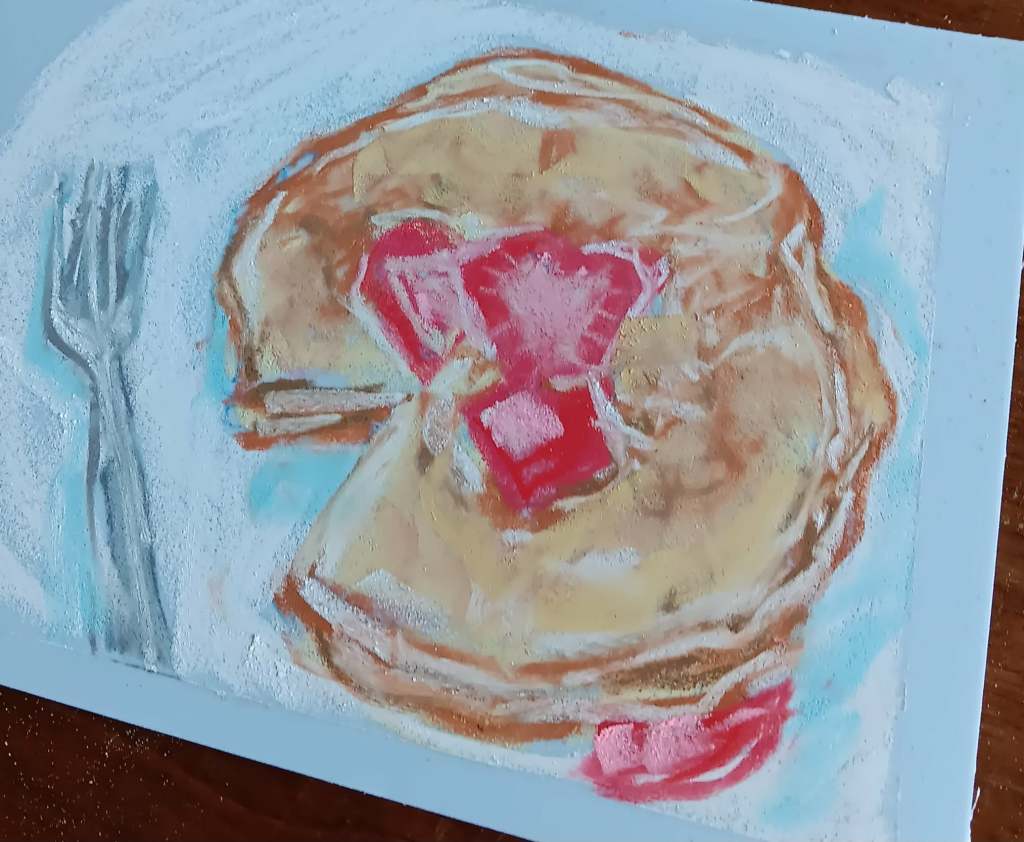
Image: quick study for color done by the author.
Please be aware this essay contains the topic of end of life care.
I carry the tray back to the kitchen. Nothing on the plate was eaten. The paper hadn’t even been taken off the straw. Under the plate cover, placed on top to keep the food warm, there were two pancakes with butter, maple syrup, and strawberries. I could smell the warm sweetness as I walked down the quiet hallway.
I had prepared this plate for an elderly man who I knew, from talking to him a few weeks ago, only liked his mother’s pancakes. He could remember sitting in the kitchen, on a red stool, as she stood at the stove flipping them for him and his brother. Saturdays were for pancakes. And, during the summer months, they came topped with the strawberries his mother grew out back. The strawberries needed to be cut so they resembled little hearts on the plate.
Begrudgingly, he had tried the pancakes I brought him the first time I made him breakfast. He’d told me they were “good enough,” which made me smile. From then on I would enter his room and ask him if he wanted “good enough” pancakes, to which he’d reply, “I guess, if that’s all you got back there.”
His tray was heavy as I opened the kitchen door. Not physically, but because I knew what this particular tray represented. A life growing closer to death.
Much of the time, as people near their end, they start requesting their comfort foods. The usuals: macaroni and cheese, oatmeal with brown sugar, soup, mashed potatoes. Then there are times when I have to get creative with the ingredients I have in the hospice kitchen and get as close to what they are describing as possible.
I’ve seen a number of deaths since I’ve been at hospice, and I have learned there are certain stages the majority of people go through as their bodies start to die. Delusions. Restlessness. But before that, appetite disappears. Preferences change. Sometimes three bites constitute a successful meal. Sometimes the tray comes back untouched.
Like today.
I hold preparing food for the dying in the category of a sacred task.
One patient told me I made the best omelet he’d had in fifty years. Another patient couldn’t feed himself, so he was tenderly fed and sung to with each meal I brought. And when no one comes, staff and volunteers step in to fill that space.
It was the same way in animal care. When there was no owner who would stay for euthanasia, I stepped in. Holding the animal closely and pouring all of the love in my heart into its body so it could leave feeling cared for.
When I worked in veterinary medicine and was a part of or performed humane euthanasia, I understood that we were providing a kindness to the suffering animal and to the owners as well. I had a coworker who said, “Sometimes death is the last kindness we can offer.”
I finally understand this.
One does not have to save someone for care to matter.
I learned that in tending to dying animals and, now, in the human capacity. Presence is necessary even when nothing can be fixed. Dignity often comes in small gestures and choices. Appetite, touch, music, humor and preference remain human even near death. Care without hope of recovery is still profoundly worthwhile. Ordinary acts become enormous when time is short.
The empty room after one of our hospice patients passes is heavy. Heavier than I thought it would be. It’s cleaned and prepared for another person to spend their final time in. It feels obscene to be cleaning all the belongings out so quickly for the next patient. One life has recently come to its end and we are moving to the next so quickly.
When someone passes, we truly express how sad it is, but then we have to move on to the next thing that needs to be done for the living. The living, and their families, still need care.
I didn’t arrive at this facility innocent of death. I lived what death does.
I am what death does.
My daughter’s death was a rupture of our lives. There weren’t neat goodbyes and handholding as she passed. It was me standing on a highway a mile from her dead body.
When I began working at hospice I thought: I’ll be okay here. I have had an intimate relationship with death for nearly two decades. I can carry the weight. The sorrow.
And I can.
But what I didn’t expect was that death could teach me to see it differently.
My first couple of weeks working showed me that death, some death, is a natural process and will happen no matter how we rage against it. It may sound odd, but there has been comfort for me in seeing a life lived fully from A to Z, decades of life, coming to its end. Does it make it easier? No. But I see death in a different light now.
In the aftermath of my life being torn apart by my daughter’s passing, I would never have been able to accept someone telling me that death could bring gifts. I am still not certain that is the right way to say it.
Death took my daughter. There is no gift in that.
What I have learned is that beauty can exist beside death.
A person can be dying and someone can still sing to him. Someone can still laugh. Someone can still care whether the oatmeal has enough brown sugar or whether the strawberries are cut into little hearts.
There is a woman here now, in her eighties, who asked me if I could butter and brown her hamburger bun when I brought her dinner.
“Like my mother used to do.”
So I did, of course.
Her mother must have been gone for many years, and yet here was her daughter, now an old woman herself, remembering the way her mother buttered a bun.
It made me think again of the man and his pancakes. The red stool. Saturdays. Strawberries from the garden cut into little hearts.
Mothers are still caring for their children long after the mothers themselves are gone.
Sometimes another pair of hands gets to carry that care forward.
This woman is not my child, but today I can carry on her mother’s mothering for her. I can keep what is important to her important until she is no longer here.
I have watched people traveling toward the end of lives they cared for and have seen what matters and what falls away.
These are the things I will carry with me into my future: Attention. Food. Touch. Curiosity. Showing up. Saying things. Going places. Love.
Loving people while they’re available to be loved.
I carry the untouched tray with the pancakes and carefully cut strawberries over to the sink and empty them into the trash. This is the last time I will make these pancakes for this man. That saddens me.
But I now know, I continue to mother.


