On The Gift Of Darkness

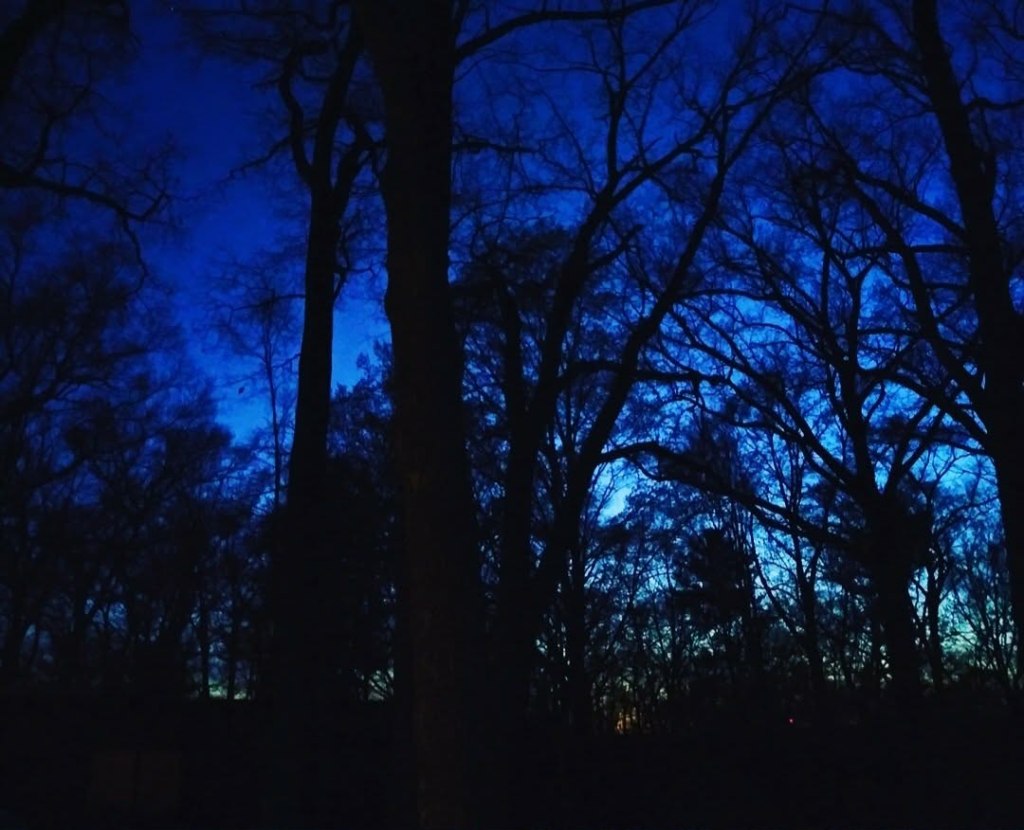
Photo taken by author.

Some people chase the sun. I chase the hour when the light finally leaves. I know I am not alone in this. I crave the quiet darkness with an intensity. There is a peace in it, a settling of the world and the self.

When the last of the daylight slips off the fields and the trees stand black against the sky, something in me unclenches. Winter is my season. The air turns clean and sharp, carrying the colorless scent of nothing blooming. Branches rise like ink strokes against the bruised-blue dusk. The world becomes a sketch of itself, lines, contours, bones. It’s the only time of year when the world stops pretending . . . honest in a way no other season dares to be.

In winter, nothing pretends. Not the world, and not me. The darkness comes early and invites me inward, away from the harsh glare of daylight, away from the pull to be bright and open and decipherable. In sunlight I become a shape others can interpret, but in the long blue dusk I return to myself. Maybe that’s why I trust winter more than any other season – it has never lied to me. Summer is all insistence and cheer. Spring makes promises it can’t keep. Autumn lingers in its nostalgia. But winter just is. Its honesty settles on my skin the same way the cold does – direct, unsoftened.

Even the bird calls turn truer then: cardinals cutting the quiet with clean, sharp notes, crows speaking in raw syllables. Night arrives like a soft blanket laid across the land, and my mind settles beneath it. In the early dark, I am not performing a life. I am simply living it.

The early darkness and the longer stretch of those hours give me the gift of inwardness. I’m able to draw my energy back to myself and away from the world around me. I feel a quiet strength return, one I lose in brighter seasons. I can rest without apology. Winter offers me solitude that is not loneliness, clean and uncluttered hours that don’t insist on being filled. My soul can stretch its tired limbs. My thoughts are given back to me. Winter hands me my own depths and says: here, these are yours. And in the stillness, I remember who I am when no one is asking anything of me.

Winter, and the darkness it brings, allows things in me that would shrink from the harsh light of other seasons to surface. In the long hours of early night, the quieter truths have room to breathe. What is buried can be mined. What is fragile can be unearthed without fear of exposure. The dark coaxes forward what the bright months chase back into hiding: old questions, softened griefs, memories that still hum at the edges of my mind. Darkness makes space for all of it, giving me the privacy and stillness to understand what rises. In the dark, nothing is rushed. Nothing is forced. What comes forward comes because it’s ready.

Restoration lives at the heart of winter for me. I am restored because I am more fully myself. Just as the landscape is stripped down to its bare bones in the dark winter night, so is my soul. The excess falls away. The noise quiets. What remains is honest and essential. In these long hours of darkness, there is more time in the day for me to soften – for the tight places in me to loosen, for the rigid, survival-shaped parts to warm in their own slow way. Long winter nights give me room to breathe into my own depth, to rest inside the truest shape of who I am.

Winter, and its darkness, have always felt familiar to me. Maybe because it is the season my daughter was born into – a time when the world itself is stripped down and new beginnings arrive quietly. Or maybe it is because winter is also the season in which she died, and something in me has been living in that blue-lit landscape ever since. The cold months know both sides of her story: her first breath and her last. And in that strange, sacred symmetry, I find a kind of belonging. Winter holds her, and it holds me. It is the season that makes room for both our truths.

Winter is the only season that speaks in a voice I trust. And the darkness . . . it’s the place that listens.
On Becoming Wild

Spring makes me sad, but it used to make me rage. Because what season dares to bloom when your daughter is dead?

Spring is the season of renewal. Months earlier, the earth slowly closed down for a long, cold slumber, with the promise of new life as the seasons turned. As the blanket of winter snow melts the air warms up, and storms start to form. Delivering the rain needed for the new growth bursting forth across the land.

Spring—and its promise of new beginnings—seemed obscene to me in the years following Becca’s death. The only season that felt comfortable to me was winter. Even though it held hard days and anniversaries, I made sense in the frigid days and lengthy nights. My soul was in its own winter, and I accepted this truth.

The first spring after losing my daughter was brutal.

Not only did it betray my idea of the world, it also held court proceedings for the drunk driver who killed my child. So much of it is a blur, memories spinning into each other, but I do remember seething when the sun shone brightly and splashed warmness all around me.

No. Not acceptable.

My world was still in the deepest part of winter.

I was rage-filled because my daughter did not have the hope of a future.
Hers was stolen from her that January night on the dark highway.
Her life was finished. Completed in a way that was not her choice.
Any dreams she had for her life were wiped out in a split second.

Yes, I lost her—but she lost herself.

I had years of this anger. Spring promised what we couldn’t have.

This is our first spring in the new house, so the budding and flowering plants are new to me. There was a rhythm in the old house I was accustomed to watching unfold — including which plants came to life first. Next to the driveway there were five flowering bushes that would show the first buds, then blooms, of the season. I had found them in the dumpster outside a local nursery, small and half-dead, so I dug them out and brought them home.
I had no idea they would take off and grow so big when I planted them.
I felt like I had saved their lives, so I was always happy when I saw them bloom

Various other plants and flowers would arrive shortly thereafter — Tiger Lilies, Lilacs. The Bridal Wreath Spirea was one of my favorites. Its long slender branches spilled over the brick half-wall onto the front porch. The flowers were delicate, but their existence was fleeting.


Much like my daughter’s time here on earth.


I’d sit near them, on a rocker, when I had a chance, because I knew they would soon be gone.

The new house has a whole different variety of plants — a new variety, but much fewer in number. I have a clean slate, of sorts, to plant what we choose.

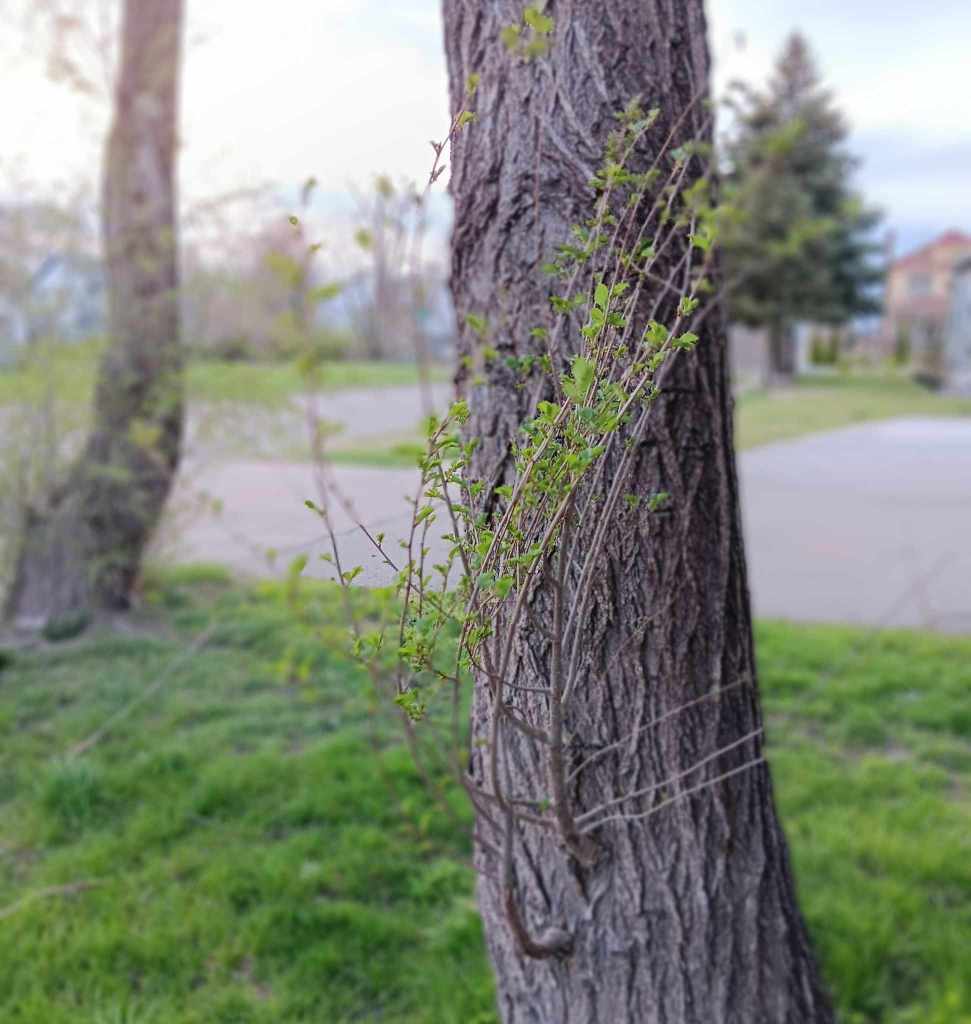
I was sitting on the front steps and noticed a tree on the corner of the yard and the alleyway. It’s a good-sized tree. I’m not sure of the type. The main trunk is probably twenty-two to twenty-four inches in diameter, so I am unsure of the age. Multiple limbs have been removed over the years because they came too close to the roof, we were told. My roommate, the actual owner of the house, mentioned that she might take the whole tree down.

As I was sitting there looking at the tree, pondering its past, I wondered if it hurt when its limbs were removed.

Were the round scars, where life used to be, sensitive?

I felt a sadness because in a few weeks the entire tree might be gone.

Then I noticed something I had not seen before — dozens of thin branches growing from near the base of the tree. I had seen them in the winter when everything was bare, but now they had little bursts of tender green leaves along each one.

Had I thought they were dead and not just in hibernation?

The thought struck me that though the tree had been cut, vital parts of its whole taken away, it still believed in life.

The tree resonated with the innermost parts of who I am as a grieving mother.

Wounded, but still sprouting. Still trying to make something of the light.

To most, I think, those spindly, defiant branches would need to be trimmed off.
They are unsightly, I was told. Left would be dozens of tiny new injuries for the tree to scar over. The hopeful defiance in reaching toward life would end. How tragic.

Losing a child is much the same.

Child loss doesn’t break you. It un-makes you.

You’re no longer who you were before — it’s like every cell was burned down to ash, and only some are able to rebuild. Like the tree, you lose vital parts.But in child loss, it’s not a limb — it’s the roots. Somehow you’re still expected to stand.

And, miraculously, you do stand.

You exist. Waiting.

Waiting for your child to come back.
For all of it to make sense.
To breathe without suffocating from the grief.

I think winter understands this resting — the space between.
The life that held your child and this one that doesn’t. The holding steady.
That is where healing begins, I believe. Not in the exuberant insistence of spring. But in the small places of hibernation. Unseen places.

Our winter of the soul is a different length for each of us. Often, we can spend years in this season. I did. Over a decade, truthfully. Well over.

There is a strange safety in winter. You know what to expect — the bare branches, the muted sky, the sharp air that cuts when you breathe.

You don’t trust spring at first when it comes. You feel the sun one day, unexpected and gentle on your face, and you think — maybe.


Maybe the hold is loosening.

Maybe it’s time to stretch toward life again.

And then the dark clouds gather on the horizon. The temperature drops.
The wind returns with that certain smell — the one that tells you snow is coming, even before you see it. Pushing back against the warmth you dared to welcome.

It reminds you: winter isn’t finished with you yet.

Grief is like that, too.

Just when you think you’ve found your footing again, it howls through the empty places inside you, knocking you off balance. But maybe — just maybe — those moments of warmth aren’t lies. Maybe they are promises.
Not that winter is over — but that spring will, eventually, outlast it.

Then there comes a day when you realize: spring came earlier this year.
Not in the physical world, but in your own. Though it seems the two seasons cannot possibly co-exist… they somehow do. And you find yourself walking through them both at the same time. Winter and Spring. Sorrow and joy.

And maybe this is how healing begins. Life overlaps the pain. We don’t leave winter behind. Instead, we learn to turn toward the sun more often.
To take the places deep inside where our child’s death slaughtered us —
and let the new green shoots of healing take root, and have a chance to grow.

Just like the branches at the base of the tree — too wild for some, too unkempt — that is how healing can appear to the world.

Not pretty.
Not curated.
Not understandable to those who don’t know.

As I sit and admire the tree at our new house, I am struck at how alike we are.

I didn’t plan to survive after Becca died.
I didn’t know how anyone could survive this unimaginable loss.

But survival, it turns out, isn’t always a choice you make.
Sometimes it’s what happens while you are lying broken on the ground. When your soul is in hibernation.

I look at the tree’s tangled base — the low, rough branches, the scars twisting its trunk — and I realize: It didn’t grow that way to be admired. It grew that way to stay alive.

So did I.

Healing didn’t make me prettier.
It made me wilder.

And maybe that’s the truest thing about surviving the unbearable:
You don’t grow back into the person you were.
You grow into someone the world might not recognize —
someone rougher, braver, rooted deeper than before.

Someone who knows that new life doesn’t erase the scars.
It rises up through them.

Warriors

Mother’s who have lost children are some of the strongest people I have ever met.

Tonight, I saw a bereaved mother visit her daughter’s grave, as she does daily, then we drove past the jail that held her child’s murderer. We were on our way to pick up a young girl who’s been staying with us. Can you imagine the strength it takes to be her?

She knelt upon the six feet of dirt that lies above her child’s coffin, picturing how her daughter looked the last time she saw her, and places her hands where her daughter’s would be. She quietly talks to her child. Sharing her day. Telling her how much she misses her. Whispering her love into the blades of grass that have started to grow on the rectangle of recently turned earth.

As she does every time, she cleans off the piece of marble where her daughter’s name is etched. Straightens up flowers, waters the blooms that are real, situates the little angel statues that have been placed for her beautiful child. Her daughter no longer has a bedroom for her mother to clean . . . so she does what all grieving mothers do, we care for the place where our child’s body rests. For her, it’s a peaceful cemetery that is bathed in the colors of sunset every night.

She climbs back into my car after visiting with her child. Sometimes, I walk to the grave site with her. Most times, I wait in the car because I don’t want to intrude on such an intimate moment. I don’t want my friend to feel uncomfortable in her grief. Grief is an incredibly intimate affair. I pull around the corner and stop for a minute, always with the window rolled down, so my friend can call to her daughter once more, before we leave, and tell her she is loved. I always say good bye, too.

Tonight, we had to go pick up the young lady who is staying with us, a refugee student from the Congo, after she was finished with her job. The quickest route to take to her job was one of the busy highways in our city. We were upon the jail before I realized it was the one he is being held in until the trial. Immediately, I was worried about her. This could have been a trigger. Especially right now. Last week there was movement in the court proceedings. Movement that caused the pain to wash over the family again. A decision that sent the family reeling with it being placed right in the middle of this grief path they walk,

She didn’t utter a word. Maybe she just couldn’t utter anything about his existence such a short distance from the highway. Possibly, for a moment, she was able to deny his existence, anywhere. I don’t know which one it was. Or maybe neither. The strength and grace she shows every single day is inspirational.

Within a few moments, the brick building with tiny slits of windows, was lost behind the now full trees. We continued north on the highway until we reached the exit for our student’s job site. A few minutes later, the girl sat in the back seat and my friend asked her (with joy in her voice) how her day had been.

Yes, there is strength in the visiting of our child’s grave site. Not falling to our knees and clawing at the hard earth with our hands is sometimes difficult to not do. Or even laying upon the new grass that covers our child’s final resting place, and refusing to leave, because they might need us . . . and we sure the hell need them.

There is also tremendous bravery in being able to be so close to the person who ended your child’s life and not go completely insane. No screaming, in the hope he can hear you. Just grace.

But I think the greatest act of courage must be to allow another young woman into your life and to care for them, be concerned about their well being. When you would give anything to have this be your daughter instead. That, my non bereaved friends, is an act of strength and hope of the highest magnitude.

We become warriors, when our child dies, in order to survive. Eventually, we are warriors for each other, and the children who need us.

YOU are strong. I am strong. Imagine how strong we are together?

Broken Circle

When I think of all the things my daughter will never do, and those that I will never get to do with her, my mind becomes overwhelmed. They number in the thousands. I once tried to make a list, but the more I wrote, the harder I cried. I gave up. Of all of them, there is one that hurts the most.

My daughter will never become a mother. I will not have the chance to guide her into finding her confidence with her own child. Impart my wisdom . . . share my mistakes. The passing of information, from mother to daughter, is a spiritual act. A profound transferring of generations of mothering from one to the next.

Becca was in school to become a primary education teacher. Her job, at the time of her death, was as a nanny for a little boy. My daughter loved children. Anyone who knew her, could attest to this fact. Always the first one parents would call if they needed a sitter. My daughter would have made an incredible mother.

My heart aches for the many things she’ll never do.

She’ll never call me with the excited news she’s expecting. Knowing her, she would have found a unique way of telling me. But I’ll never know what that is.

She’ll never rush into my home, clutching the ultrasound picture, bubbling over with information of whether I will have a granddaughter or grandson. I’ll never know who my first grandchild would have been.

I’ll never get to shop for anything that might make her upset stomach feel better. She’ll never ask me to hold her hair while she gets sick when the crackers don’t help.

We won’t lay in my bed, her stomach huge, talking about all the fears expectant mothers have as their day grows nearer. I won’t be able to tell her it’s ok, I had those fears, too. It’s normal, honey. But, I’ll be right here to help you.

The call to get to the hospital will not ring through on my phone. I won’t stand next to her, holding her hand, while she pushes through labor. She always told me she would need me there or she wouldn’t be able to do it. I know she would have, though.

I will never get the chance to look upon my beautiful child holding her own beautiful child. Seeing Becca lift her head and look at me. Her eyes holding the understanding that all new mothers gain. Now finally understanding all of the fears we had for them, all the reasons we were so protective, all the times we said no.

This circle will never be complete for me. And the one she would create with birthing her own daughter, will never open. I feel like an old flower in a barren garden. I released the seeds to create new flowers years ago, but they never had the chance to blossom. I have to try to keep the beauty for as long as I can because my child never will.

I have two sons who I hope will give me grandchildren, someday. A mother’s place is much different when it is her son having a child than when it’s a daughter. It’s not my place to become an intimate part of the process when it’s not my daughter in the throes of childbirth. That sacred place is where her mother should be. Not me.

I mourn this part of my life with my daughter very much. My heart aches knowing she never got to experience this incredible part of being a woman. So much was taken from her . . . and this is one of the biggest. She would have rocked.

All I can hope for is that my sons will call me when their child won’t go to sleep. Or they don’t know what to do. I’ll be there in a heartbeat.

Our Winter

A few days ago I read a meme on Facebook that said “The path isn’t a straight line, it’s a spiral. You continually come back to things you thought you understood, and see deeper truths. This couldn’t be more accurate in describing the path of child loss.

I’ve often described as traversing through a landscape which vaguely resembles what your world was before. Our lives get divided up into two parts: before and after. A boundary that is solid and immovable. In the after, as we look around, things are familiar yet different.

I remember wanting to stay stuck in the moment right after I found out my daughter had been killed. I knew I couldn’t go back to before, but I didn’t want to start moving away from the space of time she had been alive. I wanted the world to stop. Everything to freeze. I understood I couldn’t have her back but I couldn’t imagine a life without her. I just wanted to stay as close to my living child as I could. But we can only stay there so long. Eventually, reality forces us to look up and around us as we begin to bring our child’s existence to an end in the tangible world.

In the eighties, there was a made for TV movie called “The Day After”. There is a nuclear explosion and the survivors are forced to find a way to survive the nuclear winter that follows the blast. This is what life was like, for me, in the months following Becca’s death. Even now I wince as I write those two words together.

In my “winter of the soul” life was muffled. As if cotton surrounded me. Voices bounced around and I was never quite sure where they came from. Grey. There was so much grey. I couldn’t see colors. I knew I should be able to fashion words into complete sentences . . . but the ability was lost to me. As far as I looked, all I could see was broken pieces of what my life had been before. Pieces that were scattered across my entire world.

I remember I was in a panic to scurry around, on my hands and knees, trying to find even the tiniest pieces so I could put it all back together. It’s not possible. The biggest piece that was missing couldn’t be found in physical form again. My child. So I started to walk the path with my head down, eyes blurred with tears, and muscles sore from attempting to carry all the pieces with me.  Except, I’d stumble upon a piece, I thought I’d picked up already, over and over. I couldn’t figure out why. Had I dropped them? Or had they been stolen? Why were they reappearing?

Finally, it dawned on me, they are in my path again because I have acquired new tools. Tools that allow me to work on them and fit them in more accurately than the last time I held them in my hands. We learn as we walk this path. Even when we don’t realize it. We learn from others who have been there before us. They come back for us when we seem hopelessly lost, and walk us toward the opening. Answers are found within us. Answers we didn’t know we had. Or more accurately, we couldn’t see the first time we walked past them. They were covered with the thin grey layer that settled on everything when our nuclear winter began.

When I was young, I was sexually abused. This truth reared it’s ugly head into my life over and over. When I became a woman. When I started my period. The first time I had sex. When I birthed a daughter. But each time it appeared, it seemed smaller somehow. Weaker. Pale. It didn’t have the hold on me it did when I was a young teen. When events in my life triggered the thoughts, I was more able to examine them, then put them away until the next time. I knew there would always be a next time.

And that is what this path is all about. We are never going to get to the end of it and say “there, it’s done. I’m finished”. Our life will be spent holding the truth of the death of our child in our hands and finding a place to carry it. We look at it to see where we can fit it into our lives. We guard it. We mourn it. We live with it. We survive.

This life isn’t about getting over it, or getting through it, or even finding closure. It’s about finding a way to accept the truth and allowing it to live within us in a way that doesn’t slice our insides every single day. Child loss is our truth.

It’s a hard life. But it’s still life.